Do you read books a lot? I have always loved reading, though recently, between balancing family life and writing my blog, I find myself reading slightly less. However, whenever I have a pocket of free time, I love escaping to the local library. I usually sit in the quiet aisles for a while with a handful of books I’ve picked out, and when it is time to leave, I borrow a few to take home.
If you are an expat looking for a quiet place to study, print documents, or read, you have come to the right place. Arriving in Korea for the first time can feel overwhelming, but utilizing local resources can help you start your life in Korea with confidence start your life in Korea with confidence. Today, I am sharing a comprehensive Hwaseong city library guide, focusing specifically on my local branch: the Bongdam Library. The beauty of the Korean library system is its integration. Basically, if you are a registered resident of Hwaseong, making a membership at one local branch gives you borrowing access to every single library in the city.
The Transition to Digital: The Libropia App
I used to carry my physical library card in my wallet everywhere. However, the other day, I saw an older Korean lady using her smartphone to scan and check out books at the kiosk. Curious, I searched online and discovered a mobile app called “Libropia” (리브로피아).
You link your library membership to the app, and it generates a digital barcode so you can easily borrow books directly from your phone. Beyond just replacing your plastic card, the app offers a wealth of information, including online digital resources, e-books, and audiobooks. I highly recommend downloading it once your membership is active.
Of course, you can also use the official Hwaseong City Library website. It provides all the necessary logistical information, including opening days, closing schedules, operating hours, and locations.
Why Physical Libraries Still Matter
I do use e-books occasionally, especially when traveling. But sometimes you just miss the texture of real paper and the tactile feeling of holding a physical book. I love the sound of pages flipping and the uniquely peaceful atmosphere of a library reading room. Plus, you often stumble upon unexpectedly good books just by browsing the physical shelves—something an algorithm cannot replicate.
Standard borrowing rules apply: you can borrow up to 7 books for 14 days. You can easily extend the borrowing period for one additional week through the website or the Libropia app. If you need a book longer than 21 days, you must physically return it to the library and re-borrow it.
Location guide:
Address: Bongdam Library 8-4 Saemmaeul 1-gil, Bongdam-eup, Hyohaeng-gu, Hwaseong-si, Gyeonggi-do, South Korea
Use your preferred map for directions.
Arriving at Bongdam Library: Parking and Logistics
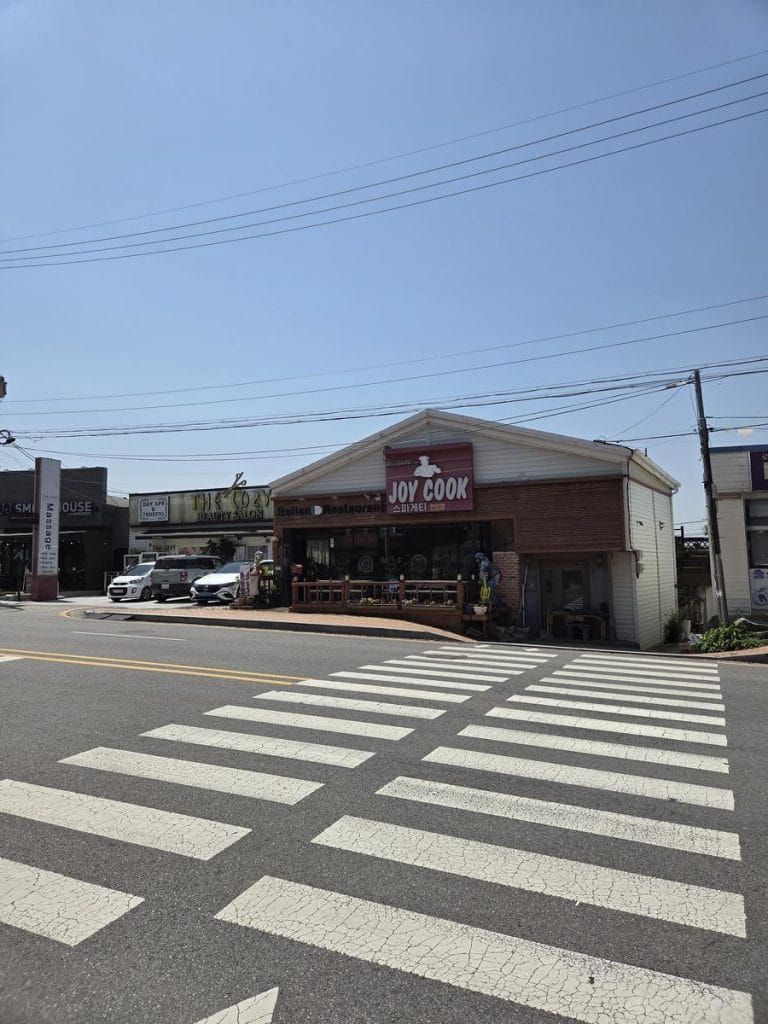
Once you have your library card sorted, let’s head to the library. Bongdam Library is located conveniently right in front of the Bongdam Community Center.
If you are driving, the library has its own car park, but it is notoriously small. There is a free public car park directly in front of the library, but finding an empty spot during the daytime is extremely difficult. My personal trick is to park at the community center, which is a short three-minute walk away. The community center parking is completely free for 1.5 hours, giving me plenty of time to browse and check out my books.
Alternatively, if you live in the neighborhood, leaving the car at home is much easier. I often just ride my electric scooter to the library since the bicycle parking area always has open spaces. Getting around locally without a car is one of the reasons living in modern Korean residential areas is so incredibly convenient.
If you need to return books after hours, there is an automated book return machine located right at the entrance. It operates from 6:00 PM until 10:00 AM the next morning. Impressively, it features a built-in UV disinfector, which makes using public library books feel much safer and cleaner.
Getting Your Foreigner Library Card
Library memberships are not strictly limited to residents with a Gyeonggi Province address. If you currently work or study in Gyeonggi, you can also join by providing a proof of employment or a certificate of university enrollment.
For foreigners, the registration process requires a bit of paperwork and a specific order of steps. Before you head to the library in person, you must first register for an account online through the Hwaseong City Library website. Once you complete the online registration, you need to bring your required documents to the librarian’s information desk to verify your identity and receive your physical card.
The required documents include your Passport or Alien Registration Card (ARC), along with a “Certificate of Domestic Residence Report for Overseas Koreans” (국내거소신고사실증명서).
Also, keep in mind that your default four-digit PIN required for checking out books at the kiosks will automatically be set to your birthday. For example, if your birthday is January 13, your PIN is 0113.
You can easily get your residence certificate printed at the community center right across the street, or you can print it yourself online using the Government24 portal.[Government24 – https://www.gov.kr/portal/foreigner/en] Handling Korean administrative paperwork can be a bit daunting for expats, similar to the process of acquiring a local driving permit, but the library staff are generally very patient and helpful.
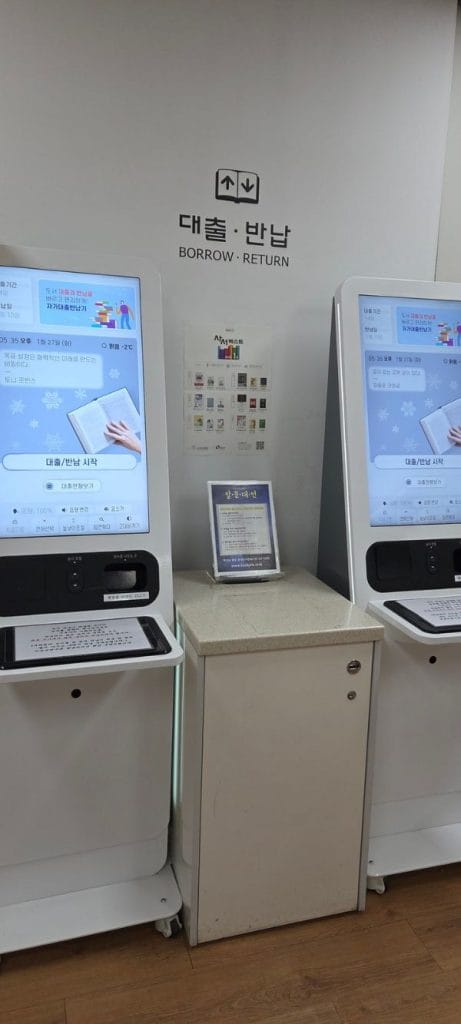
When checking out books, you can use the librarian’s desk or the automated self-service kiosks. I usually use the kiosk because it works flawlessly and supports English. There are also search computers available to locate specific books, meaning you rarely need to speak to the staff once your card is issued.
Discovering the Local Community
As you walk through the library corridors, you will notice large bulletin boards filled with local community information. This is actually one of the biggest hidden benefits of visiting a local library.
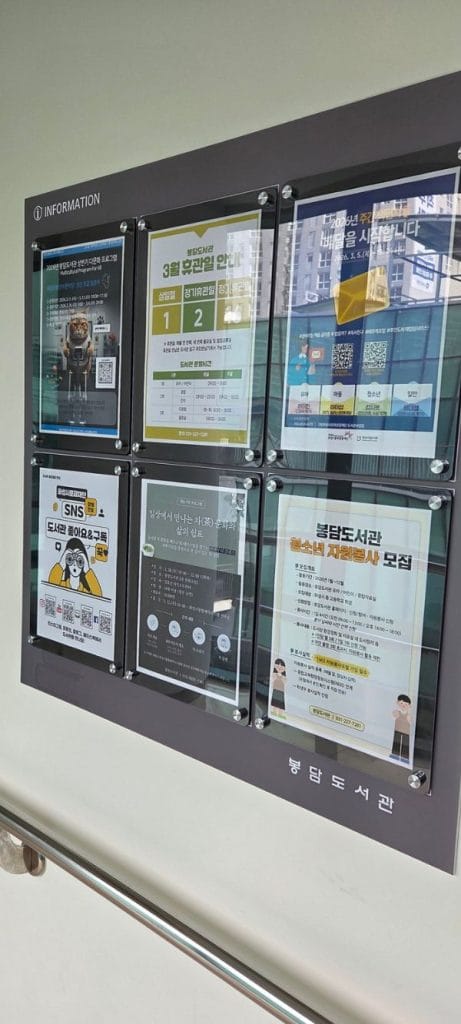
If you are new in town or looking to integrate into the local culture, checking these boards is the best place to start. I used this exact strategy when I lived in Brisbane, Australia; the Southbank library was amazing for community connection. Similarly, when I lived in Japan, I found free Japanese language classes through library flyers, which allowed me to make local friends. Keep an eye on the boards in Bongdam, and you will likely find useful information about free Korean language classes, cultural events, or volunteering opportunities. If you are looking to actively improve your real-life conversation skills, you can also book personalized 1:1 Korean lessons personalized 1:1 Korean lessons.
Getting involved locally helps you settle in faster, much like utilizing local neighborhood trading apps to buy household goods and meet neighbors.
Library Facilities: Printing, Studying, and Childcare
Bongdam library is incredibly spacious with plenty of seating. You could easily spend the whole day here.
Public Printing Services
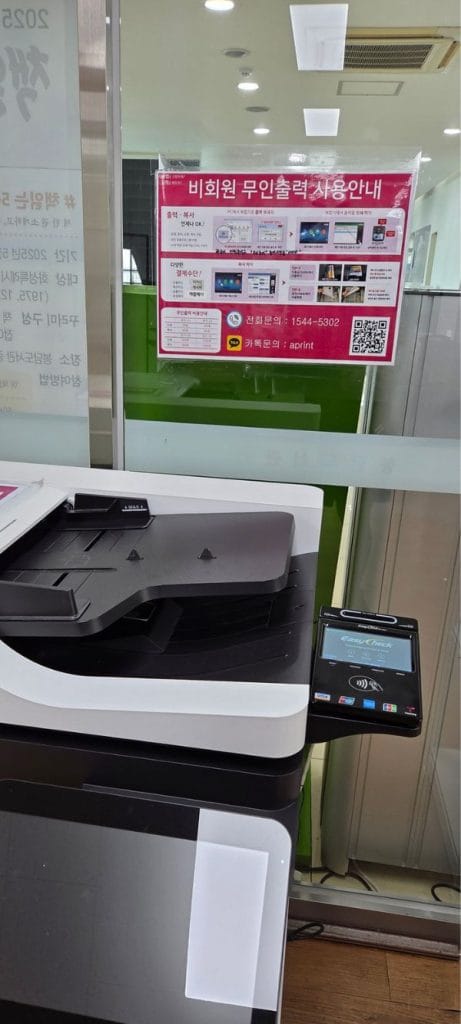
If you do not have a printer at home, do not worry. There is a public printer available in the library’s digital collection room (electronic information room) on the second floor. You simply need to reserve a PC slot. When I lived in Japan, I relied heavily on convenience stores for document printing. Korean convenience stores provide much more limited services in comparison, so knowing about this cheap library printer is an absolute lifesaver.
Free Study Rooms
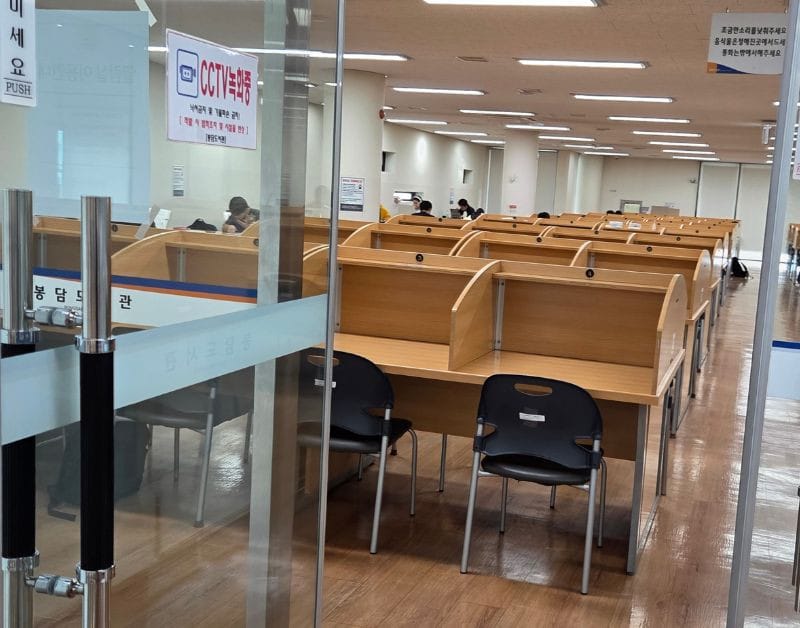
There is a dedicated general reading room, providing a completely free, quiet space to study for exams. If you need to use your laptop and type, there are specific designated areas where keyboard clicking is permitted. You often see expensive, paid “Study Cafes” lining the streets in Korea, but at the library, all these premium facilities are absolutely free.
Childcare and Kids Area
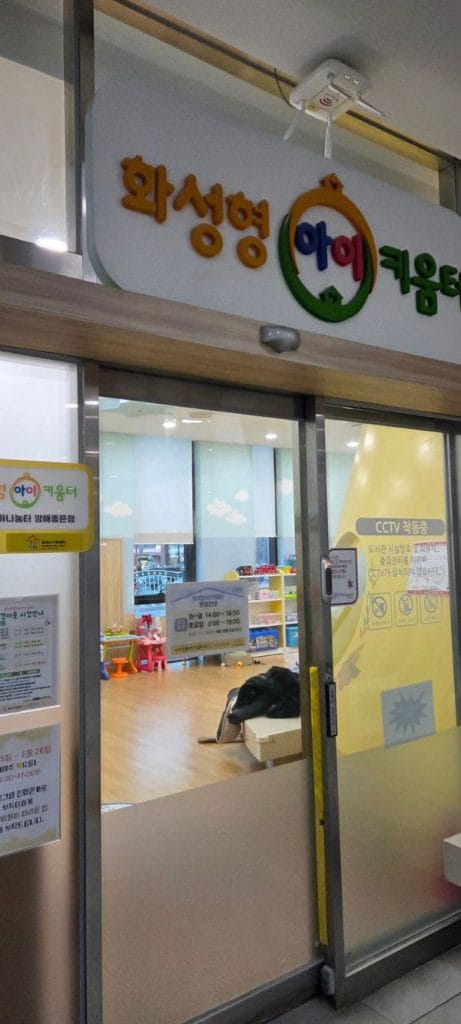
On the first floor, there is a children’s library and a childcare room equipped with free toys. My daughter is still a bit too young to fully enjoy it, but as she gets older, it will be a fantastic, free indoor place to spend quality time together during the cold winter or hot summer months.
The Nono Cafe and Multicultural Collection
If you head up to the third floor, you will find an open rest area and a lovely cafe called “Nono Cafe” (노노카페). This cafe is a wonderful city initiative that specifically hires elderly Hwaseong citizens, encouraging active employment after retirement.
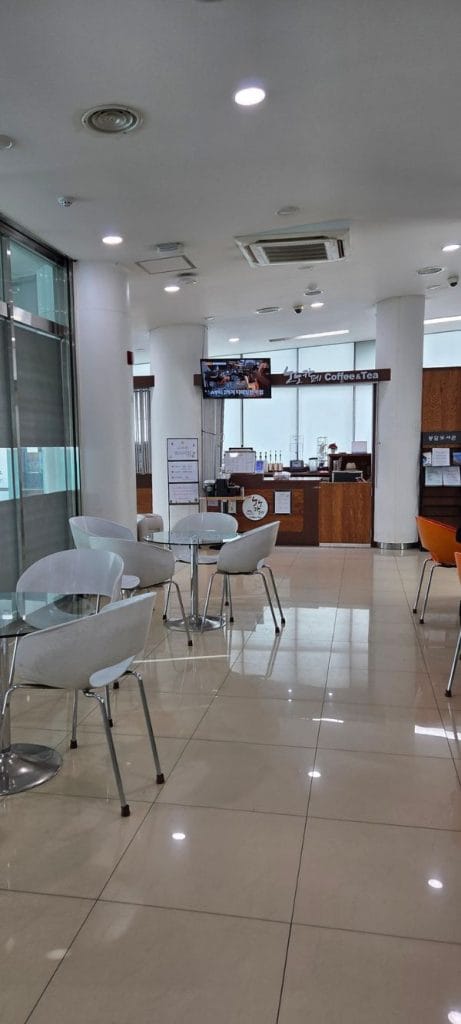
Right in front of the cafe, there are small tables and chairs where visitors are allowed to sit and eat packed lunch boxes. There is a hot water dispenser and a microwave available for public use. Bringing a packed lunch is a fantastic way to save money, especially when you pair it with smart budgeting tricks like using regional payment cards for your outside purchases.
Next to the cafe, a glass door leads out to a small outdoor sky garden. On a clear day, it is the perfect spot to get some fresh air and stretch your legs after long hours of studying.
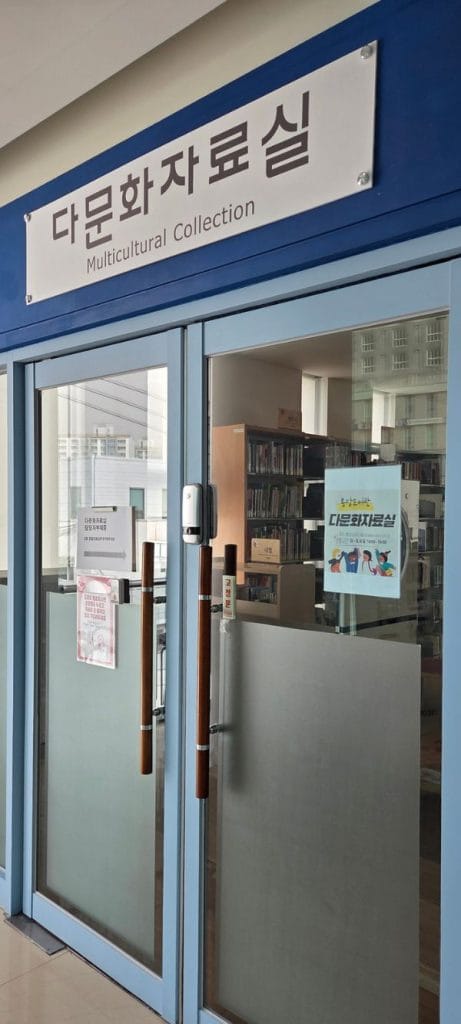
Finally, the third floor houses the Multicultural Collection. Here, expats can borrow books in a variety of languages, including Nepali, Russian, Mongolian, Myanmar, Bengali, Vietnamese, Uzbek, Indonesian, Japanese, Chinese, Cambodian, Thai, and Tagalog. Please note that the operating hours for this specific collection are from Tuesday to Saturday, 14:00 to 18:00. [Hwaseong City Library Official Website – Operating Hours]
Frequently Asked Questions (FAQ)
Q: What are the opening hours for Bongdam Library? A: The general reading rooms are open from 8:00 AM to midnight on weekdays. The comprehensive materials room is open from 9:00 AM to 10:00 PM on weekdays, and 9:00 AM to 6:00 PM on weekends.
Q: When is the library closed? A: The library is regularly closed on the first and third Mondays of every month, as well as on all national legal holidays (excluding Sundays).
Q: How much does it cost to print documents at the library? A: Black and white A4 printing costs 50 KRW per page, while color A4 printing costs 300 KRW per page.
Q: Can I return books when the library is closed? A: Yes! There is an automated, UV-sterilizing book return machine located outside the main entrance that operates from 6:00 PM to 10:00 AM the following day.
Arriving in Korea soon?
Don’t navigate your first day alone
I meet you at Incheon or Gimpo airport and guide you through everything — SIM card, T-money, transport, and getting to your accommodation. Personal support from $180.
Book arrival support →