Danggeun Market is the first app you should download when you start living in Korea. Moving here costs more than you expect in those first few weeks — but pairing this app with regional currency benefits to save 10% on daily spending can take the edge off faster than almost anything else.
💡 Key Takeaways
- Danggeun Market is free, Korea’s most trusted hyperlocal trading app — and it’s far more than a secondhand marketplace
- Foreigners can sign up, but the ARC + Korean phone number verification step catches most people — this guide walks you through it
- The “Manner Temperature” system makes it genuinely safer than Craigslist or Facebook Marketplace
- Hidden features include local part-time jobs, real estate, community boards, and neighborhood walk meetups
- You can register two neighborhoods — your home and your workplace — to double your browsing range
✅ The 10 reasons, in short
- Furnish a new apartment fast without overspending in your first weeks in Korea
- Offload everything just as quickly when it is time to leave
- Trade only with verified neighbours inside a 6km radius, which is far less chaotic than Craigslist or Facebook Marketplace
- Read a seller’s Manner Temperature before you message them, so you know who to trust
- Find local part-time work (alba) with a commute measured in minutes
- Buy a used car or find an apartment directly, with no agency fee in between
- Ask your neighbourhood anything on the community board, from restaurant picks to missing pets
- Find neighbours to walk with, which matters more than it sounds in a new country
- Ship for about 1,600 won with GS25 Half-Price Delivery and collect from a convenience store instead of giving out your address
- Pay by account transfer or Danggeun Pay so every transaction leaves a record
Living abroad always comes with a quiet background hum of uncertainty. Not even about ten years from now — sometimes you genuinely don’t know where you’ll be next year. Because you’ve already left home once, picking up and moving again feels less frightening. But it does change how you own things. When you finally settle into a high-rise and start experiencing the particular rhythms of apartment life here — including the midnight foot-hammering from upstairs — you suddenly need things to fill the space. But you hold back on anything heavy or expensive. Why buy a statement sofa if you might be gone in six months?
I felt this constantly in Australia and Japan. In Australia, Gumtree and Facebook Marketplace kept me going. In Japan, I haunted local flea market apps. Every time I arranged to meet someone — to pick up a second-hand toaster, or hand over a heater — I felt a small, particular thrill. Who is this person? What is their story? Why do they need this specific thing?
Now I am back in Korea, raising a small family. And when I look at the foreigners living here, I recognize that feeling exactly. The reluctance to accumulate. The wanting to stay light. That is exactly why Danggeun Market matters.
This is my honest guide to using Danggeun Market — why it is more useful than most expats realize, and what it quietly offers beyond secondhand goods.

What is Danggeun Market?
If you spend any time in Korea, you will eventually hear that distinctive “Dang-geun!” notification sound on the subway or drifting across a café. That is Danggeun Market (Karrot) — Korea’s undisputed first choice for secondhand trading. Whether you just landed and need to furnish an empty apartment without breaking your budget, or you’re preparing to leave and need to offload everything fast, this app is not optional. It’s essential.
Unlike Facebook Marketplace or Craigslist, which can feel chaotic and untrustworthy, Danggeun Market is built entirely around hyper-local community trust. The name “Danggeun” is a compressed version of “Dangsin-ui Geuncheo” (Your Neighborhood) — meaning you can only trade with verified neighbors within a 6km radius. That constraint is the point.
For foreigners, though, the app can feel like a wall at first. It is almost entirely in Korean, requires strict identity verification, and runs on unwritten etiquette — including the famous “Manner Temperature” score. This guide walks you through exactly how to set it up as a foreigner, how to read Korean trading shorthand (like “Moon-gori”), and how to get good deals without getting burned.
Beyond second-hand finds and job listings, Danggeun Market can also connect expats with fresh local produce and health-focused food options—a practical complement to understanding healthy Korean food delivery choices for expats managing their wellness in Korea.
Downloading is easy — find Danggeun Market (당근마켓) on both Google Play and the Apple App Store. The moment you open it, though, many foreigners hit a wall at sign-up. Here is how to get through it.
Download: You can get the app on Google Play or the Apple App Store.
1. The Phone Number Verification (The “ARC” Trap)
Danggeun is not linked to your email — it is linked to your Korean phone number and your Alien Registration Card (ARC). To sign up, you must verify your identity through your telecom provider (SKT, KT, or LG U+).
- The Common Error: Most foreigners fail here because of a “Name Mismatch.”
- The Fix: Enter your name exactly as it appears on your phone bill.
- Case 1: If your phone bill says
DOE JOHN, typingJohn Doewill fail. - Case 2: Watch spacing.
DOE JOHNis different fromDOEJOHN.
- Case 1: If your phone bill says
- Tip: If you keep failing, check your monthly phone bill text or the carrier app (like T-World or Kt Family Box) to see exactly how your name is registered. This is the same strict identity infrastructure you will encounter when trying to generate a personal customs clearance code for online shopping — even that keeps rejecting your name until you get the format exactly right.
2. Setting Your “Dong-ne” (Neighborhood)
Once verified, the app asks for your location. You cannot type “Seoul” or “Hwaseong” — you must go specific.
- GPS Required: Turn on your GPS. The app detects your Dong (neighborhood) — for example, Dongtan-dong or Nam-myeon.
- The Radius Slider: In settings, adjust how far you want to browse.
- Tight range: Your immediate apartment complex — good for heavy furniture you cannot carry far.
- Wide range: Neighboring districts — good for rare finds, but expect to drive or take a bus.

More Than Just Buying Stuff
I assumed for a long time that this app was only for selling old furniture. It is not. It is a genuine neighborhood super-app, and some of what it does quietly will surprise you:
- Part-Time Jobs (Alba): Find local work directly inside the app. Because it is location-based, the commute is short almost by design.
- Used Cars & Real Estate: Yes — you can find a car or an apartment here. Direct deals mean no heavy agency fees in between.
- Neighborhood Life (Dongne Saenghwal): A community board where people ask for restaurant recommendations, hunt for missing pets, or pull together local meetups.
- Neighborhood Walks: If you are feeling isolated — which is a real thing in a new country — you can find neighbors to walk with, or even a walking companion for your dog. It is quieter and more genuinely useful than it sounds.
The Pros & Cons (My Experience)
The Good: Safety and Speed
The feature that makes Danggeun Market genuinely trustworthy is the “Manner Temperature” (매너온도) system. Everyone starts at 36.5°C — body temperature. Good transactions push it up. Being rude, ghosting, or wasting someone’s time brings it down.
- My rule: Before buying anything on Danggeun Market, check the seller’s temperature. Above 40°C usually means you are dealing with someone reliable. A low temperature — be careful, or walk away.
- Also worth knowing: Avoid sellers who look like businesses offloading bulk stock. The real value is in ordinary people selling their own things — those transactions are almost always cleaner and faster.
The Bad: You Must Be “There”
To use the app, you must verify your location via GPS. You can only see and contact listings in your immediate area.
- The workaround: You can register up to two different neighborhoods — your home and your workplace, for example. That doubles your effective browsing range immediately.

How to Trade Like a Local on Danggeun Market
1. The “Nego” (Negotiation) Culture
In Australia, I was always a little uncomfortable with haggling. In Korea, “Nego” is normal — but manner matters more than the number.
- Don’t open with a low number out of nowhere.
- Do say hello first. Ask about the item’s condition. Make it a conversation.
- Check the listing first: If the title says “Nego X” or “Price offer not available,” respect it. But if the seller seems warm and open, asking politely for a small discount is usually fine.
2. Delivery Options
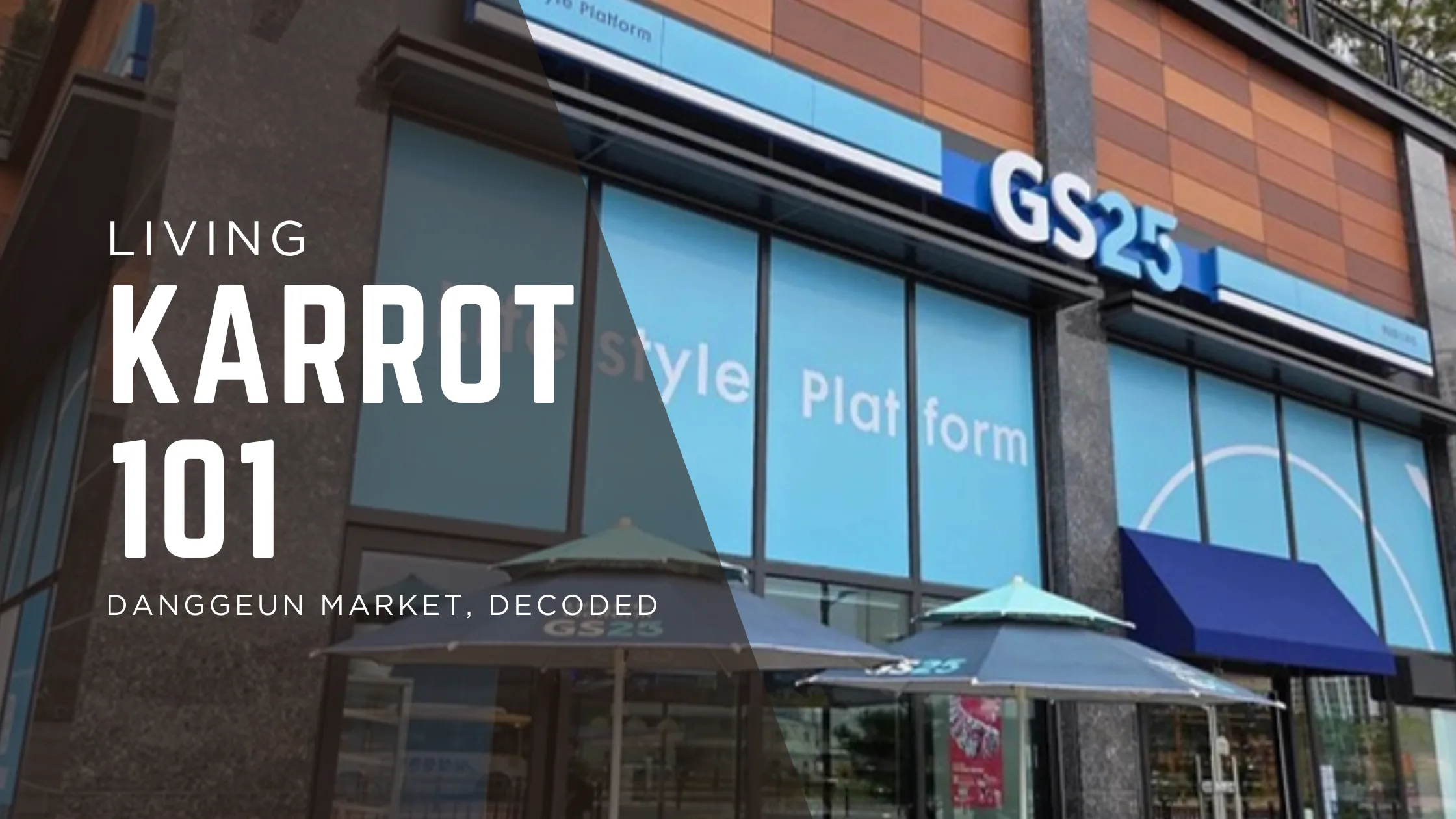
Most people prefer Direct Dealing (Jik-georae) — meeting in person to inspect before handing over money. If you are too busy to meet, ask about “GS25 Half-Price Delivery” (Ban-gap Taekbae).
- Shipping runs about 1,600 won — roughly half the normal postal rate.
- You pick up from your nearest convenience store instead of giving out your home address. Safe, cheap, easy.
3. Payment
Cash works, but Account Transfer or Danggeun Pay is better — both leave a transaction record, which protects you if anything becomes disputed later.
⚡ Quick Reference: Trading on Danggeun Market
| Situation | What to do |
|---|---|
| Seller has low Manner Temp | Walk away or proceed with extreme caution |
| Listing says “Nego X” | Respect it — do not negotiate |
| Can’t meet in person | Request GS25 Ban-gap Taekbae (≈ ₩1,600) |
| Payment method | Account Transfer or Danggeun Pay — both leave a record |
| Want wider search range | Register a second neighborhood (home + workplace) |
| Name mismatch at sign-up | Check your phone bill — use that exact name format |
Final Thoughts
I genuinely enjoy secondhand goods in a way that has nothing to do with being frugal. When something that served someone else finds its way to you — instead of a landfill — there is a quiet satisfaction in that. A second life for the object. Something like that for you too, in a new country.
Danggeun Market is more than a cheap sofa or a way to offload your old toaster before you leave. For foreigners in Korea, it is one of the few apps that actually connects you to the people who live within walking distance of your front door.
You might meet a university student selling her textbooks, a family clearing out before a move, or another expat getting ready to leave the country. Through these small five-minute exchanges at a subway exit or convenience store counter, you catch a glimpse of Korean life that no guidebook puts into words.
Download it, get through the verification, and send that first message. Your apartment — and your wallet — will thank you.
If the adjustment to Korean life is still feeling slow, open Danggeun Market today and buy something small. You might just meet a neighbor worth keeping.
❓ Frequently Asked Questions
Can foreigners use Danggeun Market?
Yes. The account is tied to a Korean phone number and your Alien Registration Card, verified through your telecom provider (SKT, KT or LG U+). Most sign-up failures are a name mismatch, so enter your name exactly as it appears on your phone bill, including the word order and the spacing.
What is Manner Temperature and why does it matter?
Every user starts at 36.5°C, which is body temperature. Good transactions push the score up, while being rude, ghosting or wasting someone’s time brings it down. Above 40°C usually means a reliable trading partner; a low temperature is a reason to be careful or walk away.
How much does GS25 Half-Price Delivery cost?
Shipping runs about 1,600 won, roughly half the normal postal rate. You collect the item from your nearest convenience store instead of giving out your home address, which makes it a safe option when you cannot meet in person.
Is it rude to negotiate on Danggeun Market?
Negotiating, or nego, is normal in Korea, but manner matters more than the number. Do not open with a low offer out of nowhere. Say hello first and ask about the item’s condition. If the listing says Nego X or states that price offers are not available, respect it.
Can I browse listings outside my own neighbourhood?
Only partly. The app verifies your location by GPS and shows listings near you, but you can register up to two neighbourhoods, typically your home and your workplace, which doubles your effective browsing range.
Speak enough Korean to handle daily life
1:1 online Korean lessons focused on practical, real-life situations — not textbook grammar. Book a session with a native Korean speaker who understands expat life.
Book a Korean lesson →