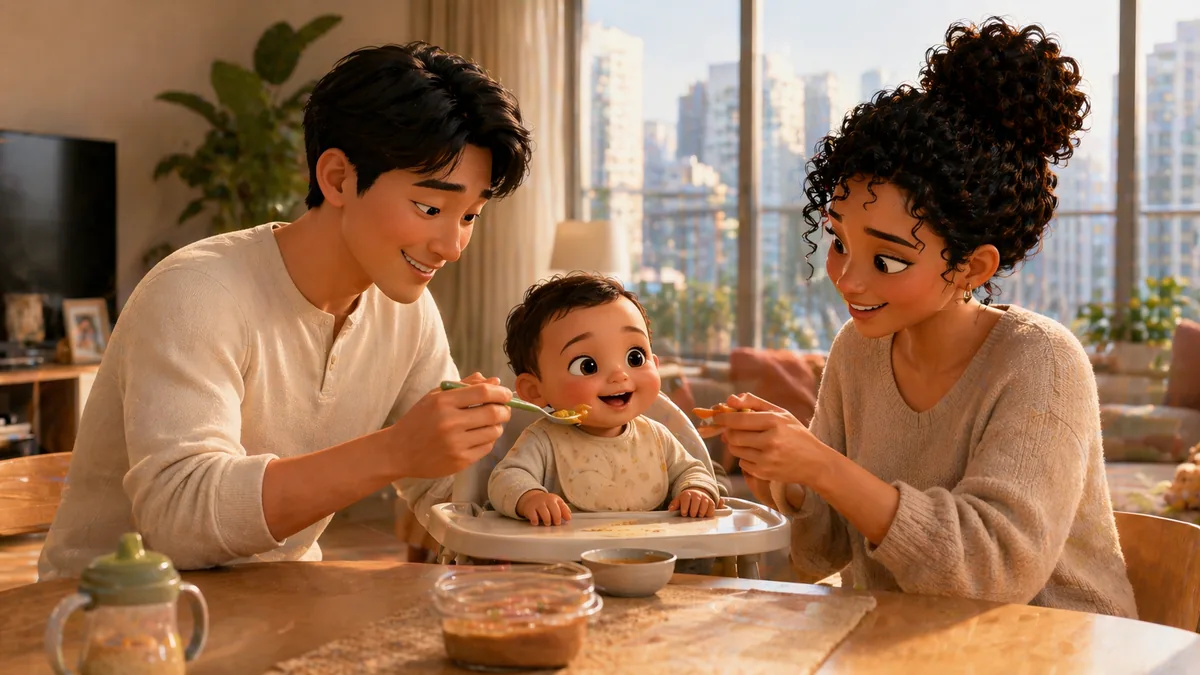
When our daughter was born premature, the first thing her pediatrician flagged was iron. For months, we mixed iron supplements into her formula — a necessary routine, but hardly a satisfying one. Then at six months, the doctor cleared her for solids and gave us a clear instruction: start Korean beef baby food as soon as possible, because iron absorbed from real food is far superior to anything that comes in a powder. That single conversation sent me to the one place in our Hwaseong neighborhood I already trusted — our local butcher — and if you are an expat parent navigating the same situation, finding a trusted local specialist in Korea makes all the difference.
She ate well on her very first try. I always knew she would. She is my baby.
Why Beef? The Iron Connection for Premature Babies
Iron deficiency is one of the most common concerns for premature babies. Because the final weeks of pregnancy are when the body transfers the most iron from mother to baby, infants born early often start life with lower iron stores than full-term babies. Our doctor was explicit: even after introducing solid foods, we would need to continue the iron supplement alongside meals. But food-sourced iron — particularly from red meat — is absorbed by the body far more efficiently than the supplement form.
Beef is the priority over pork or chicken specifically because of its higher haem iron content. That is why, from our daughter’s very first bowl of puree, beef has been in every single batch. Not optional. Not rotated out. Always there.
The Best Korean Beef Cuts for Baby Food
Walk into any Korean butcher and you will see cuts labelled in hangul. Here are the five you are most likely to encounter for baby food, and what makes each one different.
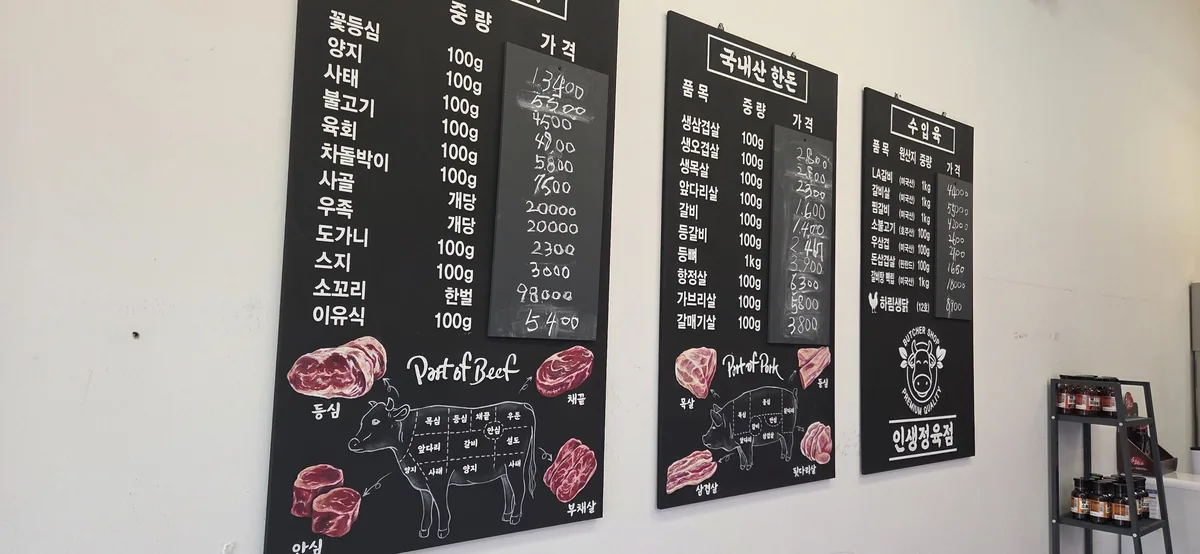
안심 (Ansim) — Tenderloin: The most tender cut. Ideal texture for early-stage purees, but the most expensive option.
우둔살 (Udunsal) — Eye of Round / Rear Round: Our go-to. Lean, affordable, and easy to mince finely. The butcher recommended it for our daughter’s age without us even asking. It sits in a sweet spot between quality and cost.
설도살 (Seoldo) — Rump: Slightly more marbling than udunsal but still a lean choice. A reasonable alternative if udunsal is not available.
채끝 (Chaekkut) — Striploin: Think of this as the middle ground between tenderloin and rear round — more flavour than the leaner cuts, slightly higher fat. Fine for older babies who are more established on solids.
홍두깨살 (Hongdukkae) — Eye of Round / Drumstick: Another lean rear cut, similar to udunsal in texture and price. Often interchangeable depending on availability.
For early-stage baby food (6–9 months), stick to udunsal or ansim — lean, soft, and easy to blend. Ask the butcher for your baby’s age and let them guide the rest. They almost always know exactly what to do.
Why the Local Butcher Beats the Supermarket Every Time
You can buy pre-minced beef at any E-Mart or Homeplus. But there is a reason I keep going back to the butcher.
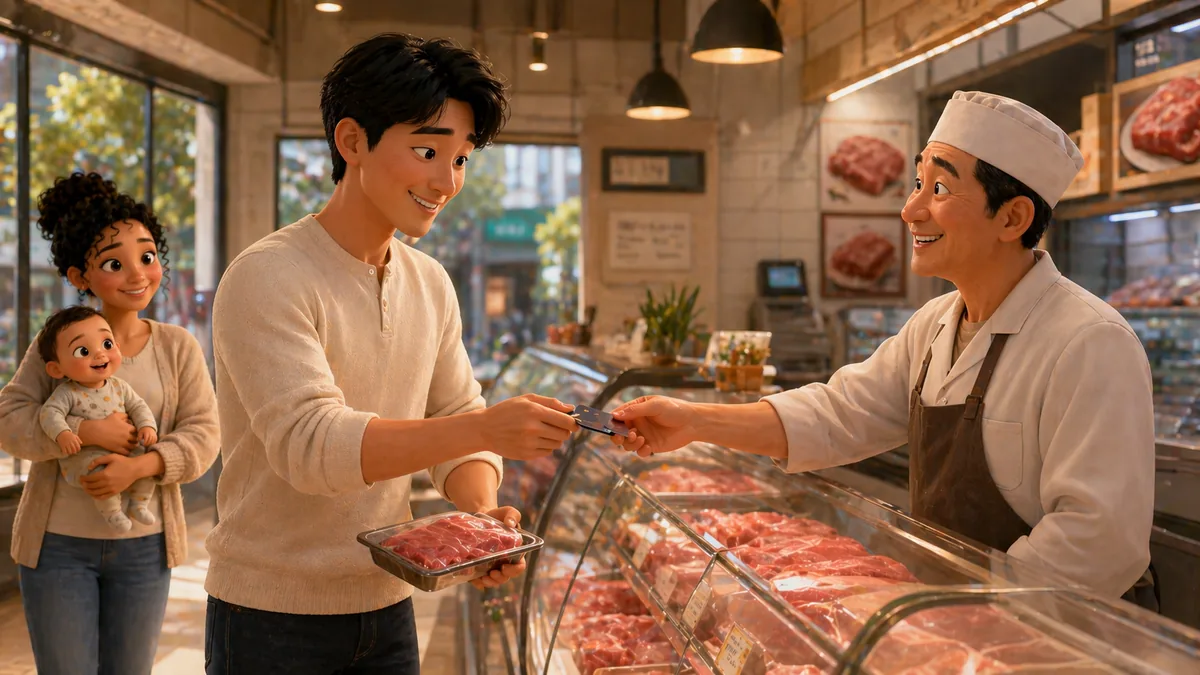
At a supermarket, you get whatever cut they decided to mince that morning, at whatever coarseness the machine produces. At a butcher, you choose the cut, specify the age of your baby, and watch them mince it in front of you by hand. The grind is finer, the fat content is controlled, and the meat goes from the counter into your bag within minutes.
In Australia or Japan, I had to look up dictionary entries just to figure out the difference between “blade” and “chuck” at the supermarket. Cut names, grind types, fat ratios — all of it was guesswork. At a Korean neighbourhood butcher, you hand over the information — baby’s age, preferred cut — and they handle the rest. There is a human layer of expertise that no supermarket shelf can replicate.
Our apartment complex in Hwaseong has a lot of young families. The butcher knows this. He has done this a hundred times before I ever walked in. That is exactly what I was counting on.
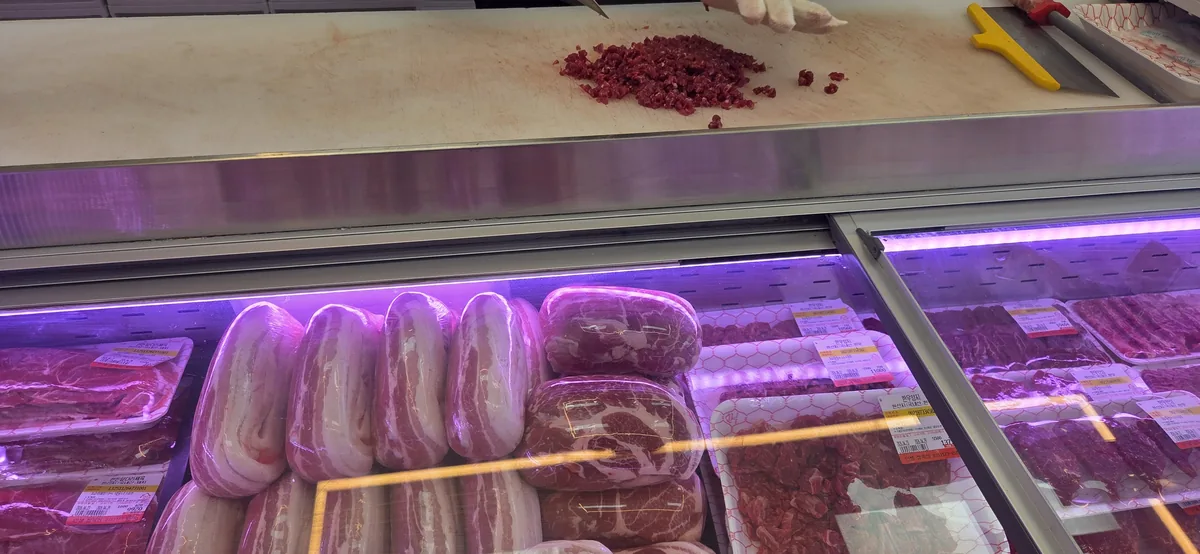
Our Go-To: Insaeng Butcher Shop, Hwaseong
I started going to Insaeng Butcher (인생정육점) long before our daughter was born — good meat, genuinely friendly staff, and a quality that the big supermarkets consistently fail to match. It became a natural first stop once we started baby food.
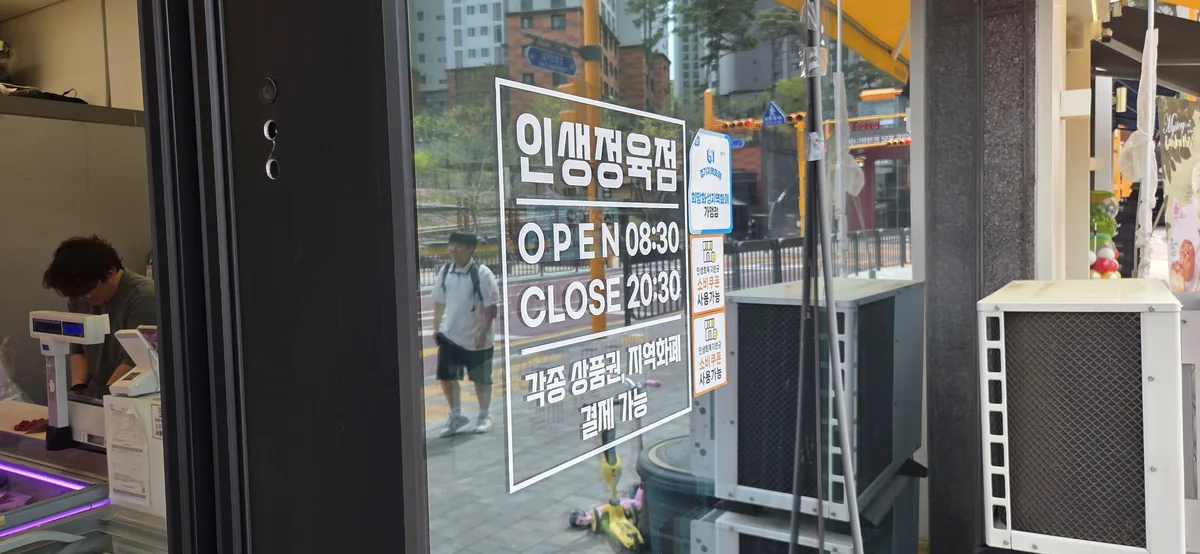
A few things that make it stand out for regular shopping beyond baby food: it accepts the Gyeonggi Local Currency Card, which effectively gives you a 10% discount on every purchase in Hwaseong. There is also a membership points system worth signing up for if you shop there regularly. And if you buy suyuk (수육) meat for boiling, they throw in bay leaves for free. Buy grilling meat — samgyeopsal and the like — and a bunch of spring onions appears in your bag.
In Japan or Australia, you always pay for everything. Every single item has a price tag. Getting something free with your purchase? You were either very lucky, or very charming. Here it just happens, matter-of-factly, as part of how the shop operates.
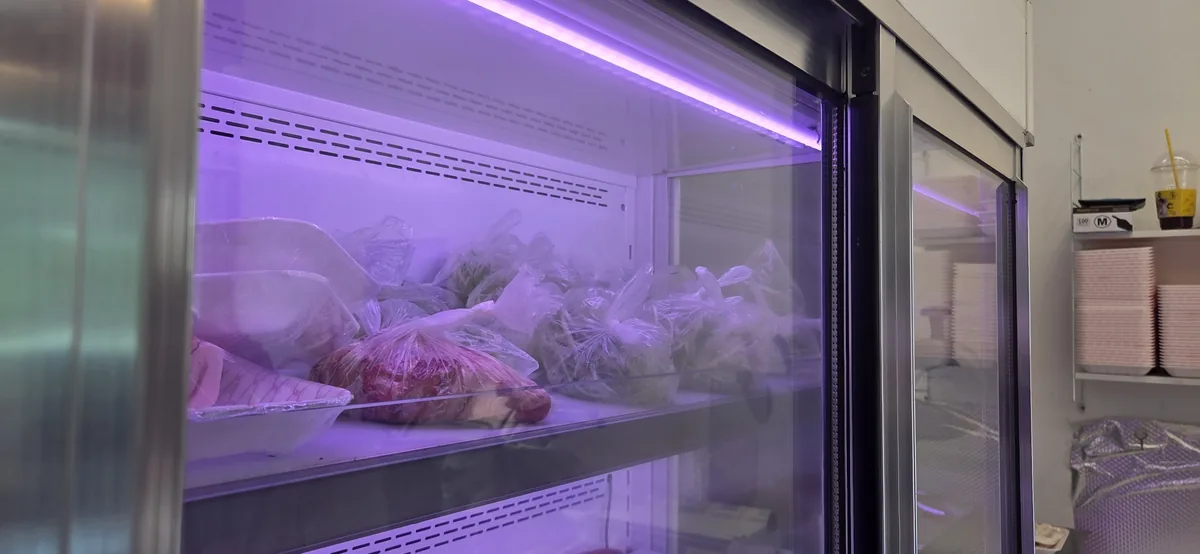
📍 Insaeng Butcher Shop (인생정육점)
Address: 18, Sambongan 3-gil, Bongdam-eup, Hwaseong-si, Gyeonggi-do, Building A, Unit 109
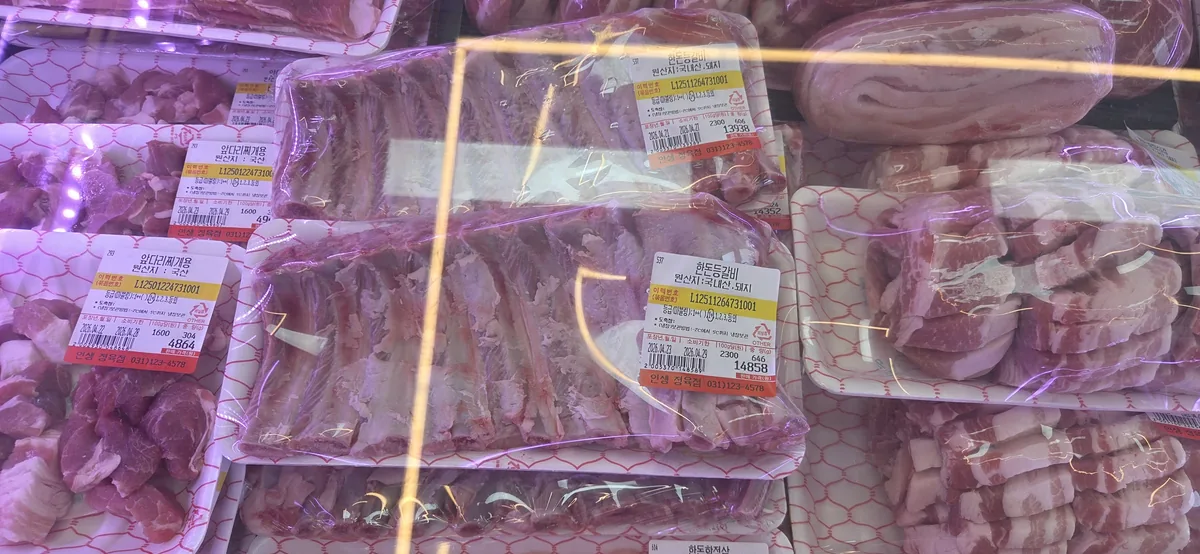
How to Order at a Korean Butcher — Even If Your Korean Is Basic
This is the part I want expat parents to screenshot and keep on their phone. I know what it feels like to stand in front of a foreign butcher counter with no idea what to say — I spent years doing exactly that in English-speaking supermarkets in Australia, dictionary open, trying to figure out what “oyster blade” meant.
These phrases are all you need:
- “이유식용 소고기 주세요.” — Please give me beef for baby food.
- “고기를 다져주세요.” — Please mince the meat.
- “아기가 몇 개월이에요?” — How old is the baby? (The butcher will ask you this.)
- “아기는 8개월이에요.” — The baby is 8 months old. (Swap in your baby’s age.)
- “200g 주세요.” — 200 grams please.
- “2만원어치 주세요.” — 20,000 won worth, please.
That is it. Walk in, say the first line, answer the age question, and the butcher takes care of the rest. The language barrier feels much larger before you try than it ever does in the moment.
How We Prepare and Freeze the Beef at Home
We buy around 200g of minced udunsal per trip. At home, the process is straightforward: cook the meat, blend it with whatever vegetable is on rotation that day, then portion it into a silicone ice cube tray and freeze.
Each batch makes enough cubes to last about three days — we use two cubes per cooking session, which gives us the right volume for her current appetite. Formula is still her primary nutrition source at this stage. The food is building, not replacing.
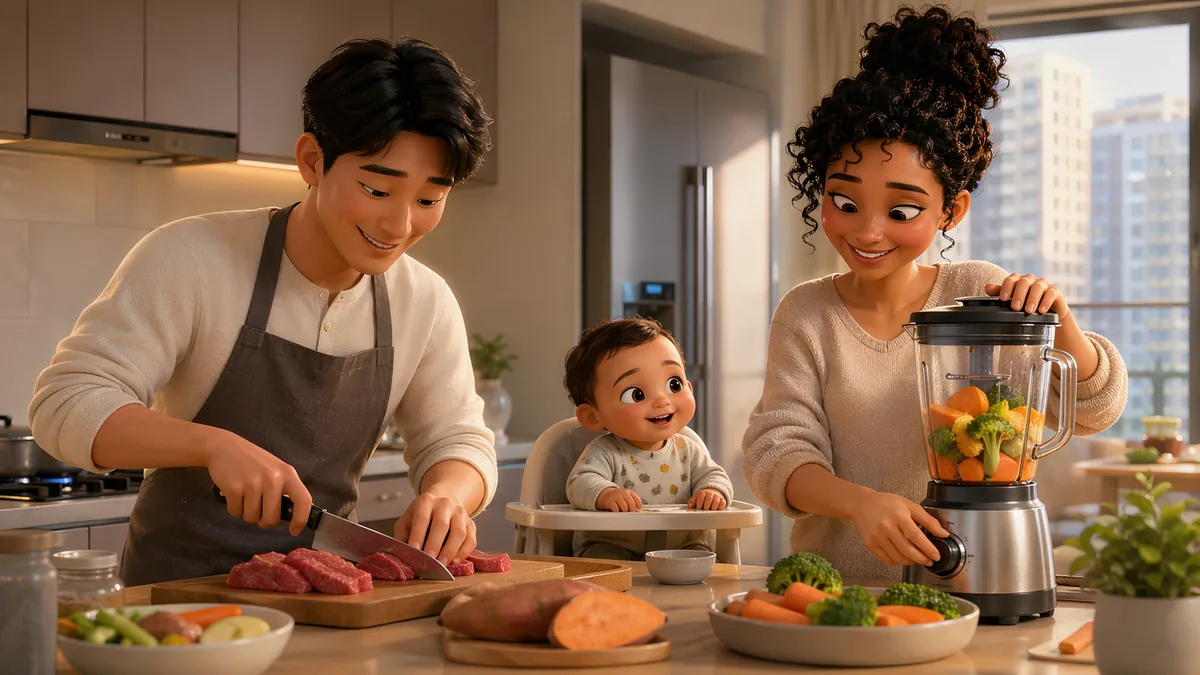
One lesson learned early: rice needs to soak. Overnight is best, or at minimum four to five hours before blending. I skipped this step on our first batch, blended it long and cooked it longer, and still found hard fragments in the puree. Some parents actually leave a little texture intentionally to help babies adjust to solid food faster — and for full-term babies that is a reasonable approach. For a premature baby, I was more cautious. Smooth was the goal.
200g minced beef → cook → blend with vegetable → silicone ice cube tray → freeze → use 2 cubes per batch → lasts ~3 days. Simple, repeatable, and the baby does not seem to mind variety as long as the beef is always in there.
What Vegetables We Rotate In
Variety matters early. The pediatrician and every parenting book we read agreed: expose babies to as many flavours as possible during the introduction window, and they are far more likely to eat vegetables without a fight later on. So we rotate through sweet potato, broccoli, carrot, cabbage, zucchini, and rice — sometimes one at a time, sometimes in combination, always with beef as the base.
No single vegetable stays in heavy rotation long enough for her to get bored. And so far, she has not refused a single bowl. She is my baby.
Practical Tips for Expat Parents Buying Baby Food Meat in Korea
A few final things worth knowing before your first butcher run:
- Any neighbourhood butcher will work. Insaeng is ours because it is close, the quality is excellent, and we trust it. Find yours. The approach is identical everywhere.
- Pay with your Gyeonggi Local Currency Card if you have one. Butcher shops are exactly the kind of small local business the card is designed for — and a 10% bonus on every meat purchase adds up quickly over months of weekly trips.
- Ask the butcher to mince fresh, not from pre-minced stock. It takes an extra two minutes and the result is noticeably cleaner in texture and colour.
- When you are out for grocery errands, batch your neighbourhood stops. The butcher, the fruit shop, the pharmacy — this is where local currency cards shine, and once you have figured out these errands, you might find yourself curious about other useful neighbourhood errands in Korea like exchanging coins at a local bank.
- Being a premature baby’s parent makes you more careful about everything. That is not anxiety — that is just appropriate. The extra step of going to a butcher instead of grabbing pre-packaged supermarket mince is worth it.
Korean parenting and foreign parenting are not so different in the end. Every parent just wants their child to grow up healthy, happy, and open to the world. Our daughter is going to grow up Korean and South African and everything in between. She will eat Korean beef juk and braai and whatever else crosses her plate. We are just getting started.
Living in Korea with a Young Family?
From hospital appointments to grocery runs, navigating daily life in Korea with a newborn is a lot — especially in a second language. JustAskJin offers hands-on concierge support for expat families in the Hwaseong and greater Gyeonggi area.