- Convincing My Wife to Walk Through the Door
- What Is the Bongdam I-Kieum Center?
- The Hygiene Question Every Parent Is Asking
- How to Register: Two Visits, Two Documents
- The Hidden Perk for Multicultural Families
- The Nono Cafe on the Second Floor
- What You Can Actually Borrow
- Location & Hours
- Your City Has One Too
My wife did not want to go. She had one very specific objection — our baby had recently discovered that everything in the world is better when it is inside her mouth, and the idea of borrowing toys that strangers’ children had already handled did not sit well with her. But I had heard about the Hwaseong Bongdam toy library and I was not ready to let it go. I told her what I always say in these situations: just go and look. We don’t have to borrow anything. It can be a good experience. If you are new to navigating life as a multicultural family in Korea, you quickly learn that the benefits available to registered residents are real, they are generous, and the window to use them does not stay open forever.
The Bongdam I-Kieum Center offers a free sanitized playroom and a toy and book rental library for Hwaseong residents. Registration requires a 등본 for the playroom and a 가족관계증명서 for the library. Annual library membership is completely free for multicultural families. There is a government-run cafe on the second floor staffed by local seniors. Parking is free and plentiful.
What Is the Bongdam I-Kieum Center?
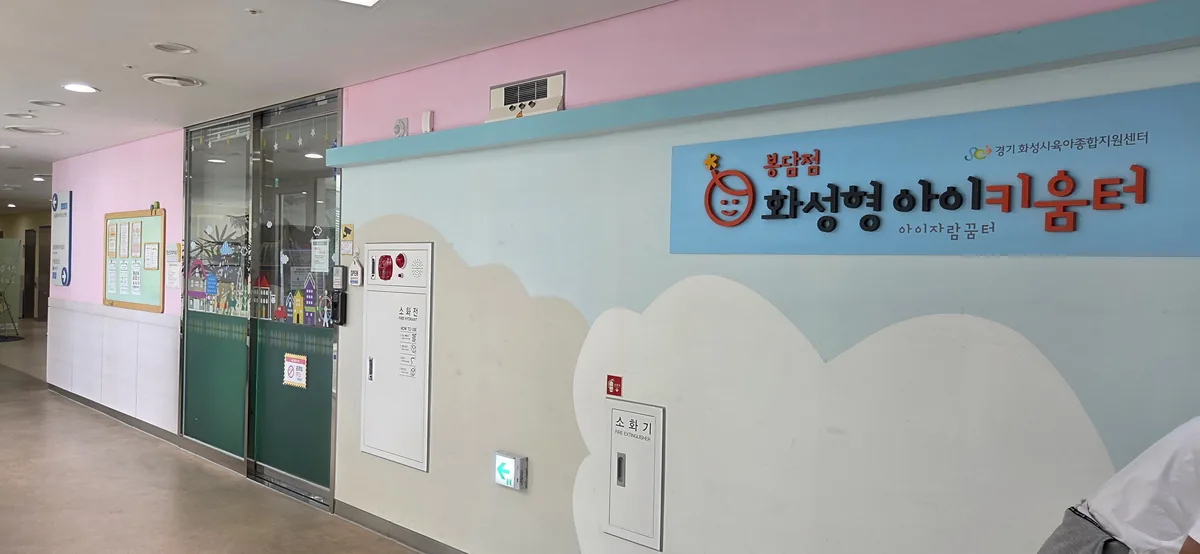
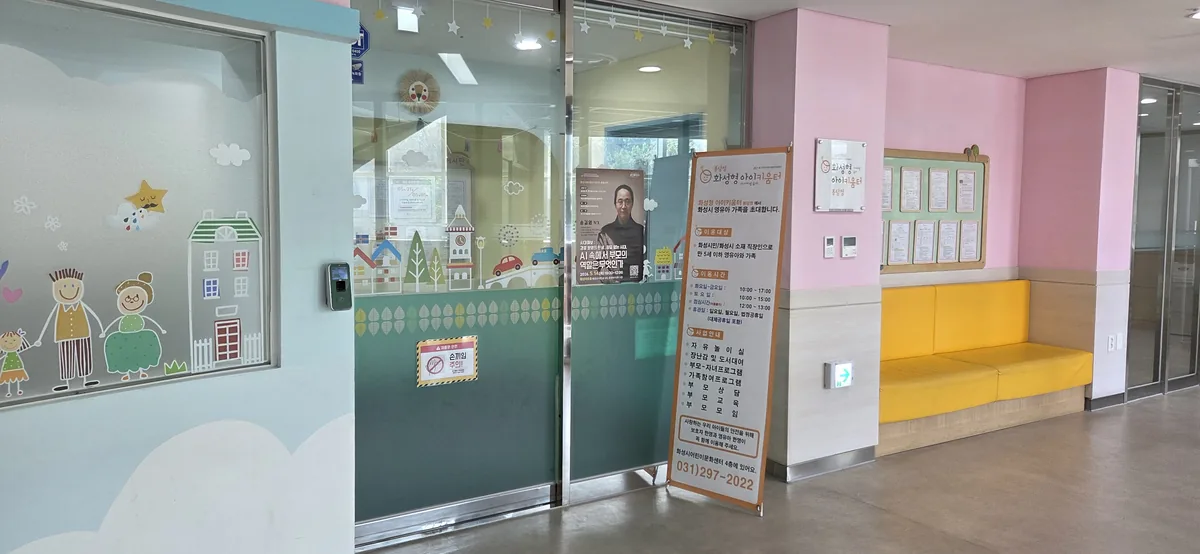
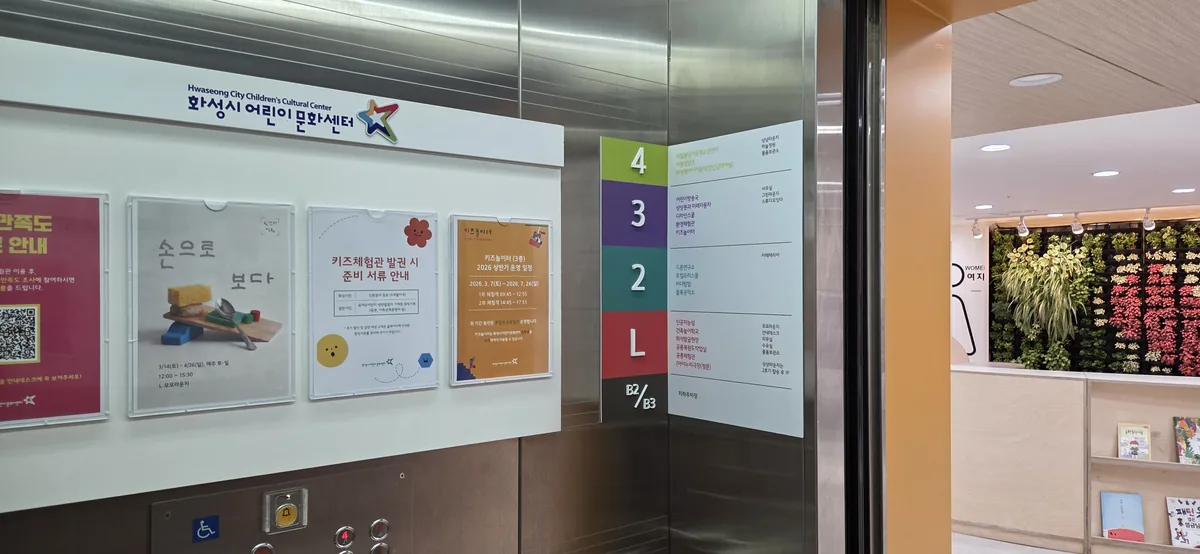
The official name is the 화성형아이키움터 봉담점 — the Hwaseong-type I-Kieum Center, Bongdam branch. It is a city-run children’s culture facility. On one level, you have a toy and book rental library. On another, a free indoor playroom that operates in timed sessions. And upstairs, a small government-run cafe. The building is large, well-maintained, and — this matters — not free-for-all. You have to prove you belong here before you can walk through the door with full access. That membership barrier is part of what keeps it running as well as it does.
Think of it as a community investment. Hwaseong City built this for its residents. If you live here, work here, or study here, you are a resident. That includes foreigners on a registered address. The center is not the most well-known facility in the area — it does not have the foot traffic of getting a library card in Bongdam at the main city library — but that relative quiet is exactly what makes it pleasant to visit.
The Hygiene Question Every Parent Is Asking
Let me answer this directly, because it was the first thing my wife asked and it will be the first thing you ask too.
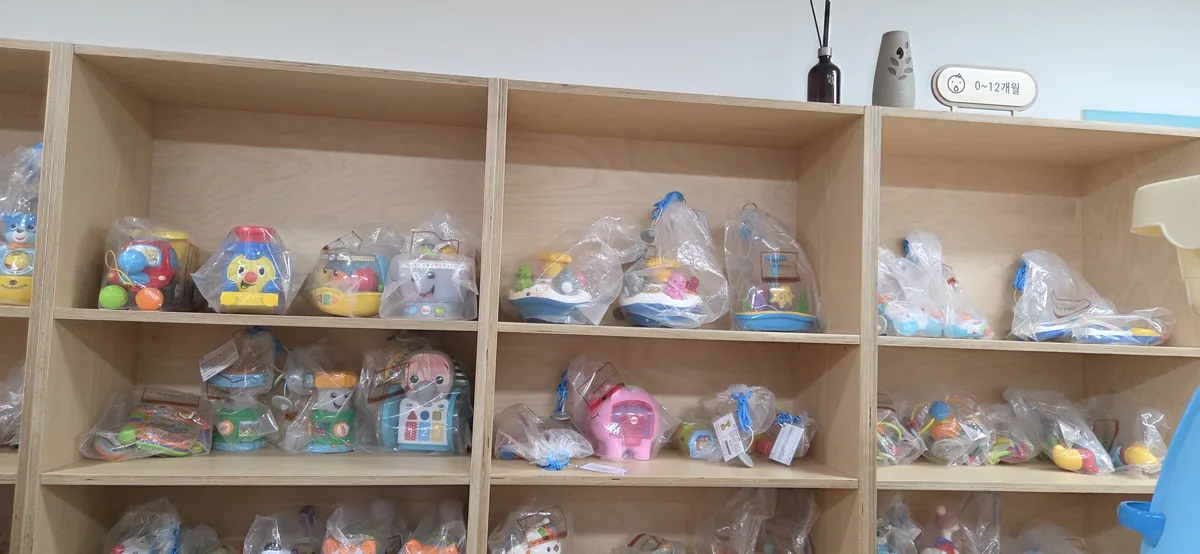
Every toy in the library is sealed in a bag. They are arranged on shelves by age group and catalogued online so you can browse and reserve before you arrive. There is a UV sanitizing machine visible right when you walk in — you can see it, you do not have to take anyone’s word for it. Between each playroom session, staff go in and clean the entire space. The membership system itself acts as a filter: to register, you must present a government document proving you are a Hwaseong resident with a child. Random visitors cannot simply walk in and use whatever they want. Every family in that room has been vetted.
Nothing in the toy library looked damaged or worn beyond use. Nothing was stained. My wife, who had been braced for the worst, looked around and said she was impressed.
How to Register: Two Visits, Two Documents
The registration system is two-stage. You do not have to do both on the same day — we did not.
Stage 1 — Playroom access: Go to hsicare.or.kr/imom or download their app. Complete the online registration form. Then bring your 등본 (resident registration certificate — digital image or paper, both accepted) plus your ID to the front desk. A staff member checks your documents, confirms your registration, and you are done. You can use the playroom immediately.
Stage 2 — Toy and book library: This one requires your 가족관계증명서 (family relations certificate). Paper only — the staff told us a digital copy is not accepted for this step. If you did not bring it on your first visit, no problem. Come back. We did exactly that.
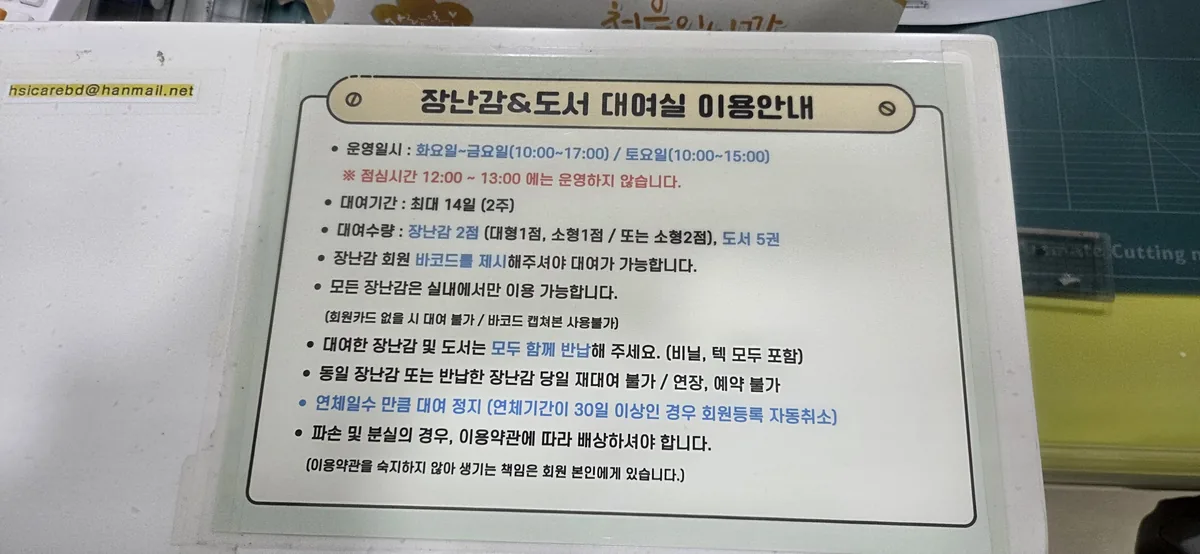
Once you are registered for the library, members can borrow up to two toys and five books for a maximum of 14 days. You can also browse and reserve items through the website before you visit, which means you can show up knowing exactly what you are picking up.
The Hidden Perk for Multicultural Families
Here is the detail that most foreign families in Hwaseong do not know about: the annual library membership fee is completely waived for multicultural families.
It was explained to us by the staff at the desk and was also printed on the information sheet they handed us at registration. It is not hidden — but it is also not something you would find unless you went looking or someone told you. We found out by showing up.
When you have a baby, money redistributes fast. You are not buying fewer things — you are buying different things. Diapers. Formula. Baby food. Picking up fresh cuts for your baby’s next meal at the local butcher adds up quickly. The toy library does not eliminate those costs, but it eliminates a whole separate category of spending. Large baby toys — walkers, ride-ons, activity tables — cost a lot and get outgrown in weeks. Borrowing them instead of buying them is not a small saving. It is the kind of saving that lets you spend money on the things that actually matter.
Struggling to figure out which government benefits your multicultural family qualifies for in Korea? JustAskJin can help you navigate the paperwork and find what you are entitled to.
The Nono Cafe on the Second Floor
I want to spend a moment on this because it is my favorite part of the building.
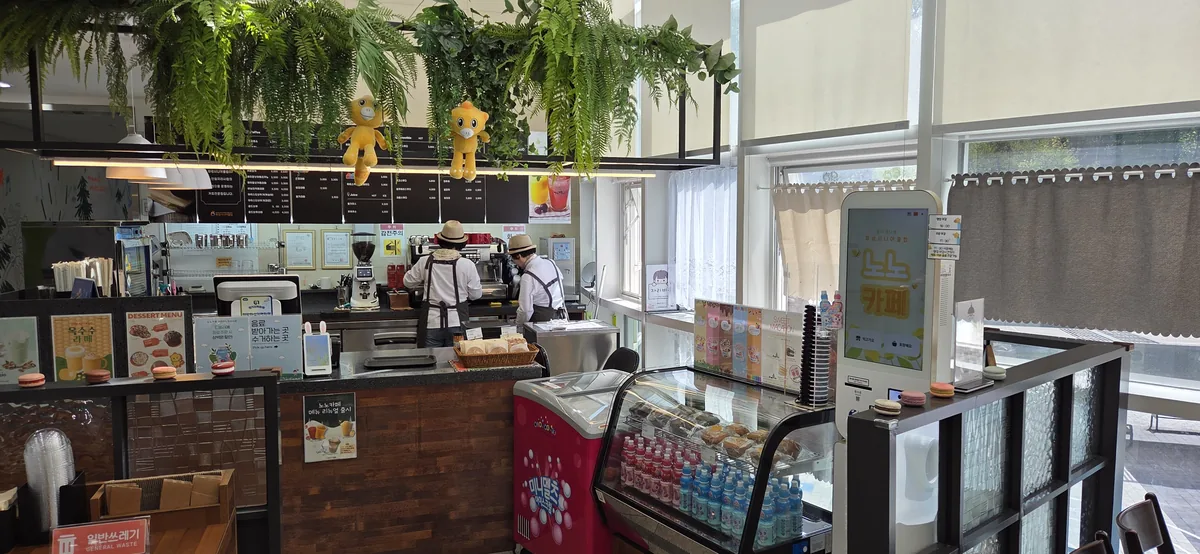
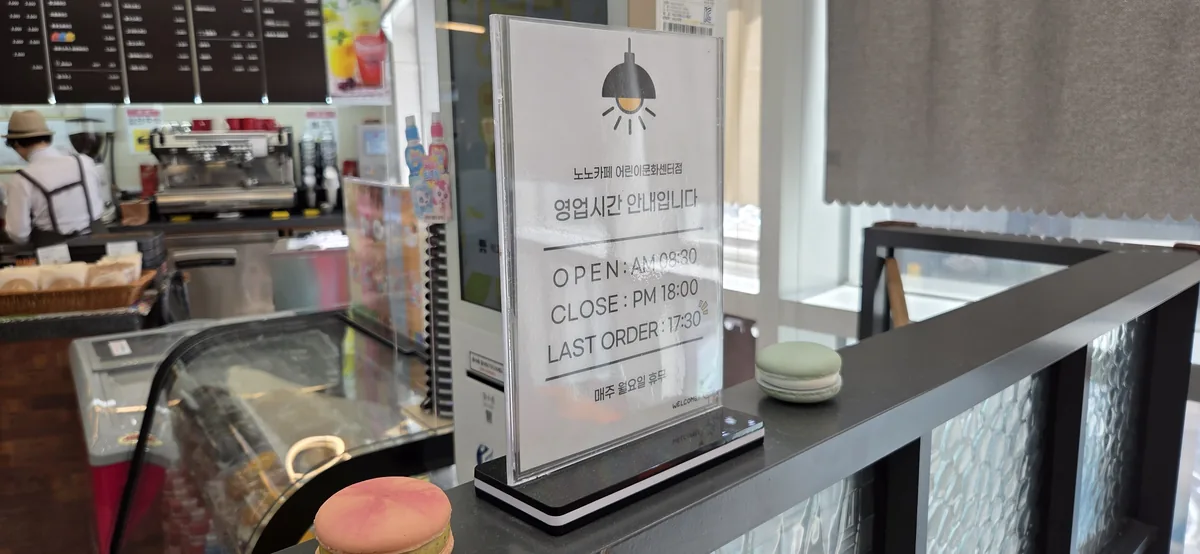
The second floor has a small cafe called the Nono Cafe. It is run by Hwaseong City as an employment program for senior residents. The staff are elderly — on our visit, two grandmothers were behind the counter. The drinks are good. The prices are reasonable. And the atmosphere is something you do not expect to find in a government building.
When we walked in with our baby, both grandmothers looked over and their faces changed. They smiled at her, that specific kind of smile that older Koreans give to very young babies — warm and unhurried. My wife, who had started the morning reluctant to even be there, felt genuinely welcomed in that moment. Not tolerated. Welcomed.
What You Can Actually Borrow
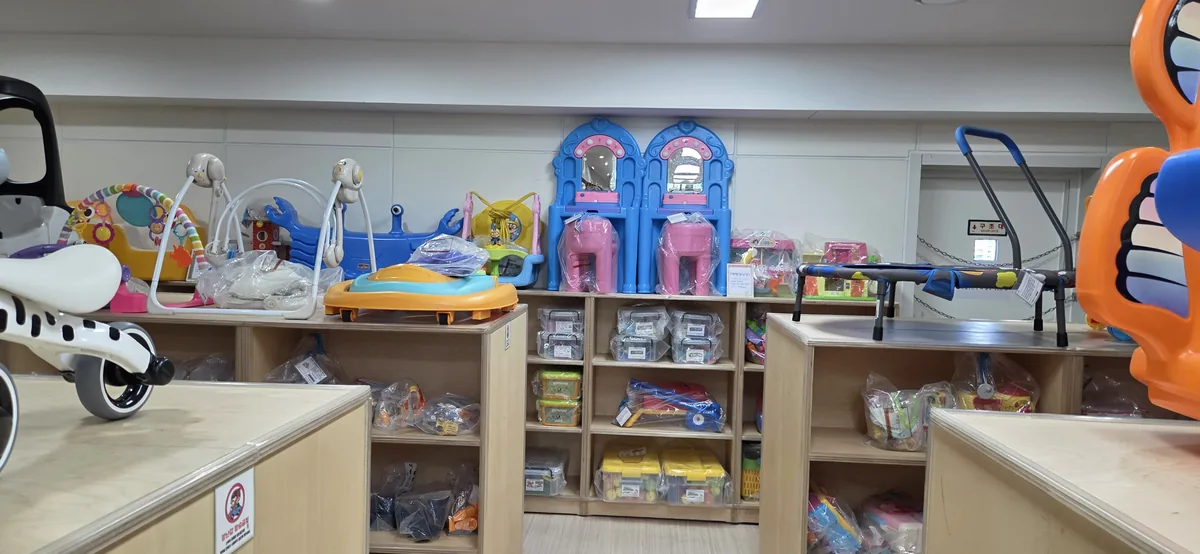
The toy library is larger than it looks from the entrance. There is a dedicated section for large items — walkers, ride-on cars, push toys, activity gyms — and a separate section for smaller educational toys, puzzles, sensory kits, and musical instruments. Everything is sorted by age range, so you are not hunting through items meant for a five-year-old when you have a seven-month-old.
The book section covers Korean children’s books across age groups. If you want your child growing up bilingual, having a rotating stack of Korean picture books at home at zero cost is not nothing.
Location & Hours
📍 Hwaseong-si Bongdam I-Kieum Center
Address: 146 Donghwa-gil, Bongdam-eup, Hyohaeng-gu, Hwaseong-si, Gyeonggi-do
The building has generous free parking. We have also walked there on a good day — spring, light breeze, baby laughing in the pram the whole way. It is a little far on foot but the kind of walk that reminds you why you chose to live here. On the way back, we talked about how fortunate we are. There is a lot of hardship in the world. Korea, for all its complexity, gives its residents real infrastructure to raise a family in. This place is part of that.
If you want to explore more of what Bongdam has to offer while you are in the area, there is also a foreigner-friendly gym right here in Bongdam — useful for the parent who needs to burn off some energy while the other handles the playroom shift.
Your City Has One Too
The Bongdam I-Kieum Center is not famous. It does not need to be. It exists for the people who live here, and if you live here, it exists for you.
If you are not in Hwaseong — your city or district almost certainly has an equivalent facility. Korea funds these centers across the country. The name will be different. The documents might vary slightly. But the logic is the same: registered residents, especially those with young children, have access to free or near-free resources that most people walk past without knowing they exist.
Do what I did with my wife. Just go and look. You do not have to borrow anything on the first visit. You do not have to commit to anything. Take the baby, look around, and decide from there. That is how every good decision in this country has started for us — one low-stakes visit at a time.
Need Help Navigating Life in Korea?
From government document prep to hospital appointments and daily errands — JustAskJin is a concierge service built for expats in Korea. We handle the hard parts so you can focus on your family.