
I spent hours trawling through Korean blogs and YouTube videos from Japan, convinced that signing a rental contract here would be an administrative ordeal. The further I read, the more intimidating it looked — conflicting advice, horror stories about lost deposits, warnings about fraud. Then I actually arrived back in Korea, walked into a real estate office in Hwaseong, and sat down to sign. It was over faster than any apartment paperwork I had ever touched in Japan.
That gap between pre-arrival panic and on-the-ground reality is something a lot of expats experience with the Korean rental system. The contracts themselves are not the hard part. What trips people up is everything that happens around the contract — the legal steps that activate your protection, the documents you need in hand before signing, and the verification checks that keep fraud at bay. This Korean rental contract guide for expats covers exactly that: what the two main systems mean, how to lock in your legal protection, and what to watch for before you hand over a single won.
📌 Quick Summary:
Foreigners can rent in Korea under the same legal framework as Korean nationals — but only if they complete the right steps. Get your ARC, register your residence within 15 days of moving in, file the lease report, and obtain a 확정일자 (hwakjeongilja — confirmed date). Miss any one of these and your deposit has no legal protection.
Jeonse and Wolse Explained for Foreigners
Most Western rental markets run on a simple monthly rent model: you pay every month, the landlord keeps a small security deposit, and that is broadly it. Korea does it differently — and for many newcomers, the difference is significant enough to cause real confusion.
전세 (jeonse — lump-sum deposit rental) involves handing the landlord a large lump sum — often tens or hundreds of millions of won — at the start of the contract. You pay no monthly rent for the duration of the lease (typically two years). The landlord invests or uses that capital, and you get the full deposit back when you leave. When I first looked at jeonse figures from Japan, my instinct was that it was simply out of reach — which is part of why I started with wolse instead.
월세 (wolse — monthly rent with deposit) is closer to what most expats are used to, though it still involves an upfront deposit — typically smaller than jeonse — plus a fixed monthly payment. When I first moved back to Korea, I started with a wolse officetel in Hwaseong: a compact, fully furnished one-room unit with a washing machine, induction stove, TV, and basic furniture already included. My employer covered part of the monthly rent as a housing benefit — some Korean companies do this, so it is worth asking before you assume you are on your own. The plan was simple — one year, minimal upfront cost, minimal things to move. It worked exactly as intended, and after that year I upgraded to a jeonse apartment.
One misconception worth addressing early: many expats assume that foreigners cannot access jeonse, or that landlords will automatically refuse non-Korean tenants. In practice, foreigners can enter both jeonse and wolse contracts under exactly the same legal framework as Korean nationals. The conditions for legal protection are the same too — it is just that foreigners are less likely to know what those conditions are.
If you are arriving in Korea for the first time, my honest advice is to start with wolse, not jeonse. The upfront cost is far smaller, the fraud exposure is lower, and it buys you a year to understand how the system actually works before you commit a life-changing deposit. That is the exact path I took — a wolse officetel first, then a jeonse apartment once I knew the ground. Jeonse is the better deal financially if you have the capital and you have done your verification, but it is not where a newcomer should begin.
Korean Rental Deposit Protection: The Three Steps That Actually Matter
Here is the thing that Korean-language sources make clear but many English-language guides gloss over: obtaining a 확정일자 (hwakjeongilja — confirmed date stamp) alone does not protect your deposit. Legal protection under the Housing Lease Protection Act requires three conditions to be met simultaneously — actual occupancy, residence registration at the address, and the confirmed date stamp. If you skip or delay any one of them, your priority repayment right does not apply.
Worried About Your Rental Deposit in Korea?
Navigating Jeonse, Wolse, and the admin steps that actually protect your money can feel overwhelming — especially before you arrive. If you’re unsure which steps apply to your situation, Jin can help you work it out.
Ask Jin
- Move in and take possession. Physical occupancy is the first condition. You need to actually be living at the address — not just signed the contract.
- Register your residence at the new address within 15 days of moving in. For foreigners, this means reporting your change of stay address (체류지 변경신고, cheryuji byeon-gyeong singo) under the Immigration Act — a different deadline from the 14 days that applies to Korean nationals. You can do this online through HiKorea, or in person at your local immigration office or community centre. One foreigner-specific catch: filing online through HiKorea does not automatically print the new address on your ARC — you still need a community-centre visit to update the card itself. Missing the deadline can result in a fine of up to 1,000,000 KRW, and more critically, leaves your deposit legally unprotected for every day you delay.
- Obtain the hwakjeongilja (confirmed date stamp). This used to require a separate trip to the community centre. Since the lease-report system began in 2021, if your lease meets the reporting threshold — a deposit over 60 million KRW, or monthly rent over 300,000 KRW — filing the lease report through rtms.molit.go.kr automatically grants the confirmed date. If your lease falls below that threshold, you can still obtain it manually at the local community centre or district office at a cost of approximately 700 KRW.
💡 Pro Tip:
All three conditions — occupancy, residence registration, and confirmed date — must be in place for your deposit to have legal priority. The confirmed date takes effect only once your residence is registered. Do both on the same day if you can.
Alien Registration Card Rental Requirements and Essential Documents
Your Alien Registration Card (ARC) is more than an ID card — for any rental contract involving a significant deposit, it is the document that makes legal protection possible. Foreigners staying in Korea for more than 90 days are required by law to obtain one, and it is strongly recommended for any deposit-based contract regardless of duration.
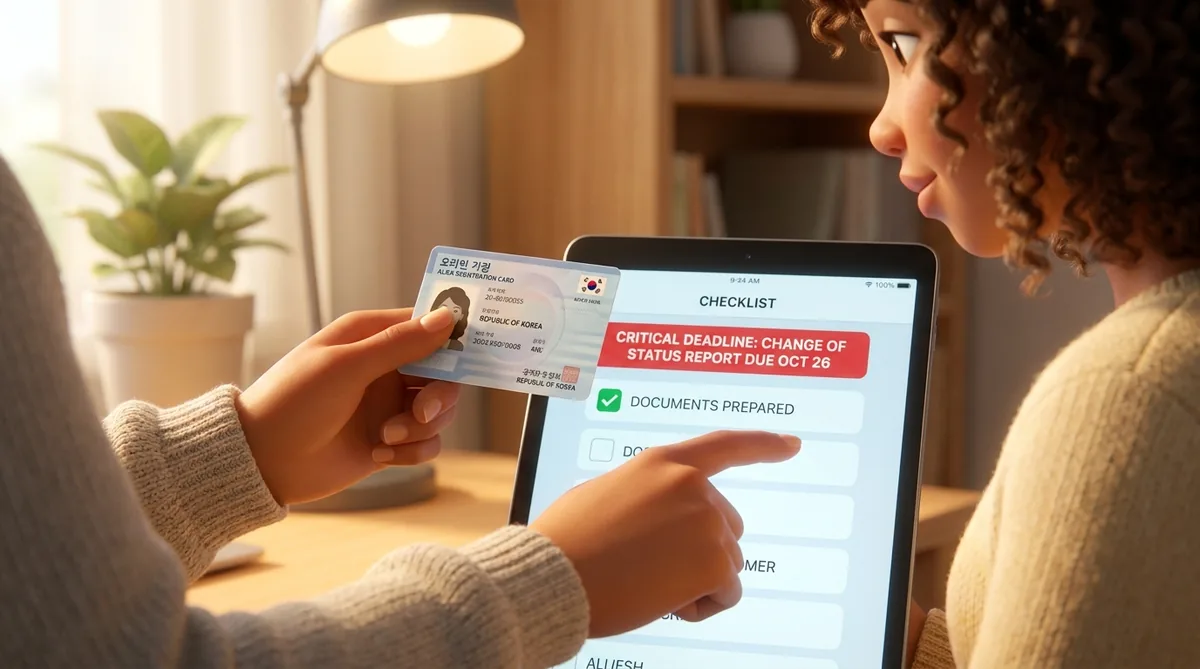
For short-term leases of three months or less, or if your ARC has not been issued yet, a passport can substitute for identity verification. But once your ARC is issued, update your contract details to reflect it — and use it for all administrative reporting. You can read more about understanding your legal rights as a foreigner in Korea in a separate post, but the ARC is the thread that runs through almost all of them.
Understanding your lease contract’s deposit protection clauses is the first step, but if your landlord refuses to return your 월세 deposit despite the contract terms, you’ll need to know the legal steps to recover your security deposit in Korea.
Documents to Prepare Before Signing
- Alien Registration Card (ARC) — or passport if ARC not yet issued
- 등기부등본 (deungnibuedeungnok — real estate register certificate), checked on the day of signing
- Landlord’s government-issued ID, for identity verification
- Signed lease agreement / contract (needed for lease report filing)
Viewing the real estate register certificate costs about 700 KRW on the Supreme Court Internet Registry Office (iros.go.kr) — an official issued copy is 1,000 KRW, but a 700 KRW viewing is enough to check the property yourself. Pull the most recent version on the day of signing — not the day before. You want to see who the legal owner is, whether there are mortgages or liens on the property, and whether any attachment or provisional disposition orders have been recorded. If the name on the register does not match the person signing as landlord, stop and ask why.
Preventing Rental Fraud in Korea
Rental fraud in Korea is real, and the most common form follows a recognizable pattern: a property with significant existing debt is rented to multiple tenants, the landlord disappears or goes bankrupt, and the tenants discover their deposits rank behind the bank’s mortgage in the repayment queue. The legal steps above are your structural protection. These verification habits are your early warning system.

Check the register before you trust anything else. Pull the 등기부등본 yourself — do not rely on a printed copy the agent hands you. Verify the landlord’s identity against it in person. If the property has a large outstanding mortgage relative to its market value, your deposit could be exposed even if you complete every legal step correctly.
Watch the debt-to-value ratio. A common rule of thumb among Korean tenants: if your deposit plus any senior mortgage (근저당, geunjeodang — a lender’s lien recorded on the register) adds up to more than roughly 70–80% of the property’s market value, treat the contract as high-risk — in a forced sale there may not be enough left to return your deposit. And when you pay, send the balance to the bank account of the person whose name is on the register — never a third party’s.
Confirm your agent is licensed. Real estate agents in Korea must be registered and certified. Ask to see their licence. Licensed agents are legally accountable for the transaction; unlicensed ones are not. When I was searching online from Japan and reading through Korean forums, one of the things that genuinely scared me was the volume of stories involving unlicensed brokers. In practice, the agents I encountered in Hwaseong were straightforward — but verification is non-negotiable.
Be cautious with building types. Not all properties are eligible for lease reporting or hwakjeongilja. Certain types of accommodation — including goshiwon — may fall outside the reporting system. Confirm eligibility with your agent before signing.
💡 Pro Tip:
If you are searching remotely before arriving in Korea, the uncertainty can feel overwhelming — I know because I was there. The moment I arrived and could physically visit properties, talk to agents, and read the area, the anxiety dropped immediately. If you can delay signing until you are on the ground, do it.

Risks and Penalties for Non-Compliance
The penalties for skipping or delaying the required steps are not theoretical. Failing to report your change of residence can result in a fine of up to 1,000,000 KRW, and the amount scales with how long the delay runs. More seriously, every day your residence is unregistered is a day your deposit sits without legal priority protection — if the landlord’s financial situation deteriorates in that window, you may have no recourse.
The Housing Lease Declaration System introduced mandatory reporting requirements, and a grace period for penalties that applied to early cases ended in June 2025. If you are signing a new contract now, treat all reporting as mandatory from day one. There is no grace period to rely on.
Late reporting of your lease — through rtms.molit.go.kr — also carries penalties, so do not treat that step as optional even if your deposit falls below the automatic hwakjeongilja threshold. The act of reporting establishes your legal position. For more on registering your residency and updating administrative records in other contexts, see our related guide.

Insurance and Legal Aid Options for Foreigners
Even when you do everything correctly, disputes happen. Korea has two main systems available specifically for this situation.
Deposit return guarantee insurance is available through the Housing and Urban Guarantee Corporation (HUG) and Seoul Guarantee Insurance (SGI). These products cover you if your landlord refuses or is unable to return your deposit at the end of the lease. Foreigners are eligible to subscribe. Eligibility conditions and premiums vary, so check directly with HUG or SGI before signing your lease rather than after — some products have application windows tied to the contract start date.
Legal aid services for foreigners are available through two channels. The Korea Legal Aid Corporation handles housing disputes and can be reached at 132. For general immigration and residency questions, including lease-related residency issues, the Foreigner Comprehensive Assistance Center is available at 1345. Both lines offer multilingual support. If a dispute escalates, the legal toolkit includes content-certified mail (내용증명, naeyong jeungmyeong), lease registration orders, payment orders, and small claims procedures — all of which can be initiated with guidance from Korea Legal Aid.
If a contract dispute feels too complex to navigate alone, the JustAskJin service can help you understand your position and work out the next practical step before you engage formal legal channels. That kind of early-stage clarity often resolves situations before they escalate.
⚠️ Deposit protection is not automatic
Signing a contract does not protect your deposit. Legal priority only applies once you are physically moved in, your residence is registered at the new address, and you have obtained the confirmed date stamp — all three, in the same window. One missing step and the protection does not apply.
The Korean rental system rewards tenants who understand it and follow the process precisely. The paperwork itself, as I found on that first contract day in Hwaseong, is genuinely not the hard part. The hard part is knowing which steps to take, in which order, without delay. Now you do.
Frequently Asked Questions
What are the essential steps for foreigners to legally protect their Jeonse or Wolse deposit in Korea?
This Korean rental contract guide for expats identifies three steps that must happen together: move in and take physical possession, register your residence at the new address within 15 days, and obtain the hwakjeongilja (확정일자 — confirmed date stamp). All three conditions must be satisfied simultaneously for your deposit to have legal priority under the Housing Lease Protection Act. Completing them on the same day is the safest approach.
What documents do foreigners need to sign a rental contract and report residency in Korea?
You will need your Alien Registration Card (ARC), or a passport if the ARC has not yet been issued. You should also obtain the 등기부등본 (real estate register certificate) on the day of signing, verify the landlord’s government-issued ID, and keep a copy of the signed lease agreement for the lease report filing. The register certificate can be viewed at iros.go.kr for about 700 KRW (1,000 KRW for an official issued copy).
How can foreigners verify a property and real estate agent to prevent rental fraud in Korea?
Pull the 등기부등본 yourself on the contract day rather than relying on a copy provided by the agent — this shows you the legal owner, any existing mortgages, and any attachment or disposition orders. Ask to see the agent’s licence, as licensed agents are legally accountable for the transaction. Also confirm with the agent that the property type is eligible for lease reporting and hwakjeongilja before signing.
What are the penalties for not reporting a change of residence or rental contract in Korea?
Failing to report your change of stay address can result in a fine of up to 1,000,000 KRW, with the amount scaling by the length of the delay. More critically, every day your residence goes unregistered is a day your deposit lacks legal priority protection. The grace period for Housing Lease Declaration System penalties ended in June 2025, so all reporting obligations are now fully enforced from the date of signing.
Is deposit return guarantee insurance available for foreigners renting in Korea?
Yes — foreigners are eligible for deposit return guarantee insurance through the Housing and Urban Guarantee Corporation (HUG) and Seoul Guarantee Insurance (SGI). These products cover deposit non-return if your landlord is unable or unwilling to repay at the end of the lease. Eligibility conditions and premiums vary by product, and some have application windows tied to the contract start date, so check directly with HUG or SGI before signing rather than after.