My daughter had been going to hourly daycare for about three weeks — just one or two hours at a stretch, practicing being away from us — when I finally sat down and did what I’d been putting off for months. I opened the i-sarang app and applied for a full-time daycare spot. Not because I was desperate. Because I’d just had a conversation at the boxing gym that changed how I thought about the whole process.
One of the moms at the gym had been through the Korea daycare waiting list recently — same neighborhood, similar situation. She told me something that no government guide had made clear: apply to all three waitlist types at once, and set your target admission month as early as realistically possible. “Having options is much better than an uncertain future,” she said, “and it doesn’t cost anything.” I came home, opened i-sarang, and did exactly that. This guide covers what I learned — the system, the strategy, and the honest truth about where even the best-positioned families end up.
📌 Quick Summary:
Korea’s daycare enrollment system runs through the i-sarang portal and app. Priority is determined first by rank, then by score, then by application date. There are three separate waitlists you can apply to simultaneously — and most expats only apply to one. Applying early, choosing the earliest realistic admission month, and understanding the scoring system are the three levers that actually move your position.
How the Korea Daycare Waiting List Actually Works
The first misconception worth clearing up: Korea’s daycare enrollment is not first-come, first-served. Position on any waitlist is determined by three factors in strict order — rank (1st, 2nd, or 3rd), score within that rank, and then application date as a tiebreaker. A family that applies a year before you but holds a lower rank will always sit behind you. That changes how you think about urgency.
The system runs through the 임신육아종합포털 아이사랑 (Imshin Yuga Jonghap Portal i-sarang — Pregnancy and Childcare Integrated Portal), accessible via the website or the mobile app on Android and iOS. For families in Seoul, there’s also the dedicated 서울시 보육포털 서비스 (Seoul si bo-yuk po-tal seo-bi-seu — Seoul City Childcare Portal), but for everyone else in Korea, i-sarang is the platform.
If you’re looking to set up banking for your child alongside managing these benefits, here’s our complete guide to opening a child’s account with KB Kookmin Bank online.
What surprised me was how simple the actual application was. After months of anxiety about complicated paperwork, all I needed upfront was my daughter’s 주민등록번호 (jumin deungnok beonho — resident registration number). No document uploads at sign-up. The complexity isn’t in the form — it’s in understanding when to apply and which options to select. That’s where most expat families lose ground.

There are three separate waitlists available through i-sarang, and this is the most important thing to understand. You can apply to all three simultaneously at up to three daycare centers. Most people don’t know this.
- 전체순번 (jeonche sun-beon — Overall Waitlist): Shows your position among all children of all ages at that facility. It’s a broad number and doesn’t tell you much about your actual chances for a specific age group.
- 상시순번 (sang-si sun-beon — Rolling Waitlist): Covers children the same age as yours whose target admission month is the following month. This list activates one month before your desired entry date, so the earlier your target month, the sooner you appear on it.
- 신학기순번 (sin-hak-gi sun-beon — New Academic Year Waitlist): For children whose target admission date falls by the following March. Korea’s school year begins in March, which is when the largest wave of spots opens as older children move up or graduate.
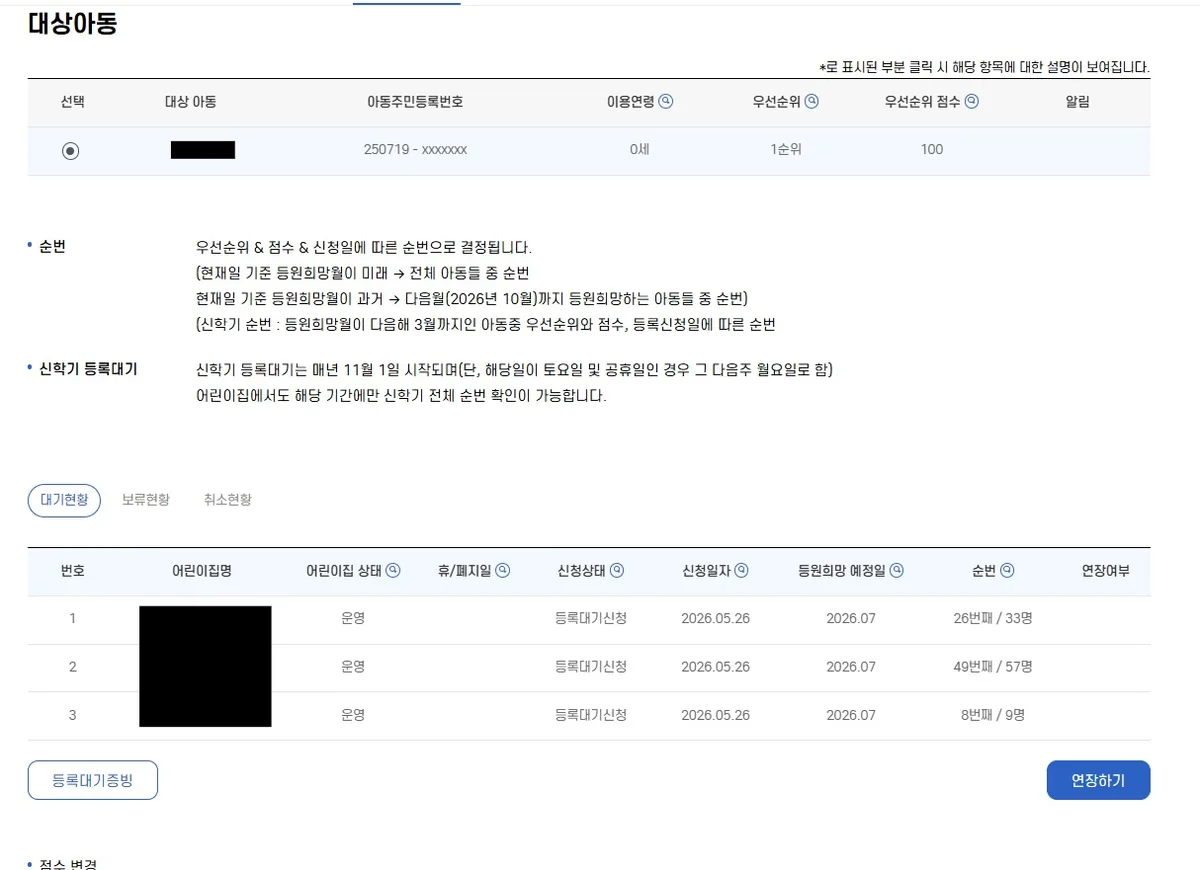
I applied to all three for three different daycares in the Hwaseong area — including two in our apartment complex. My current position is 25 out of 30 on each list. Late 80th percentile. Not comfortable, but not out of the conversation either.
Korea Daycare Priority Eligibility and the Scoring System
This is where the system rewards preparation — and where families with the most points can still end up waiting longer than they expected.
Navigating Korea’s Daycare System as an Expat Family?
Priority eligibility, document requirements, and multicultural family bonuses can be confusing — especially if you’re doing this in a second language. Jin can help you work through the specifics in English before you go in.
Ask JinPriority is assigned in three ranks. First-rank families hold the highest priority and include: households where both parents are employed (including those on parental or childcare leave, graduate students, and vocational trainees), single-parent families, families with disabled parents, multicultural families, low-income households, and a handful of other protected categories. Second rank covers situations like siblings already enrolled at the same daycare. Third rank is everyone else.
No matter how many second-rank points a family accumulates, they cannot overtake a single first-rank applicant. The rank ceiling is absolute. Within first rank, scores are calculated as follows:
| Situation | Score |
|---|---|
| Both parents employed, 3+ children | 700 points |
| Both parents employed, 2+ children | 300 points |
| Both parents employed | 200 points |
| 3+ children (regardless of employment) | 200 points |
| 2+ children under 8 | 100 points |
| Child of pregnant mother | 100 points |
| Sibling enrolled at same daycare (2nd rank) | 50 points |
| General infant/toddler (3rd rank) | 0 points |
Point values shown are totals for each qualifying combination, not items to add together. A family that qualifies under multiple categories receives the highest applicable score.
My family qualifies for first rank with a 100-point multicultural family bonus — my wife is employed (currently on childcare leave), I’m Korean, and she’s South African and Zimbabwean. That combination places us firmly in the 1st-rank pool. But here’s the honest reality check: that bonus is real and it helps. It is not, however, invincible.
At 25/30 on the waitlist, I’m sitting behind dozens of other first-rank families. Many of them have two working parents and multiple children. Opening spots don’t appear on a schedule — they appear when another family withdraws, when a child gets sick and the parents pull out, or when a family picks a different daycare. You’re not waiting for the system to move. You’re waiting for someone else’s plan to change.

According to Korea’s Ministry of Health and Welfare, competition is particularly fierce in high-density residential areas like Hwaseong, where large apartment complexes bring high concentrations of young families. If you’re navigating related government support policies for families at the same time, it helps to understand where daycare enrollment fits in the broader timeline.

How to Apply via the i-Sarang App: Step by Step
The i-sarang process is more straightforward than the anxiety around it suggests. Here’s how it works in practice.
- Complete birth registration first. You cannot start the daycare application until your child has a resident registration number. Do this as soon as possible after birth — there’s no benefit to waiting, and every day you delay is a day you’re not in the system. As I’d tell any expat parent: do it as soon as you report your baby’s birth.
- Register on i-sarang. Download the 모바일 아이사랑 앱 (mo-ba-il i-sa-rang aep — mobile i-sarang app) on Android or iOS, or use the website. Create an account using your child’s resident registration number. This is the step where I expected a wall of bureaucracy and found almost nothing — the initial setup was genuinely quick.
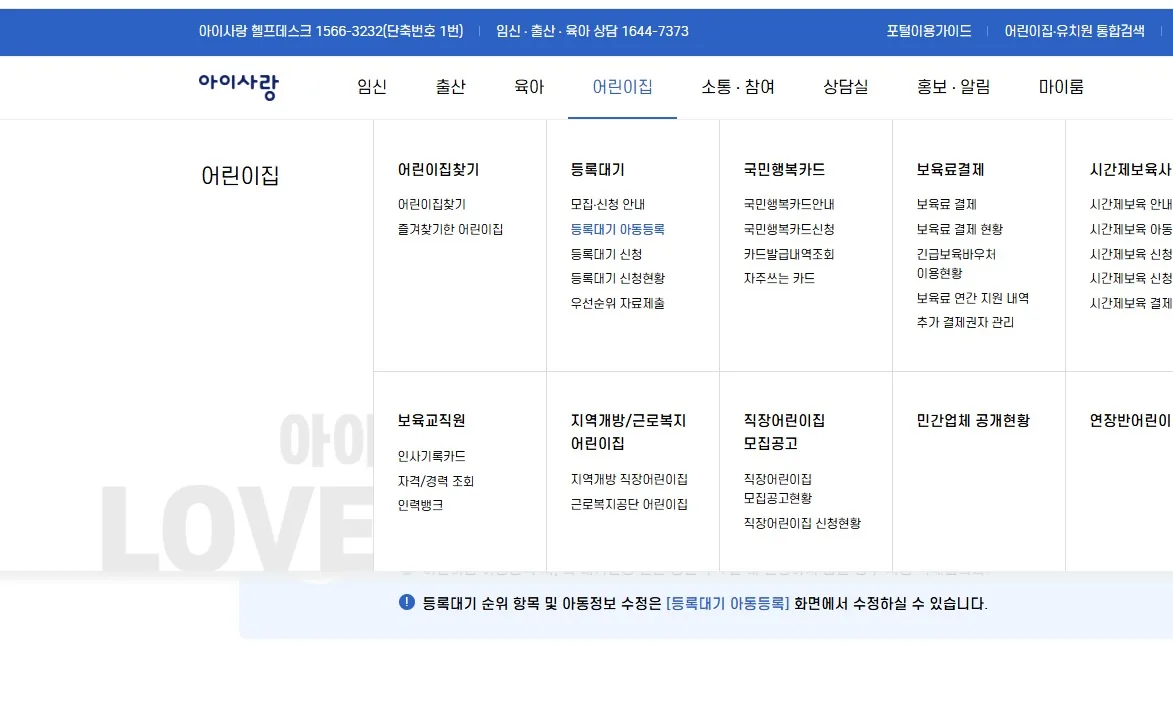
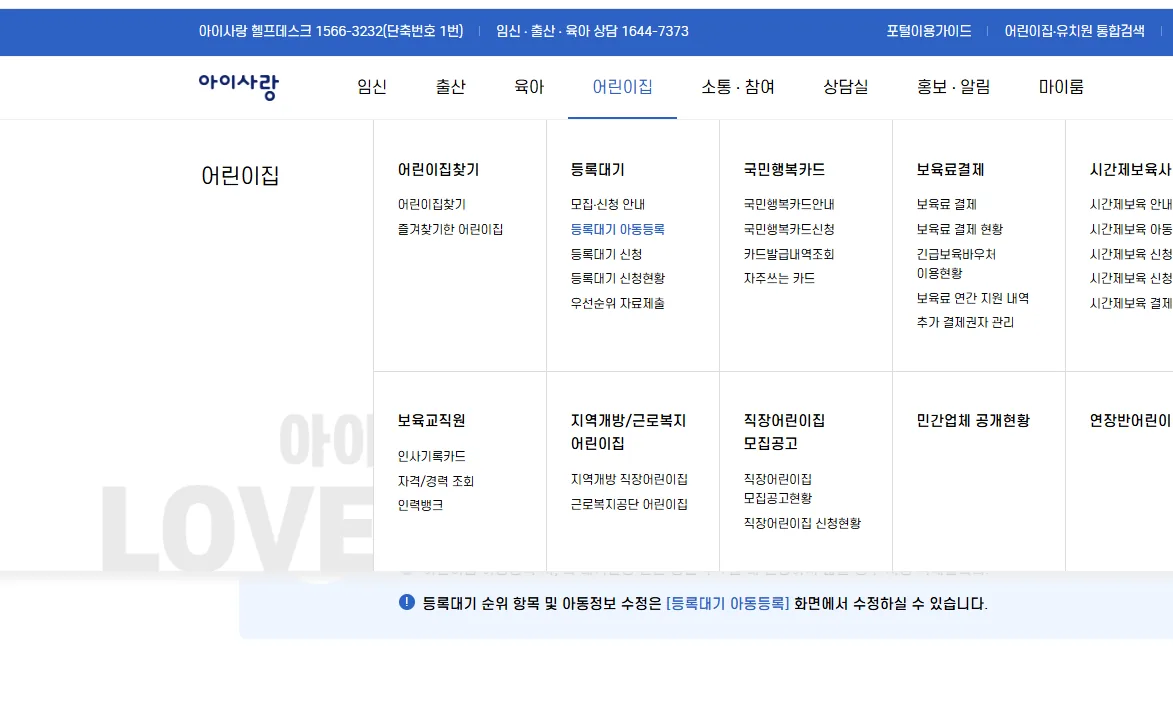
- Navigate to childcare waiting list registration. In the menu, go to 어린이집 (eorin-i-jip — daycare) and select 등록대기 (deungnok daegi — waiting list registration). This is the entry point for all three waitlist types.
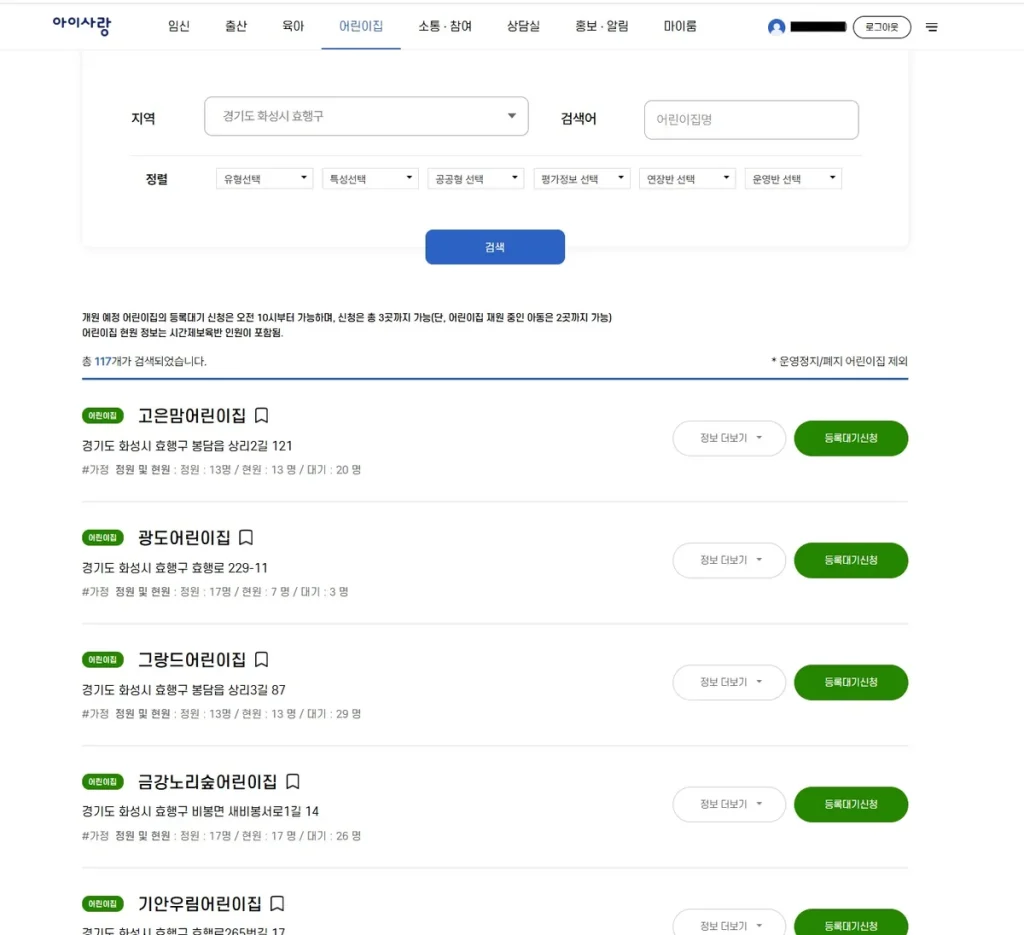
- Search for your target daycare centers. You can search by facility name if you already know which daycares you want, or filter by region using the location dropdown — for example, 경기도 화성시 (Gyeonggi-do Hwaseong-si). The system will return results with capacity and enrollment details for each facility.
- Apply to all three waitlist types for each daycare — and set your admission month as early as possible. This is the step I almost got wrong. I initially selected October as my daughter’s target admission month (입소희망월 — ip-so hee-mang-wol). A daycare teacher advised me to switch it to July. Earlier target months shift your position upward on both the rolling and new academic year waitlists. The difference between July and October is material. I changed it immediately.
- Submit and confirm. After submitting, you’ll see a dashboard showing all your active applications, your waitlist position at each facility, and the application date. You can hold active applications at up to three daycares simultaneously if your child is not yet enrolled anywhere.
💡 Pro Tip:
Daycare centers begin actively contacting eligible applicants from November 1st each year for new academic year spots. If you want to be in that window, your application needs to be active and your admission month set correctly well before then.
If you hit any hurdles with the portal interface, the i-sarang official website has support documentation, and for complex eligibility questions, JustAskJin can help you work through the specifics in English before you go in.
Required Documents for Korea Daycare Priority Applications
The good news: you don’t need to upload documents to get on the waitlist. The documentation requirement kicks in when a spot actually becomes available — documents must be prepared and registered on i-sarang up to one week before the child’s admission date. When the daycare contacts you, have everything gathered already. The window can move fast.
For general enrollment, you’ll need to prepare:
General Documents (All Families)
- Daycare Enrollment Application Form — includes parent details, child information, and health status
- Resident Registration Copy (주민등록등본)
- Vaccination Certificate (예방접종 확인서)
- Health Certificate (건강진단서) — see our post on infant health check-ups required for daycare enrollment for how to get this
Additional Documents for 1st-Rank Employed Couples
- Proof of employment: Certificate of Employment, Commission Agreement, or Employment Contract
- Insurance/pension verification: Employment Insurance Qualification History, Workplace Health Insurance Certificate, or National Pension Subscriber Certificate
- Income proof: Withholding Tax Receipt for Earned Income or Certificate of Income Amount
- For multicultural families: Family Relations Certificate (가족관계증명서)
⚠️ Foreign Spouses and Documentation
If your household includes a foreign-national spouse, automated government record-linking won’t cover them. You’ll need to manually obtain and submit an alien registration certificate and supporting documents in paper form to the daycare director — the system won’t pull these automatically the way it does for Korean nationals.
⚠️ Foreign Parents: Set Up Your 국민행복카드 Before Admission
Overseas credit cards cannot be used to receive childcare subsidies through i-sarang. Foreign-national parents need a 국민행복카드 (Gungmin Haengbok Card — National Happiness Card) issued by a Korean bank.
In our household, I handle all the Korean administrative tasks — language ability makes that the natural division of labor in an international marriage. My wife manages the emotional and family-side decisions. It works. But for expat families where neither partner has strong Korean, navigating the document requirements is genuinely the hardest part of this process. The form itself is easy. The document chain behind priority eligibility is where people get stuck.

Practical Tips for Expat Families on the Korea Daycare Waitlist
A few things I wish I’d known — or acted on — earlier.
Apply the moment birth registration is done. There is no strategic reason to wait. Every week you delay, families who applied immediately after their child’s birth are building their lead on the application-date tiebreaker. I procrastinated for months. Don’t do that.
Apply to all three waitlist types at every target daycare. Most expats I’ve spoken to applied to the overall waitlist only and left the rolling and new academic year options blank. That’s leaving free optionality on the table. It costs nothing to apply to all three, and each list operates on slightly different mechanics — having all three active means three different windows where your name could come up.
Set your admission month earlier than feels necessary. I was targeting October. The daycare teacher I spoke to told me to change it to July. I did. Earlier 입소희망월 directly shifts your position on the rolling and new academic year waitlists — it’s not a minor adjustment, it’s a structural improvement in your position.
Community intel beats official documentation. The advice that actually changed my approach came from parents at my boxing gym, not from any government guide or expat Facebook group. People who’ve just been through the process in your specific area know the unwritten rules. Find them.
Don’t obsess over the app. Your position changes only when someone ahead of you withdraws or a new applicant with a higher score joins. Checking daily doesn’t accelerate anything. The daycare will call you when a spot opens. Check occasionally, note your position, and move on with your life.
If you get a spot somewhere, actively extend your other applications within 7 days. When a child is enrolled at a daycare, i-sarang automatically cancels the other 1–2 waitlist applications unless you log in and click to extend them within 7 days of enrollment. Miss that window and you lose your position — though you have a 3-month grace period to restore it via the portal. After 3 months, you start over. This matters if you get into a private daycare but want to stay on the public daycare waitlist.
If you’re planning around when your parental leave ends, understanding parental leave benefits alongside the daycare timeline matters — they’re interconnected. And if the waitlist extends longer than expected, the hourly childcare program as a temporary option is worth understanding in detail. My daughter has been using it for three weeks and it’s done exactly what we needed: let her practice being away from us, a little at a time.
Right now I’m at 26/33. My wife is on childcare leave, I’m at home, and neither of us is panicking. The application is in, the options are open, and we’re watching for the call. That’s the realistic outcome of doing everything right — not a guaranteed spot, but genuine optionality instead of a closed door.
📌 Quick Recap — What Actually Moves Your Position:
1. Apply immediately after birth registration — application date is the final tiebreaker.
2. Apply to all three waitlist types (overall, rolling, new academic year) at each target daycare.
3. Set your admission month (입소희망월) as early as realistically possible.
4. Understand that 1st rank with bonus points is an advantage, not a guarantee — you’re still competing with dozens of other 1st-rank families.
5. Talk to parents in your building or neighborhood who’ve been through it recently. Their unwritten knowledge is worth more than any official guide.
Frequently Asked Questions
How do I apply for daycare in Korea using the i-sarang app?
Download the 모바일 아이사랑 앱 on Android or iOS, or use the website at childcare.go.kr. You’ll need your child’s resident registration number (주민등록번호) to create an account — no complex document uploads are required at this stage. Navigate to the 어린이집 menu, select 등록대기, then search for your target daycare centers and apply to all three waitlist types at each one.
What is 1st-rank priority for Korea daycare, and who qualifies?
First-rank priority covers households where both parents are employed (including those on parental leave, graduate students, and vocational trainees), single-parent families, multicultural families, families with disabled parents, and low-income households. No second-rank applicant can overtake any first-rank applicant regardless of score. Within first rank, scores range from 100 points (basic multicultural or single qualifying factor) up to 700 points for dual-income families with three or more children.
What documents do I need to confirm a Korea daycare spot when one opens?
Documents are not required to get on the Korea daycare waiting list — they’re needed only when a spot opens and you confirm enrollment, typically up to one week before the admission date. All families need a Daycare Enrollment Application Form, Resident Registration Copy, Vaccination Certificate, and Health Certificate. First-rank employed couples also need proof of employment, insurance or pension verification, and income proof. Families with a foreign-national spouse must submit an alien registration certificate in paper form, as the automated government record system does not cover non-Korean nationals.
How many daycares can I apply to at once in Korea?
If your child is not currently enrolled in any daycare, you can hold active waitlist applications at up to three daycare centers simultaneously through i-sarang. If your child is already enrolled and you want to transfer, the limit is two centers. You can apply to all three waitlist types (overall, rolling, and new academic year) at each center — this is free and multiplies your chances of being contacted when a spot opens.
Does setting an earlier admission month actually improve my position on the Korea daycare waitlist?
Yes — the target admission month (입소희망월) directly affects your position on both the rolling waitlist and the new academic year waitlist. The rolling waitlist activates one month before your desired admission date, so an earlier month means you appear on that list sooner. Setting July instead of October, for example, is not a minor cosmetic change — it is a structural improvement in how the system treats your application across multiple list types.