Another trip to the petrol station had us wincing last week. The South Korea fuel subsidy for residents — officially called the 고유가 피해지원금 (Goyuga Pihaejiwongeun), or High Fuel Price Damage Support Payment — is the government’s direct response to that exact pain, and if you’re a registered resident here, you very likely qualify. Before you assume this kind of benefit is only for Korean nationals, it’s worth knowing that the program targets the bottom 70% of income earners nationally, a bracket that includes a substantial number of expat households. We’ve already covered other government support programs available to residents on this site, and this one deserves equal attention.
📌 Quick Summary:
The 고유가 피해지원금 is a one-time government support payment of 100,000 to 600,000 won per person, designed to offset rising fuel and living costs. Residents in the bottom 70% of income earners are eligible. You can apply online via card company apps or the local gift certificate app, or offline at your 주민센터 (Jumin Center — Community Service Center) or bank branch. The application window runs until 3 July 2026, and funds must be spent by 31 August 2026.

What Is the 고유가 피해지원금?
Korea has been hit by a triple burden lately — high fuel prices, a weak won against the dollar, and persistent inflation across everyday goods. The government launched this support payment specifically to cushion lower-income households from those compounding pressures. Think of it as targeted relief rather than a blanket handout: the less you earn and the further you live from Seoul, the more you receive.
The payment amounts break down like this:
- 기초수급자 (Gichosupgeupja — Basic Livelihood Recipients): 550,000 won in the 수도권 (Sudogwon — Seoul metropolitan area), 600,000 won outside it
- 차상위·한부모 (Chasangwi·Hanbumo — Near-poverty and single-parent households): 450,000 won metro / 500,000 won non-metro
- Income bottom 70% (general residents): 100,000 won metro / 150,000 won non-metro, with additional top-ups of 200,000–250,000 won for residents in designated 인구감소지역 (ingugamso jiyeok — population-decline areas)
Living out here in Hwaseong — which sits in Gyeonggi-do rather than Seoul proper — means our household falls under the non-metro bracket for the general population tier, so it’s worth checking your own registration address carefully before assuming the lower figure.

💡 Pro Tip:
A common misconception is that government cash support programs in Korea are only for Korean citizens. This one is income- and residence-based, not nationality-based. If you’re registered at a Korean address and your household income qualifies, you’re in the pool.
Expat Eligibility: Korea Support Payments and Who Qualifies
The eligibility question is the one I get asked most by expat friends, and the honest answer is: it depends on your registered income status in Korea’s national systems. The 70% threshold is assessed using data held by the National Health Insurance Service (NHIS), which already holds income data for most registered foreign residents who pay into the health insurance system. You can check your own eligibility directly on the NHIS website before you even start an application.

The key factors for expat eligibility are:
- You must be registered at a Korean address (주소지 등록 — jusojijeungnok)
- Your household income must fall within the bottom 70% as assessed by government data
- Basic Livelihood and near-poverty tiers require prior registration in those welfare categories — most general expats will fall under the 70% general tier
If you’re unsure of your income bracket, the dedicated call center for this program can help: 1670-2626. They handle queries specifically about this payment, which is more useful than navigating a general welfare hotline.
How to Apply for Korean Government Subsidies: Step by Step
There are two routes — online and offline. Online is faster by a significant margin, but offline at your local 주민센터 (Jumin Center) is a solid fallback if you hit a wall with the app process.
Online application: Through your card company’s app or website, or through the 지역사랑상품권 (Jiyeoksarang Sangpumgwon — Local Love Gift Certificate) app. You’ll select your preferred payment method during the process.
Offline application: Visit your 주민센터 (the community service center for your registered district) or a bank branch. Bring your ID. Hours are generally Monday to Friday, 9 AM to 6 PM for the Jumin Center, and 9 AM to 4 PM for banks — confirm with your specific branch.
Here’s how the online process looked when I applied. Steps are based on the Gyeonggi Province government services app, but the flow is similar across other regional apps.
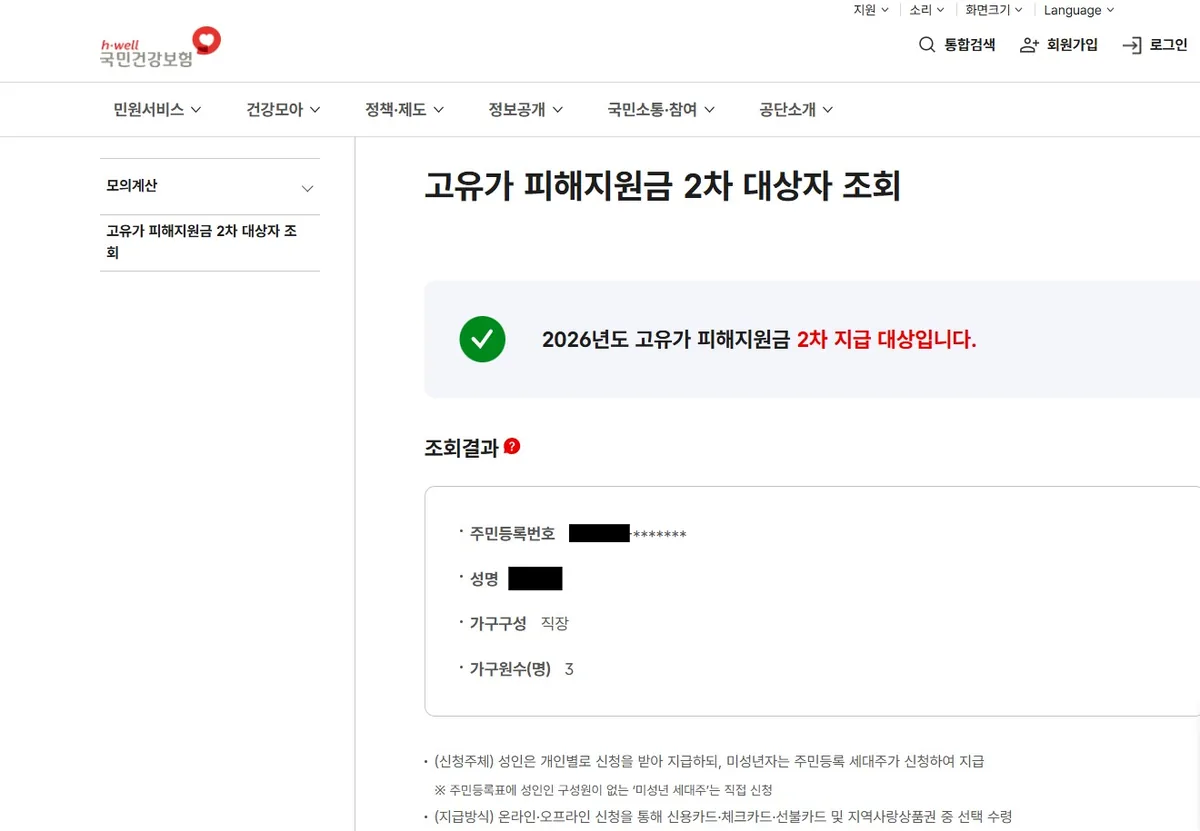
Step 1: Check your eligibility on the NHIS website
Before anything else, go to the NHIS website and search for the 고유가 피해지원금 2차 지급 대상 조회 (second-round eligibility search). You’ll see a green confirmation if you’re eligible. Your registration number and name are used to verify — personal details are masked in the results.
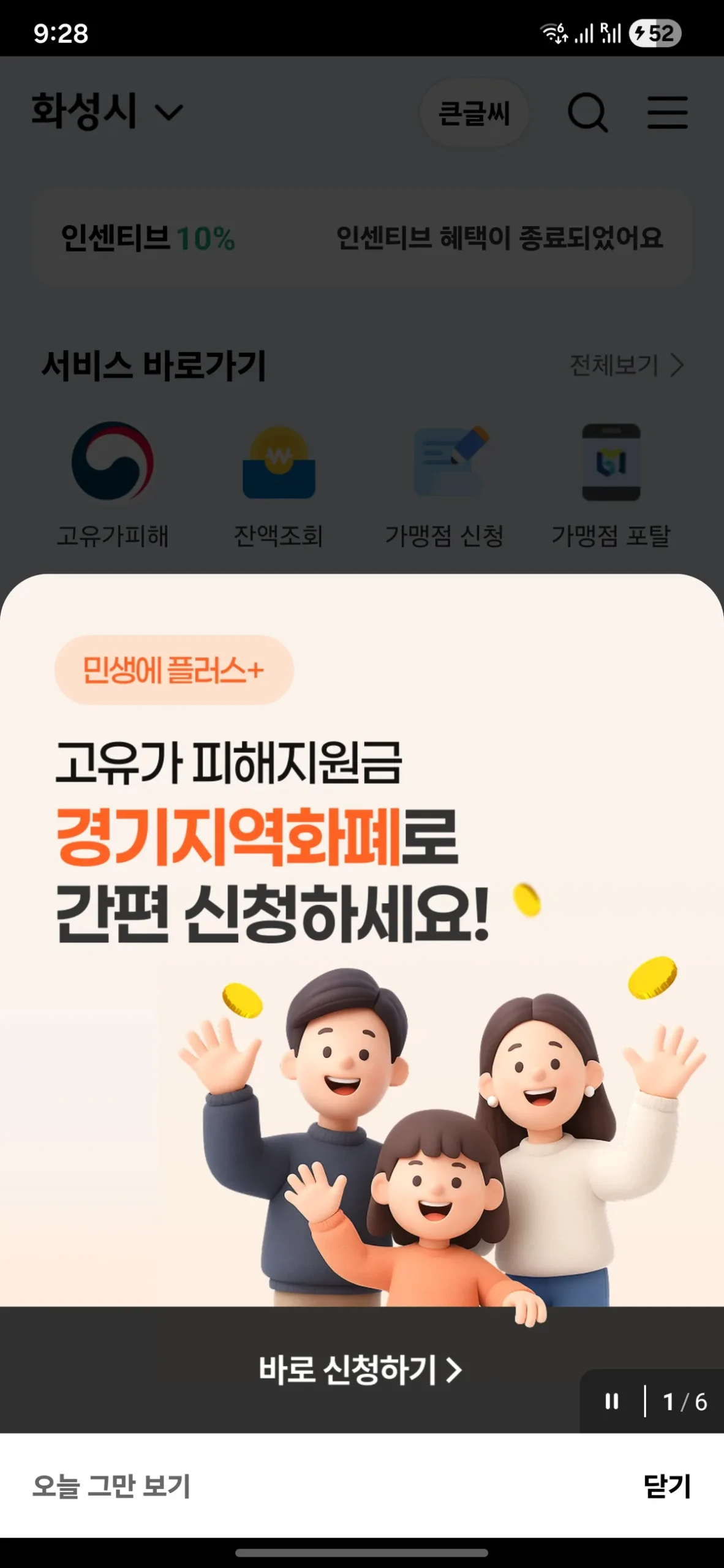
Step 2: Open the government services app and find the support program
Open the Gyeonggi-do government services app (or your regional e
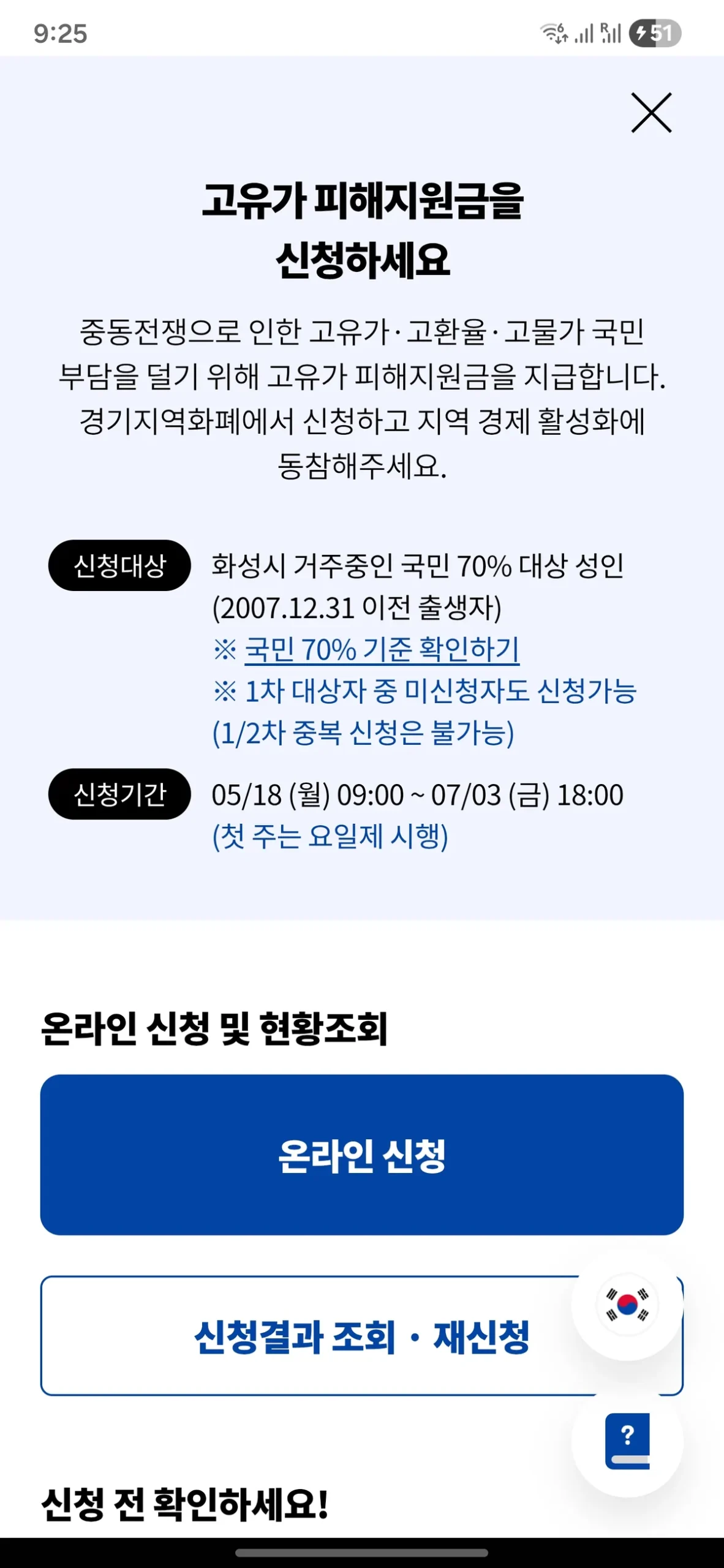
quivalent). The main screen shows a banner for the 고유가피해 (disaster relief assistance) program with a 바로 신청하기 (Apply Now) button. Tap it.
Step 3: Select your application method
The portal presents two options for how you want to receive and use the funds — via local gift certificate or via credit/debit/prepaid card. Tap the blue banner labeled 고유가 피해지원금 신청 바로가기 to proceed to your chosen method.
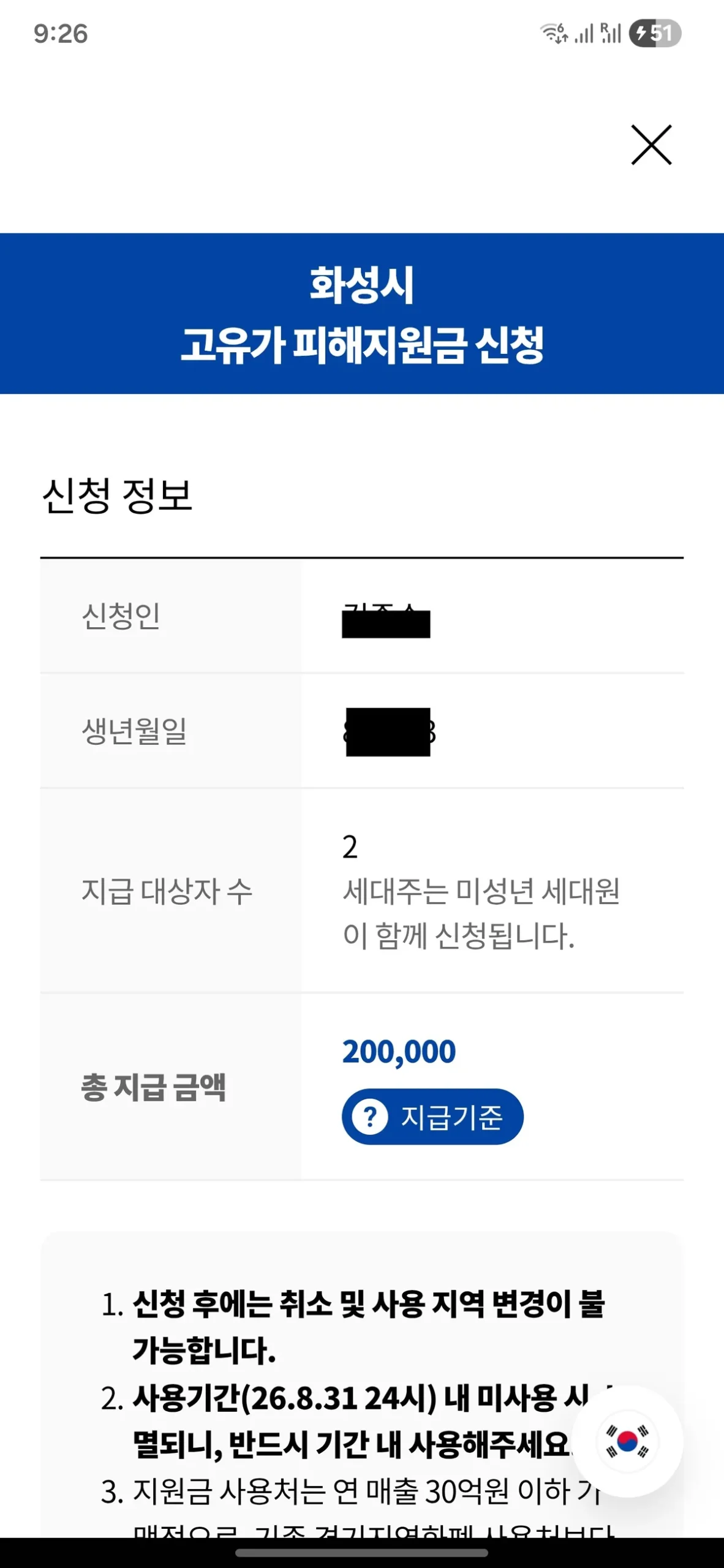
Step 4: Review application rules
A summary screen outlines the key conditions — eligible amount, spending region, and usage deadline. Read this carefully, especially the part about regional restrictions. Your funds must be spent within the district matching your registered address.
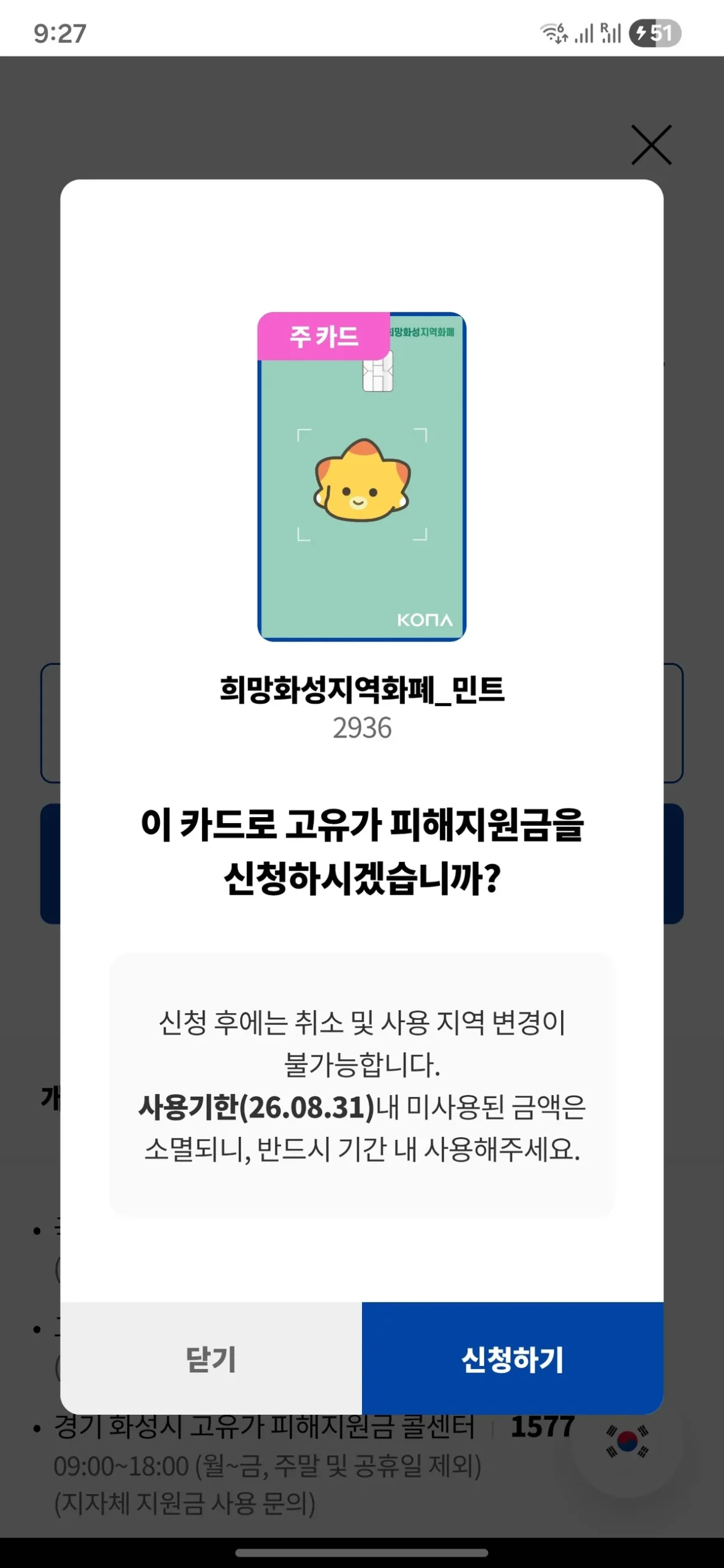
Step 5: Select your card
If you hold multiple local currency cards, you’ll be prompted to choose which one should receive the funds. Pick the card you use most regularly in your local area.
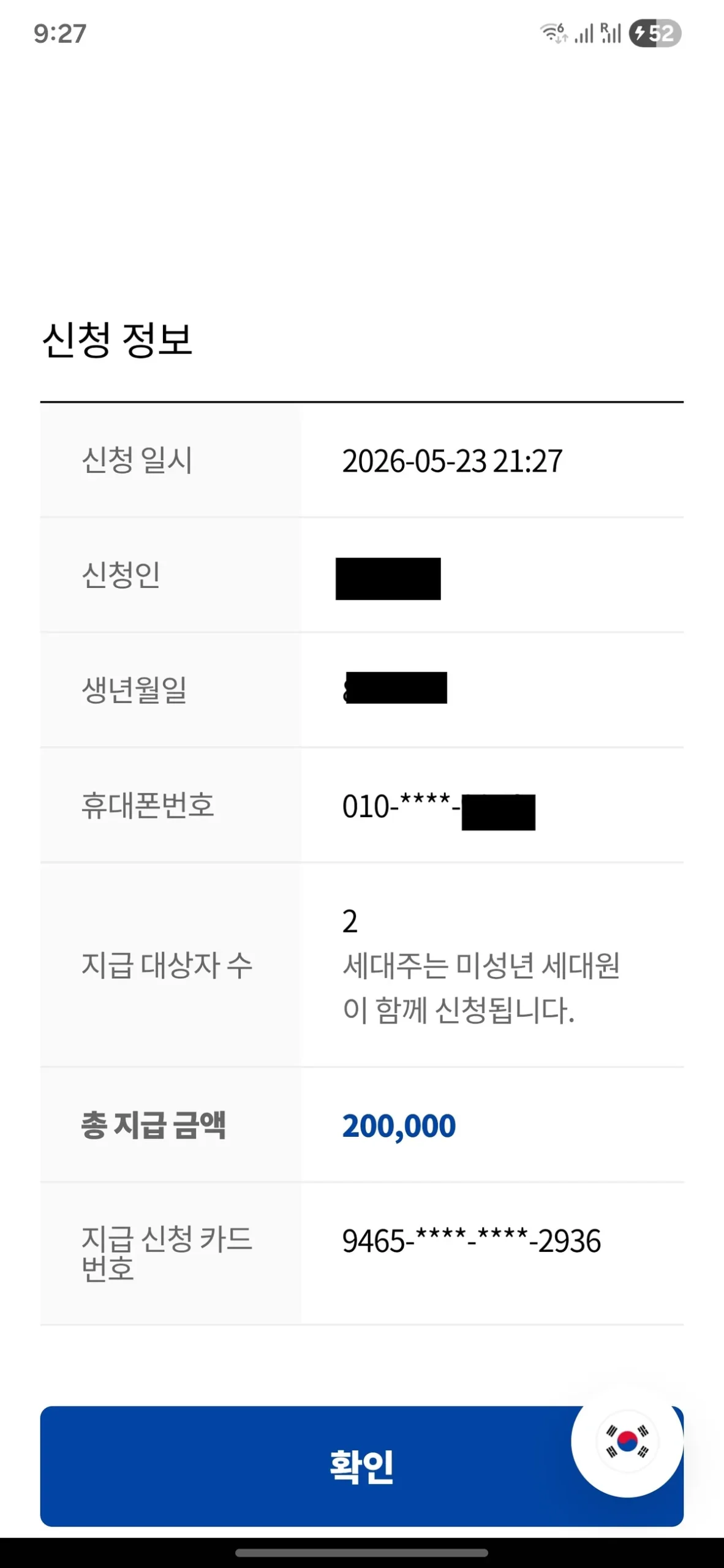
Step 6: Confirm and submit
Review your personal details and the confirmed support amount — 150,000 won base for the non-metro general tier, plus a 50,000 won top-up for Gyeonggi-do residents, totalling 200,000 won in this round — then submit.
💡 Pro Tip:
After submitting, you’ll get a KakaoTalk notification confirming approval. Save it — it’s your timestamped record of the application and useful if anything goes wrong with the payment loading to your card.
If the app process feels overwhelming in Korean, this is exactly the kind of situation where JustAskJin can step in — navigating Korean-language government portals and making sure you select the right options is a common request.
Where to Use Korea Local Gift Certificates
Understanding how to use local gift certificates and regional currency cards is half the battle once the funds land. The 지역사랑상품권 (Jiyeoksarang Sangpumgwon) can only be spent within the region matching your registered address — so if you live in Hwaseong, you spend in Hwaseong, not in Seoul.
Eligible merchants are small businesses with annual revenue under 3 billion won. That covers most local restaurants, markets, independent shops, and service businesses. What’s excluded:
- Entertainment venues and gambling-related businesses (유흥·사행업종)
- Large chain stores and department stores above the revenue threshold
- Online-only merchants (for the gift certificate format specifically)
If you opt for a credit, debit, or prepaid card instead of the gift certificate format, the same merchant eligibility rules apply — but you get the flexibility of using it anywhere the card is accepted among qualifying small businesses, rather than scanning a QR code or presenting a physical voucher.
Key Dates and Deadlines
⚠️ Recency note: The dates below come from official program materials dated May 2026. Program windows can extend or close early — always verify current status via the official call center (1670-2626) or the Korean government portal before applying.
- Basic Livelihood and near-poverty tier — 1st round: 27 April 2026 to 8 May 2026 (closed)
- Basic Livelihood and near-poverty tier — 2nd round: 18 May 2026 to 3 July 2026
- General residents (bottom 70%) — 2nd round: 18 May 2026 to 3 July 2026
- Spending deadline (all tiers): 31 August 2026
If you received payment in the 1st round, you cannot apply again in the 2nd round — the system checks for duplicate claims automatically.
💡 Pro Tip:
Don’t let the August 31 deadline sneak up on you. Mark it in your calendar now. Unused balances on local gift certificates typically expire without refund, and this program’s funds are no exception.
Frequently Asked Questions
Can foreigners and expats receive the South Korea fuel subsidy for residents?
Yes — the South Korea fuel subsidy for residents is assessed on income and registered address, not nationality. Foreign residents registered at a Korean address and whose household income falls within the bottom 70% nationally are eligible under the general tier. Basic Livelihood and near-poverty tiers require prior welfare registration, which most general expats won’t hold, but the 70% general tier is open to qualifying registered residents regardless of citizenship.
How do I check if my income qualifies?
The fastest method is to run the eligibility check on the NHIS website (nhis.or.kr) using the 고유가 피해지원금 조회 search function. The system uses income data the NHIS already holds for you. If you’re unsure how to navigate that page in Korean, call the dedicated line on 1670-2626 — they handle this program specifically.
What’s the difference between receiving the payment as a gift certificate versus a card?
Both formats restrict spending to small businesses under 3 billion won annual revenue within your registered district — entertainment and gambling venues are excluded either way. The gift certificate (지역사랑상품권) is tied to the local certificate app and works at affiliated merchants via QR or physical voucher. A credit, debit, or prepaid card is more flexible in terms of how you pay but follows the same merchant eligibility rules. For most expats, the card option is simpler if you already have a compatible card registered.
What happens if I miss the application deadline?
The application window closes on 3 July 2026. After that date, no new applications are accepted for this program cycle. There is no late application process. The spending deadline for approved applicants is 31 August 2026 — any unused balance after that date is forfeited.
Can I use the support funds outside my registered district?
No. Funds must be spent within the 시·군 (si·gun — city or county) that matches your registered address. If you live in Hwaseong, you spend in Hwaseong. This is strictly enforced — the payment system is tied to your registration data, and out-of-district transactions will be declined at the point of sale.
Not sure if you qualify — or struggling with the Korean-language portal?
JustAskJin helps expats navigate exactly this kind of government process. From checking eligibility to walking through the app step by step, we can make sure you don’t miss out on support you’re entitled to.
Ask Jin for Help