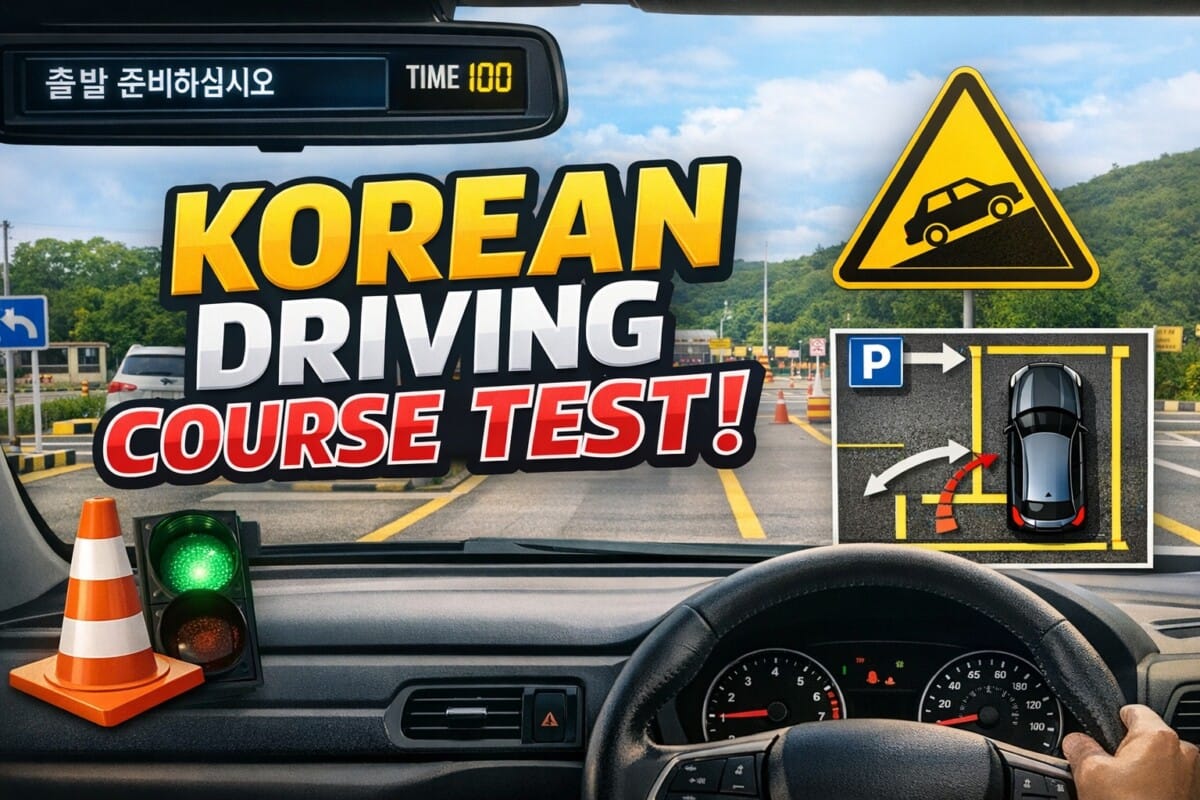
If you read Getting a Driver’s License in Korea: My Wife’s ExperiencePart 1, you know that I had already completed the safety lecture and the written theory exam. Once you have the theory test taken care of, you can then get started with the driving part.
This brings us to The Korean driving test (practical portion).
To be specific, this part is actually divided into two distinct phases:
- The Course Test (Step 3)
- The Road Test (Step 4)
Here is exactly how I navigated both, dealing with “T-Parking” and the road routes around Anyang to finally pass my Korean driving test.
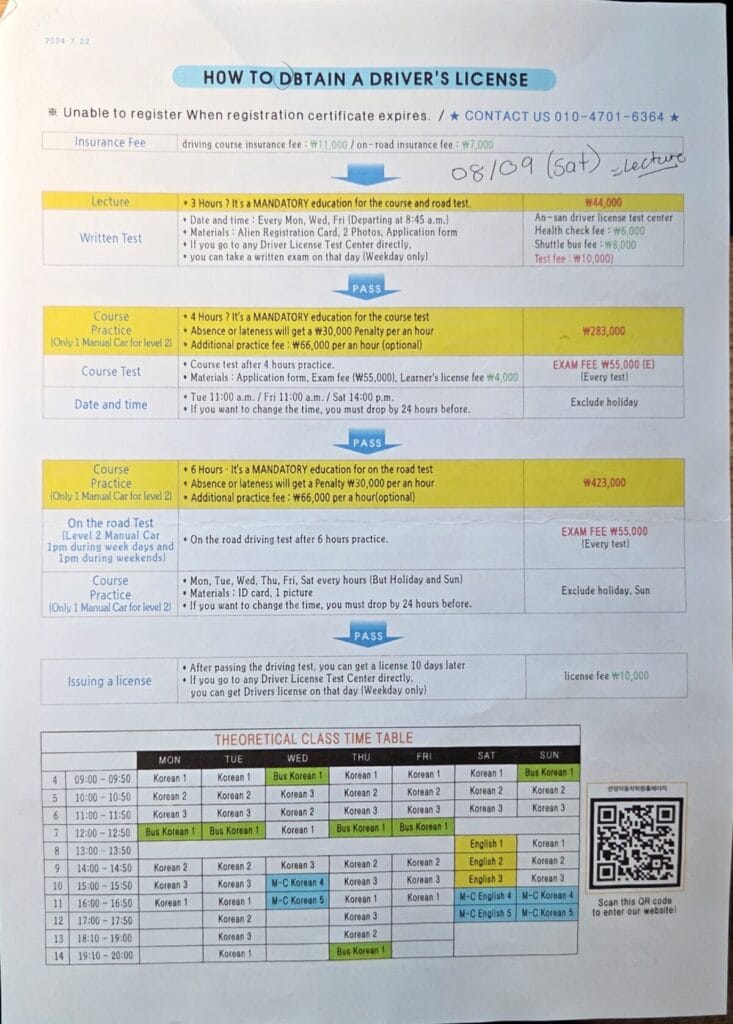
Step 3: Preparing for the Course Test
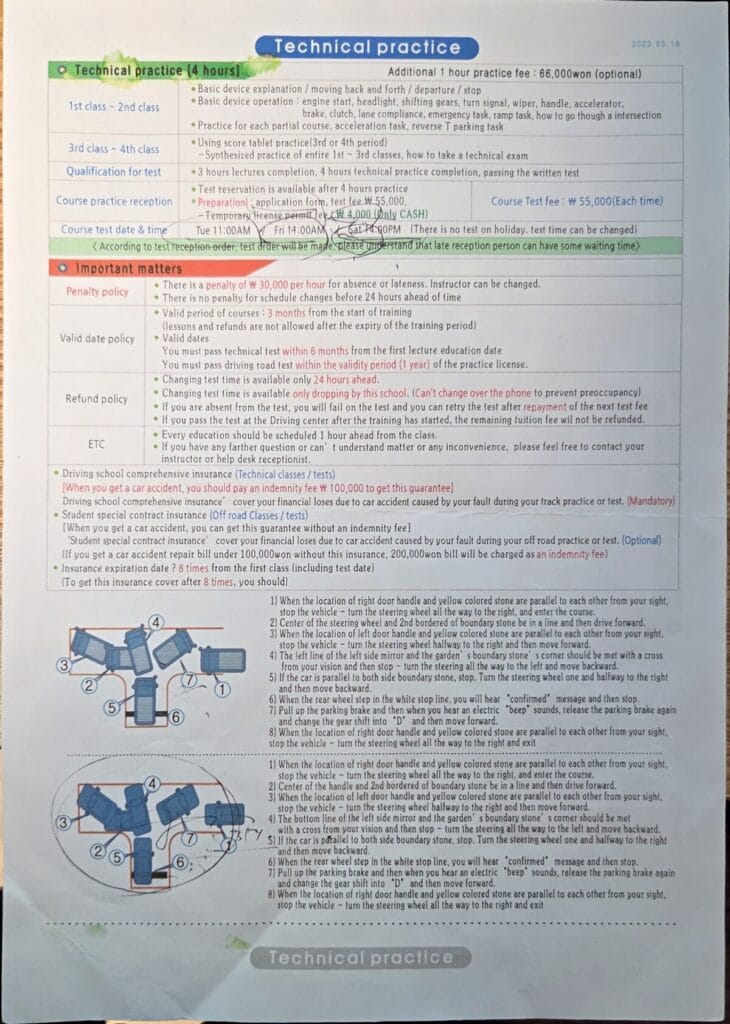
As I mentioned earlier, Step 3 is preparing for the Course Test. This is a driving exam held in a designated closed-circuit area within the school grounds.
It tests specific technical skills needed for the Korean driving test, such as:
- Hill starts (stopping and going on a slope).
- Staying strictly within the yellow lines.
- Using your indicators correctly.
- T-parking.
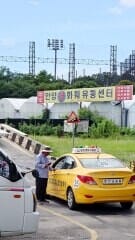
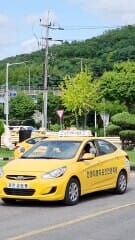
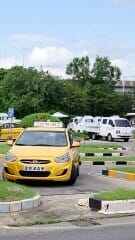
My Secret Weapon: YouTube
If you sign up for the Anyang Driving School, I highly recommend watching the school’s official YouTube video. It shows the exact course layout at Anyang and explains exactly what is scored on this part of the Korean driving test.
If the video does not load, you can watch it directly on YouTube here .
This video explains how the Korean driver’s license course test works.
Watching this multiple times before my first class was incredibly helpful. It allowed me to start memorizing the course map and the steps required to pass before I even sat in the car. Because the Korean driving test is so procedural, understanding the general layout of the course helped me to feel more confident while driving.
The Mandatory Course Practice (4 Hours)
You are required to take a mandatory 4 hours of course practice. You can do this all in one day or split the four hours between two days. I chose to split it over two days (2 hours per day) because I hadn’t driven in awhile and did not want to exhaust myself.
Day 1 of Practice: On the first day, I used my Student Card to clock in a few minutes before my class time and received a ticket.
I’m not sure how driving lessons went for other students, but my instructor asked if I had any driving experience at the start of the lesson. I said “Yes.” Hearing that, he basically drove the car out of the parking area, stopped, and told me to switch to the driver’s seat.
I started driving along the course slowly. My instructor realized pretty quickly that I could actually handle a car and understood the layout (thanks to the YouTube video!), so he told me to go directly to the starting point. We immediately jumped into a mock version of the practical Korean driving test.
Understanding the “Computer” Scoring System
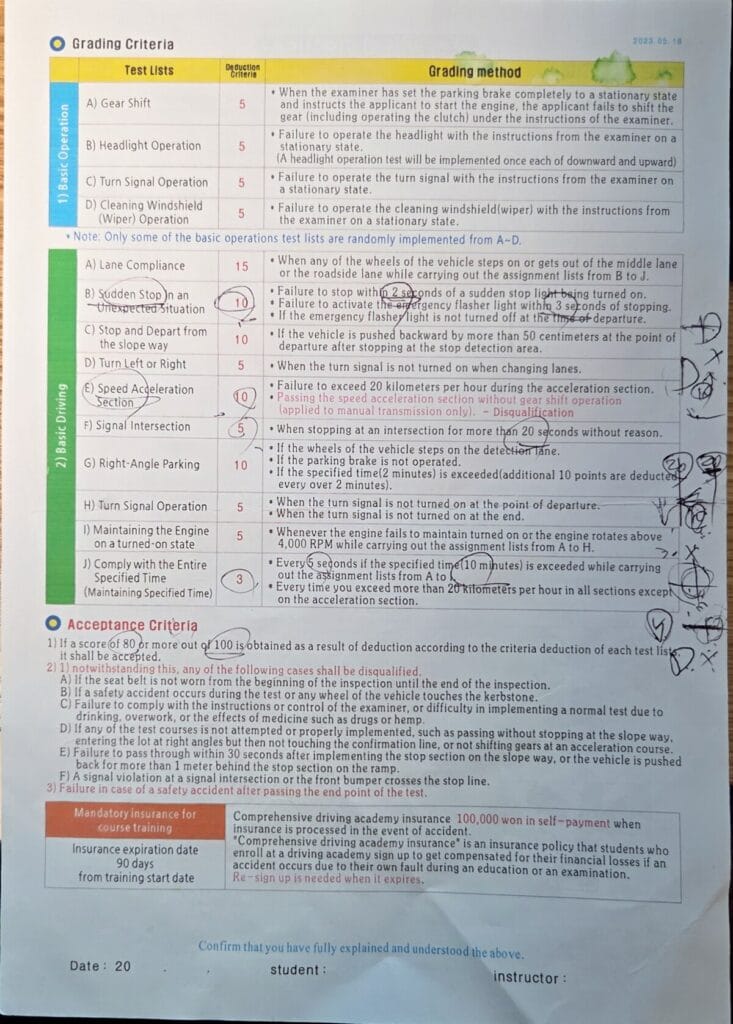
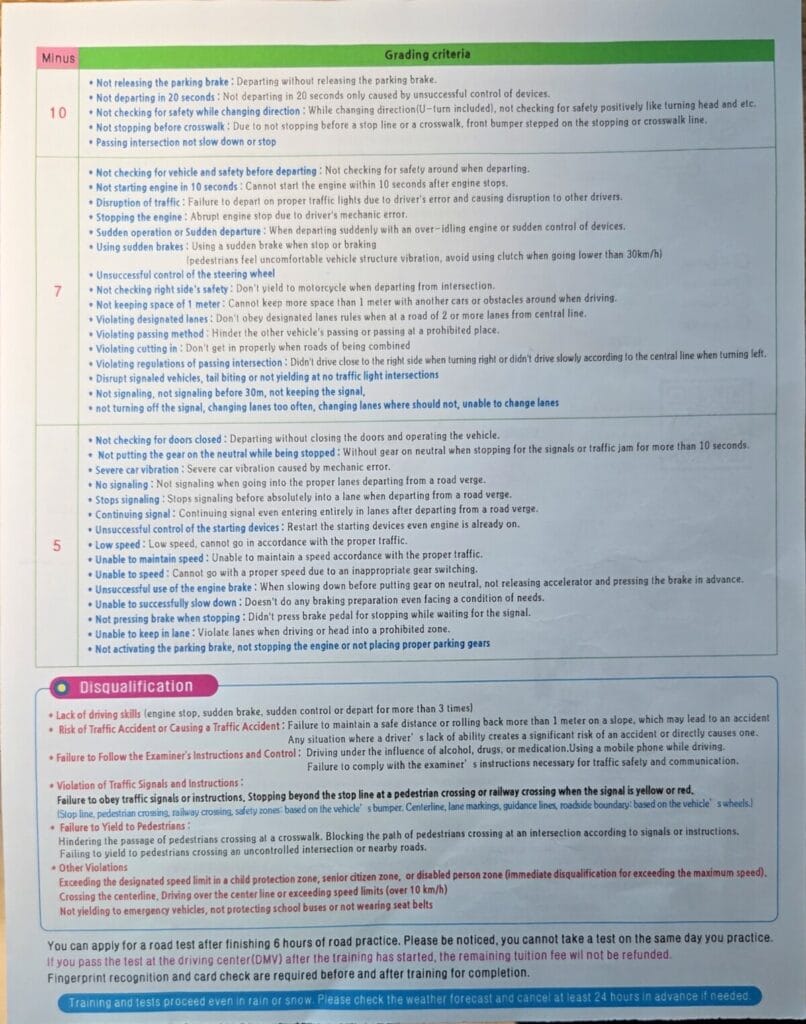
Here is a crucial detail about the Korean driving test: You will be alone in the car during the test and you are given instructions via a tablet computer attached to the dashboard.
- Starting Score: 100 points.
- Passing Score: 80 points or more.
- The Catch: For every action you fail to do correctly or fail to do within the designated time, points are automatically deducted. Or in some cases, some actions lead to automatic failure.
Different actions have different point values, which your instructor will explain to you verbally and with handouts. (And yes, you can set the test language to English!)
It’s Not About Driving, It’s About Timing
As I mentioned in my previous post, the Korean driving test does not really test your driving ability. The Course Test is the perfect example of this.
When you initially start the engine, the computer will instruct you to do roughly three stationary actions before you even move the car.
- Example: “Switch the indicator on and off.”
- Example: “Switch the windscreen wipers on and off.”
- Example: “Turn on high beams.”
You must complete these actions within a specific number of seconds. If you don’t do them by the time limit, you lose points immediately before the car has even moved. So, passing the Korean driving test is mostly about listening to the instruction and timing your action.
Mastering the T-Parking Formula
On my first day, I went through the course about 3 times total.
- Class Structure: 50 minutes of driving, followed by a 10-minute break.
I pretty much understood the general driving track in my first hour, but my instructor left the T-parking section for the second hour.
We spent almost the entire second hour just practicing T-parking. Again, regarding T-parking, the instructor didn’t really teach me how to drive a car. Instead, he helped me memorize a “formula.” He taught me the specific timing of when to turn the wheel and which landmarks (like a specific rock or yellow line) to look at to align the car perfectly.
At Anyang Driving School, there are four T-parking spots. During the test, you can choose any of the four. Warning: T-parking is timed. If you take too long, or if you cross a yellow line, it can lead to an automatic failure on your Korean driving test.
By Day 2 of my practice, I was confident. I had memorized the exact actions and landmarks needed to do a clean T-parking. So, I booked my official Course Test for the very next day.
Note: If you are less experienced with driving or feel nervous, you can book additional practice hours (for a fee) before signing up for the test.
Taking the Course Test
I booked my test for 2:00 PM on a Saturday. (If I am not mistaken, Course Tests at Anyang were held on Tuesdays, Fridays, and Saturdays).
There were quite a few people taking the test that day. We all waited until our names were called. When it was my turn, I handed over my ARC, and the staff had a car ready at the starting line.
I completed the course exactly as I did during my practice lessons.
- I listened to the computer.
- I hit my marks on the T-park.
- I finished with full points.
Success! At this school, you have to pass the Course Test within 6 months of your last practice session. After parking the car, I collected my ARC and went to the reception. They stamped my application form, and I paid 4,000 won (cash) for a “Learner’s License.”
Note: The school kept my application form, saying they would return it after I completed the final Road Test.
Step 4: Preparing for the Road Test
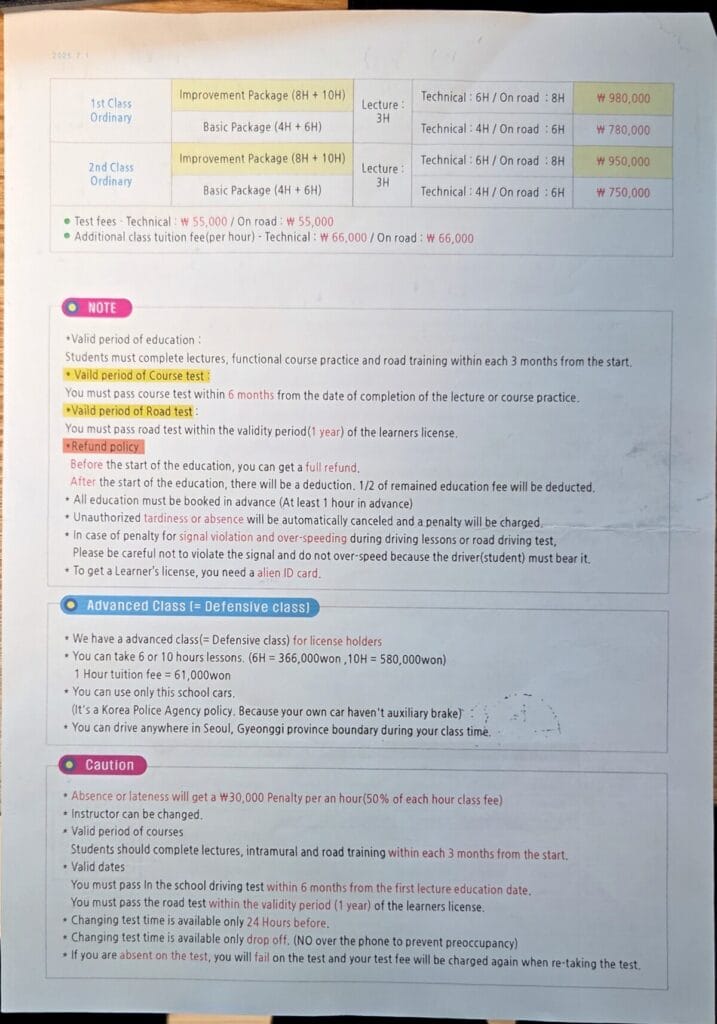
Now that I had my Learner’s License, I moved on to the final step of the Korean driving test. For this step, it is necessary to have six hours of mandatory practice before taking the exam.
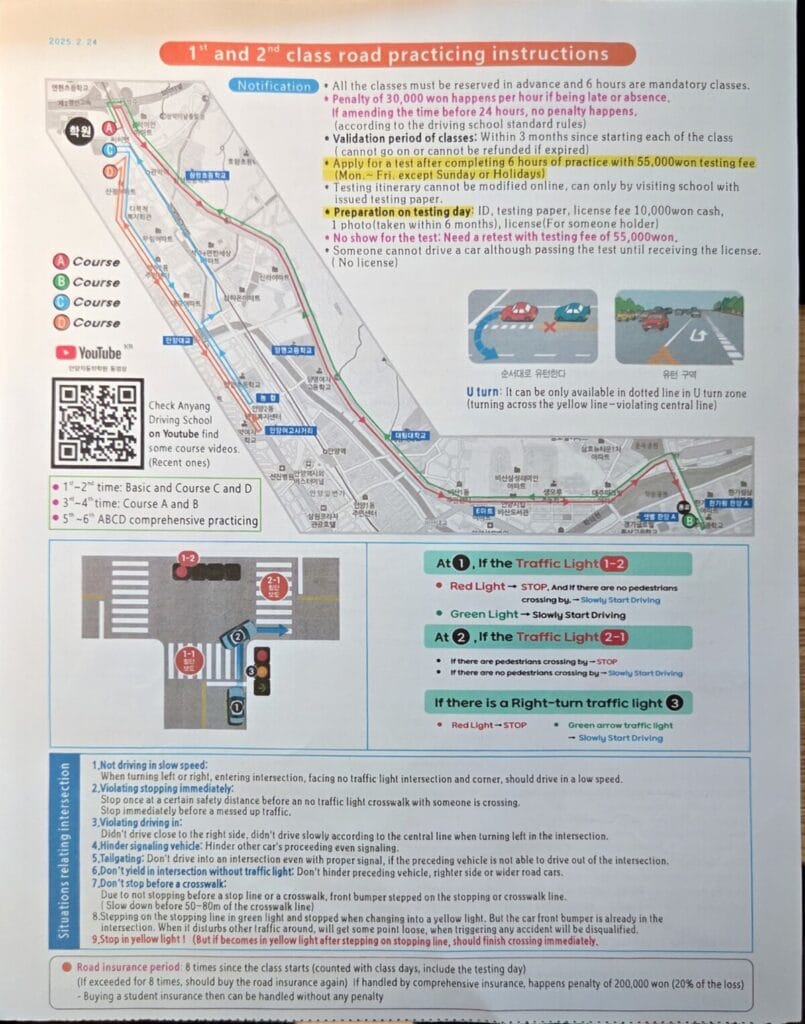
Just like before, I went back to YouTube. For Anyang Driving School, the road test consists of a pool of four specified routes (A, B, C, and D) around the neighborhood.
- Route D: The simplest and shortest. Routes C, A and B in order of difficulty.
- Time: The four routes take anywhere from 12 to 20 minutes.
You can watch the route videos here:
If the video does not load, you can watch it directly on YouTube here .
This video explains how the Korean driver’s license road exam works.
Before my first class, I watched all four videos. I spent a little extra time on Routes C and D because I knew we would be practicing those on Day 1.
The Road Practice Sessions
My six hours were split over three days.
- Day 1: Routes C and D.
- Day 2: Routes A and B.
- Day 3: Review of my choice (I asked to practice all of them again).
FYI: I had a different instructor each day. Some were better than others, but overall I had no major issues.
To start the lesson, the instructor switches on the dashboard tablet to “Mock Test Mode.” Just like the Course Test, the computer gives you instructions. However, this time it acts more like a GPS navigation system (“Turn right in 300 meters”).
The “Lane Strategy”
While following the computer’s GPS instructions, my instructor coached me on which lane to be in at certain points on the route. At first, I thought it was a legal requirement to be in specific lanes for the Korean driving test. Actually, the instructors were just trying to put me in the best position for a change in route.
The hardest part of the road test? Trying to remember which lane your instructor recommended for every specific section of all four routes.
The first day felt overwhelming, but by the end of Day 2, after practicing A and B, I felt comfortable. On Day 3, I did one final run-through of all the routes and booked my Road Test for the next day.
Taking the Road Test
The day of the test arrived. As always, I brought my ARC.
When my name was called, I walked out to the car with one other person:
- The Invigilator: Sitting in the passenger seat.
- The Observer: Another student taking the test, sitting in the back.
The Observer Rule: This is a strict requirement for the Korean driving test. Even if you are the first person to drive, you cannot leave after you finish. You must switch seats and sit in the back to observe the next person’s test.
In my case, the invigilator told us we would be doing Route C and Route D. We actually got to choose who did which route! I opted for D, and the other student took C.
The Result
I took my test second. I started the test following the computer’s voice instructions as I did during my driving lessons. The invigilator gave me one or two instructions when necessary as well. Upon completion of my route the invigilator let me know I had passed.
I went back to the reception, and they gave me two options:
- Collect my license from the driving school after 10 days.
- Collect it myself from the official government Driver’s License Test Center after 48 hours.
Final Thoughts on the Korean Driving Test
Overall, the process was very manageable. Doing a bit of research in advance and watching the Youtube videos was extremely helpful.
If I had to give advice to anyone looking to pass the practical Korean driving test, it would be this:
- Join an English-friendly driving school. It helps immensely with organizing the tests and paperwork.
- Use the Apps. Don’t buy books for the written test; just use the free apps.
- YouTube. Watch the videos associated with your specific driving school. Memorizing the course and the road routes before you get in the car makes the Korean driving test feel much easier.
Safe driving, everyone!
If you are looking for a complete overview of navigating the roads here, check out my Complete Guide to Driving in Korea for Expats.
Arriving in Korea soon?
Don’t navigate your first day alone
I meet you at Incheon or Gimpo airport and guide you through everything — SIM card, T-money, transport, and getting to your accommodation. Personal support from $180.
Book arrival support →