📌 Quick Summary:
Kimjang (김장) is the Korean tradition of making large batches of winter kimchi as a family or community — usually late November to early December. This is not a 2-hour cooking class. It is a full day of physical labor, precise timing, and deeply satisfying payoff. Here is what it actually looks like inside a real Korean farming family’s kimjang weekend.
- → What Is Kimjang and Why Does It Matter?
- → The Setup: A Countryside Warehouse and a Family Farm
- → Kimchi Ingredients: Korea’s Winter Preparation Starts Months Before
- → The Work: What Kimjang Day Actually Feels Like
- → How Much Kimchi Does a Korean Family Make?
- → The Real Reward: Suyuk, Soju, and Uninvited Neighbors
- → Kimjang as a Multicultural Family Tradition in Korea
- → Can Foreigners Participate in Kimjang?
- → Frequently Asked Questions
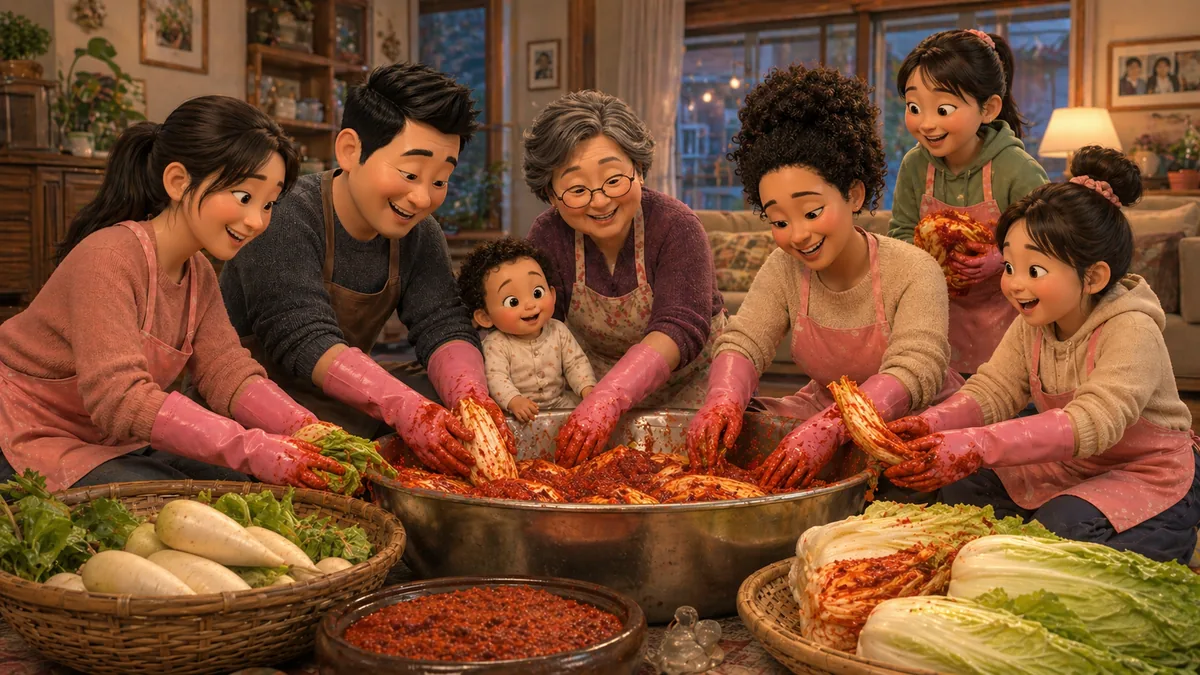
By 9am, the warehouse next to my parents’ farmhouse already looked like a small factory had moved in overnight. Buckets everywhere. Napa cabbage soaking in salt water from the night before. The smell — cold air mixed with salt and raw baechu (배추) — hits you before you even step inside. This is kimjang kimchi family tradition expat korea in its most honest form: not a cooking class, not a festival booth, but a full day of work inside a panel-wall building in the Korean countryside, making enough kimchi to feed three households for an entire year. As we navigate having a baby in Korea as a multicultural family, participating in kimjang feels like handing our daughter something that cannot be bought or replicated — her Korean heritage, made with her grandparents’ own hands.
What Is Kimjang and Why Does It Matter?
Kimjang (김장) is the Korean tradition of making large quantities of kimchi before winter sets in. Not a jar or two. We are talking about enough kimchi to last an entire household — sometimes multiple households — through the cold months ahead.
In 2013, UNESCO inscribed kimjang on its Representative List of Intangible Cultural Heritage of Humanity, recognizing it not just as food preparation but as a communal act of cooperation, sharing, and cultural identity. That recognition matters — but it does not fully explain what the day actually feels like on the ground.
The timing follows the Korean seasonal calendar. Kimjang traditionally begins around ipdong — the start of winter — which falls in early November. Most families execute their kimjang from late November through early December, when temperatures are cold enough to slow fermentation and keep freshly made kimchi from spoiling. Families in the southern regions of Korea tend to start slightly earlier than those in the north, where winter arrives later.
💡 Pro Tip:
Watch the weather, not the calendar. Korean families — especially farmers — time kimjang based on actual temperature drops, not a fixed date. If there is a warm spell in late November, experienced kimjang makers will wait. The cold is not just tradition. It is food science.
The Setup: A Countryside Warehouse and a Family Farm
My parents live in the countryside. My father is a farmer. That context shapes everything about our kimjang.
We do not make kimchi in an apartment kitchen. We use a warehouse adjacent to their house — a practical, no-frills structure built with insulated panels rather than brick and mortar. It keeps out the worst of the cold but not all of it. Inside: farming tools, dried vegetables hanging from beams, Korean porcelain stacked in corners, and the general organized chaos of a working farm that has been running for decades. This is not a staged, photogenic space. It is a real working environment.
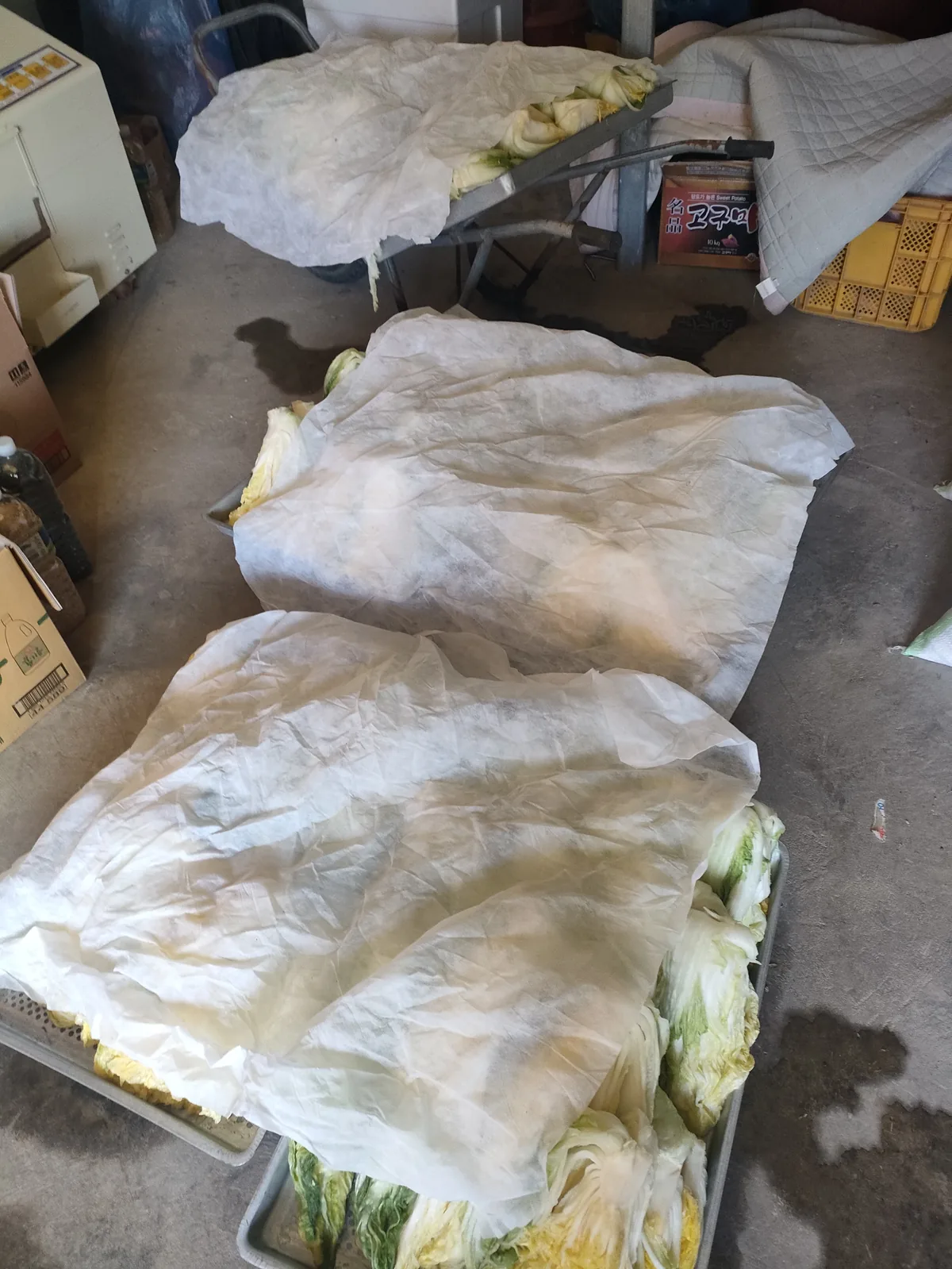
The cabbage is salted the night before. By the time we arrive the next morning, there are already rows of baechu sitting in heavy salt water, turning slowly limp under white cloth. Buckets of salted radish wait nearby. The groundwork for a full day of labor is already done — and the day has not even started.
Kimchi Ingredients: Korea’s Winter Preparation Starts Months Before
One of the biggest misconceptions about kimjang is that it begins the day you start mixing. For families who grow their own produce, the preparation starts in spring.
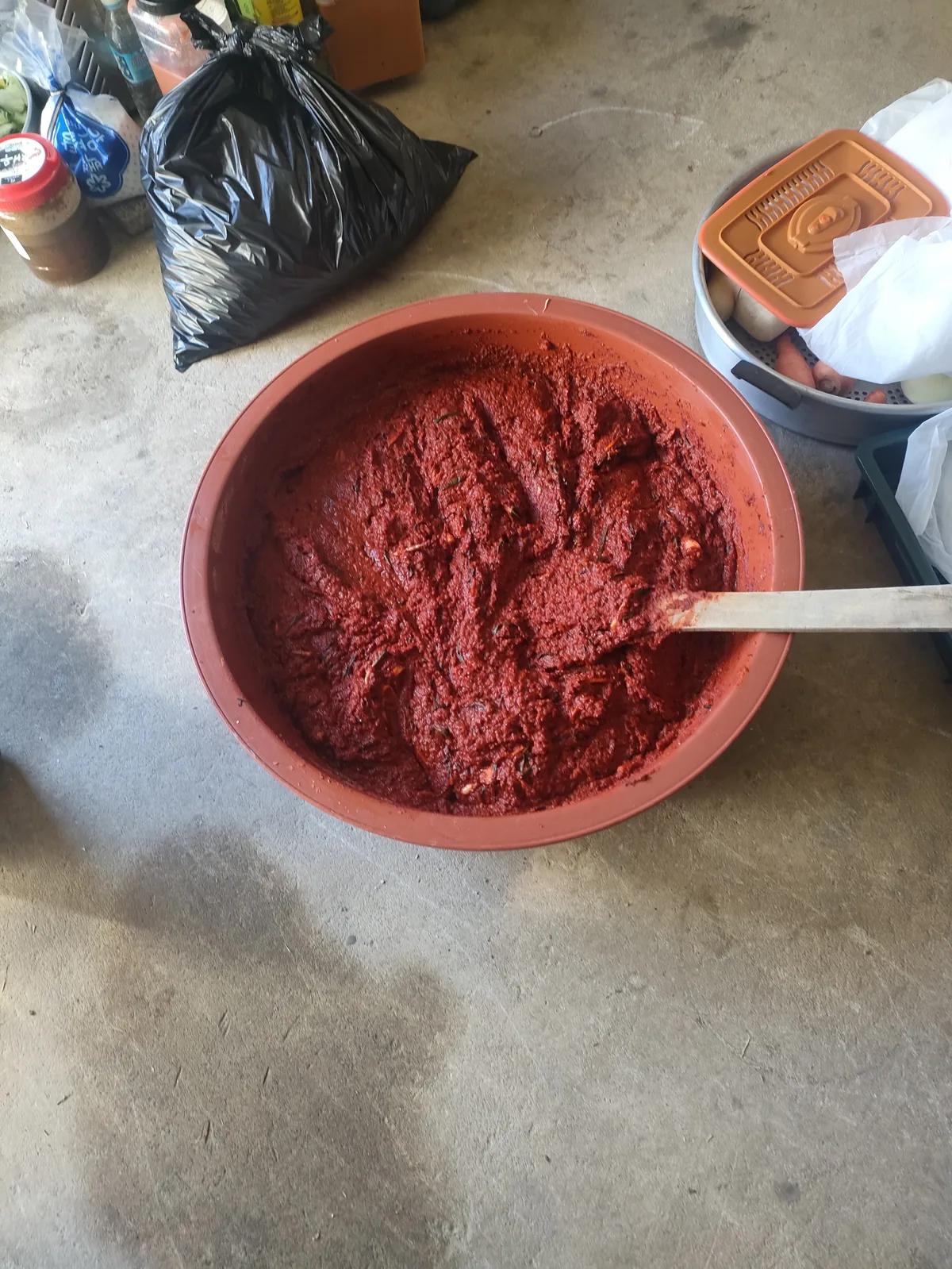
My parents grow their own baechu (배추), radish, spring onion, garlic, and chili on their farm. The chili peppers are harvested earlier in the year, dried, and ground into powder by my mother — not bought from a supermarket shelf. On kimjang day, she makes the seasoning paste from scratch: gochugaru (red pepper flakes), garlic, ginger, jeotgal (젓갈 — salted fermented seafood), and fish sauce. She makes a batch, distributes small tastes to whoever is nearby, listens to the feedback — more salt, more chili, a little more fish sauce — and adjusts. There is no written recipe. There is decades of experience and family consensus.
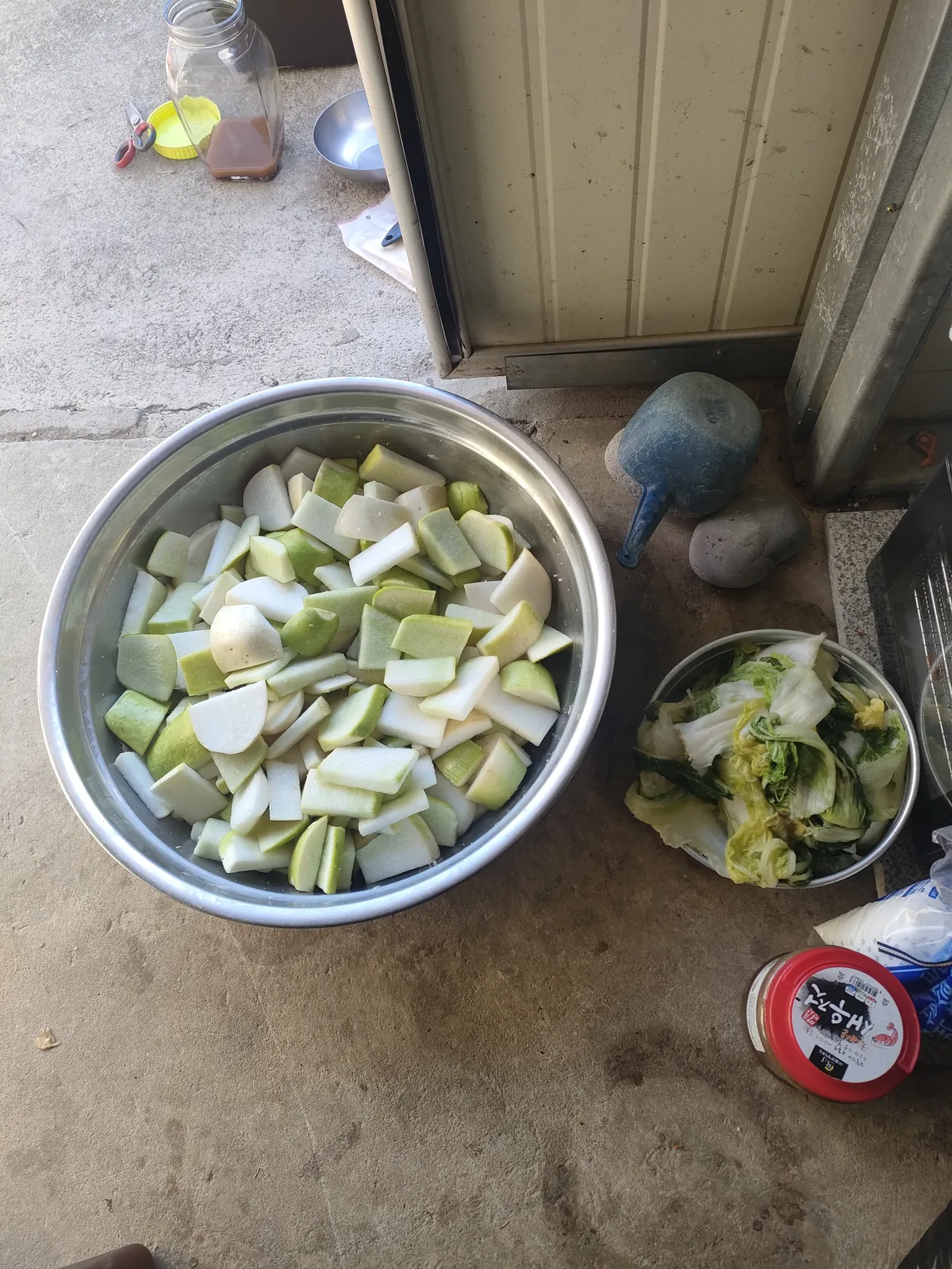
For expats or families without access to a farm, the ingredients are widely available at Korean supermarkets and traditional markets in autumn. As a reference point, a modern pre-packaged 10.5kg kimjang kit from organized suppliers was priced at around 75,000 KRW as of November 2025 — useful if you want a benchmark, but that price does not include the labor, the space, or the gomujanggap (고무장갑 — heavy-duty rubber gloves) you will absolutely need.
💡 Pro Tip:
Kimjang is often misunderstood as a budget move — a way to save money on kimchi by making your own. The reality is different. When you factor in quality gochugaru, fresh jeotgal, and the sheer amount of garlic involved, homemade kimjang is an investment in quality and tradition. Not a grocery hack.
The Work: What Kimjang Day Actually Feels Like
We start around 9am after breakfast. There is a correct way to approach kimjang day: properly fed, properly dressed, with no illusions about how the next several hours are going to go.
The core work is mixing the seasoning paste into the salted cabbage leaves — coating every layer, every fold. The paste is a watery, intensely red mixture that gets everywhere. Even with proper long-sleeved gomujanggap on both arms, by midday the paste has found its way onto your clothes, your face, and somehow the back of your neck. It is not anyone’s fault specifically. It is the person next to you, the person carrying the sauce bucket, and also entirely your own fault. It just happens.
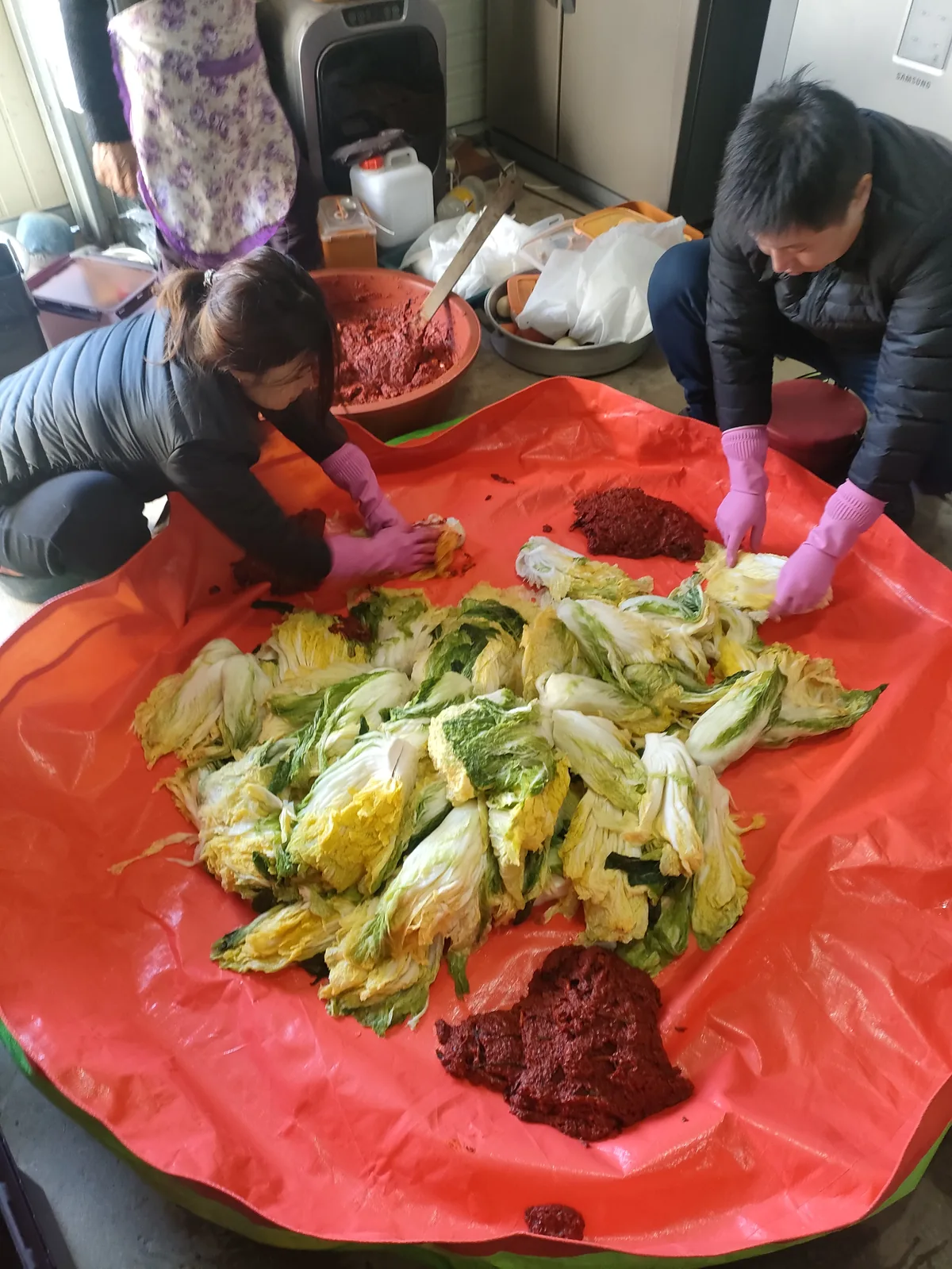
The physical reality is harder than it looks. You are squatting or sitting on cold concrete for stretches of three to four hours at a time. A small cushion is your only defense against the floor. You are moving — standing to carry buckets, sitting to mix, standing again to pack the finished kimchi into containers. By the afternoon, your back knows exactly what you have been doing all day.
My second oldest sister and her family came. My oldest sister runs her own business and could not leave the shop, so we made her share too, packing it up for delivery later. That is how kimjang works in a real family — you account for people who cannot be there. Nobody is left out of the year’s supply.
How Much Kimchi Does a Korean Family Make?
Enough to fill a kimchi fridge — and then some.
Korean homes typically have two refrigerators: a standard fridge and a dedicated kimchi fridge (김치냉장고). The kimchi fridge maintains the precise temperature and humidity that slows fermentation and keeps kimchi at peak quality for months. Our kimjang produces enough to fill large purpose-built containers that go directly into that fridge.
We are making kimchi for three households: my family in Hwaseong, my second sister’s family, and a delivery to my oldest sister in Seoul. The scale of what that requires — in cabbage weight, in sauce volume, in physical container space — is something you genuinely cannot picture until you are standing in front of it.
💡 Pro Tip:
A proper kimchi fridge is not optional for long-term storage — it is the difference between kimchi that ferments correctly over winter and kimchi that goes wrong. If you are renting an apartment in Korea, consider to buy it. 2 firdges in the house, one for general purpose, one for only kimchi.
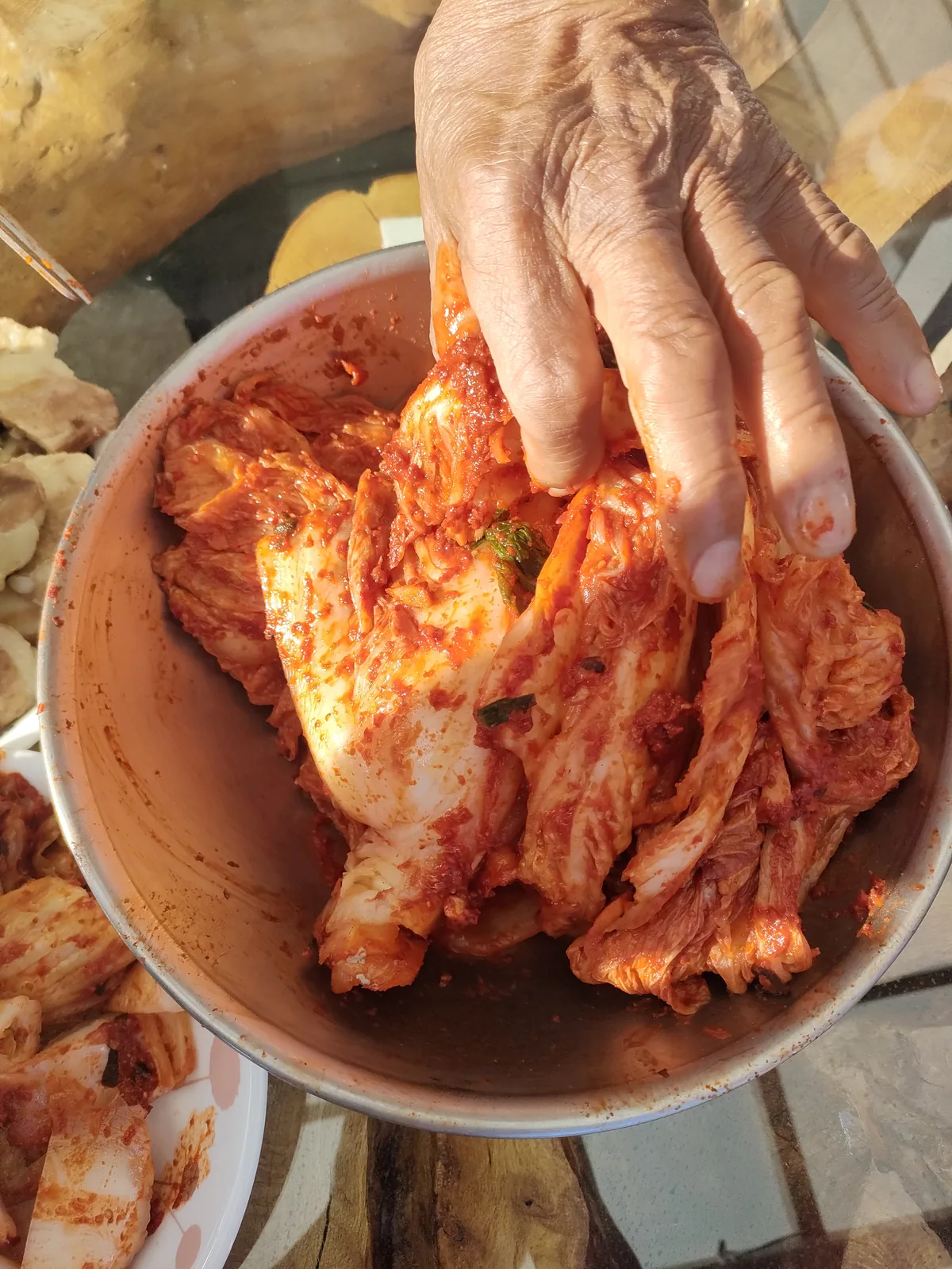
The Real Reward: Suyuk, Soju, and Uninvited Neighbors
At some point during the day, work pauses. Someone brings out the suyuk (수육).
Suyuk — boiled pork belly, sliced thick — is the traditional kimjang day meal. It is made specifically for the occasion. I bought the meat that year. My father looked at the amount and said it would not be enough. I did not understand why. Then the neighbors arrived.
Six to eight people, not all at once. In the countryside, this is normal. Someone passes by, sees the activity, stops in. Another neighbor arrives carrying vegetables to share. They join the table, eat, drink, talk, and leave after a while. Then another group arrives. It is slightly chaotic and entirely warm. My father is well-known in his small community. Of course there would not be enough meat.
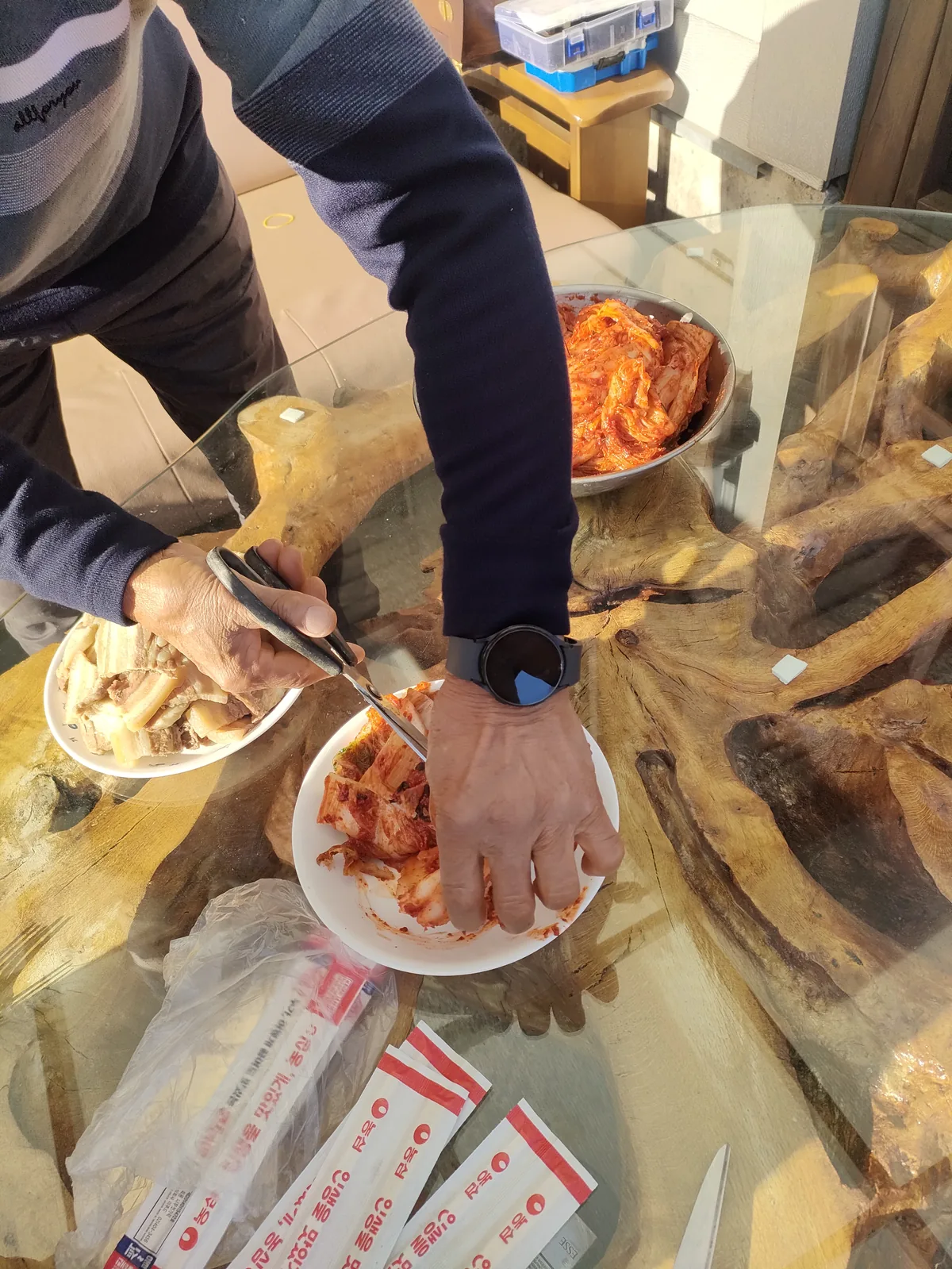
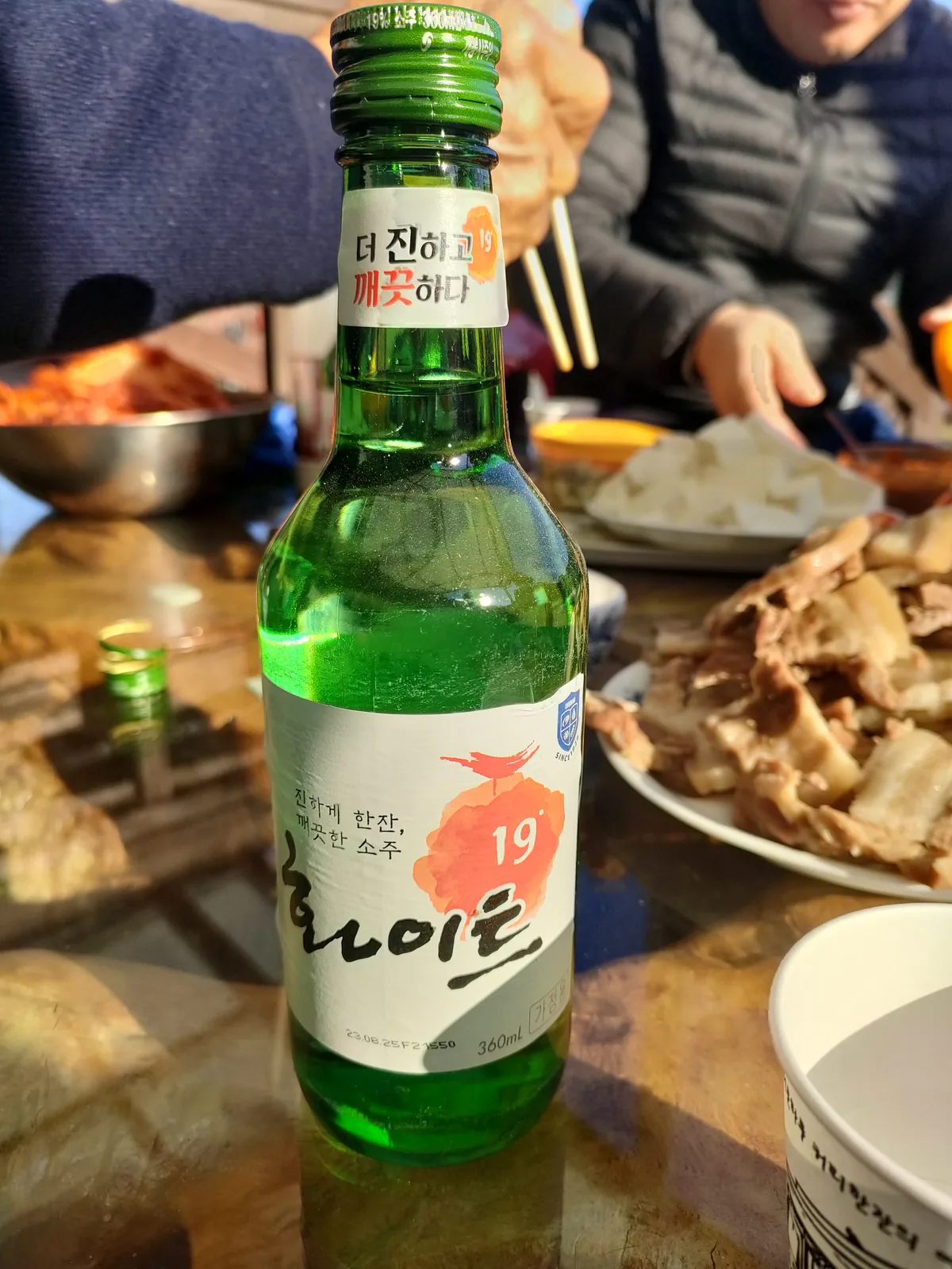
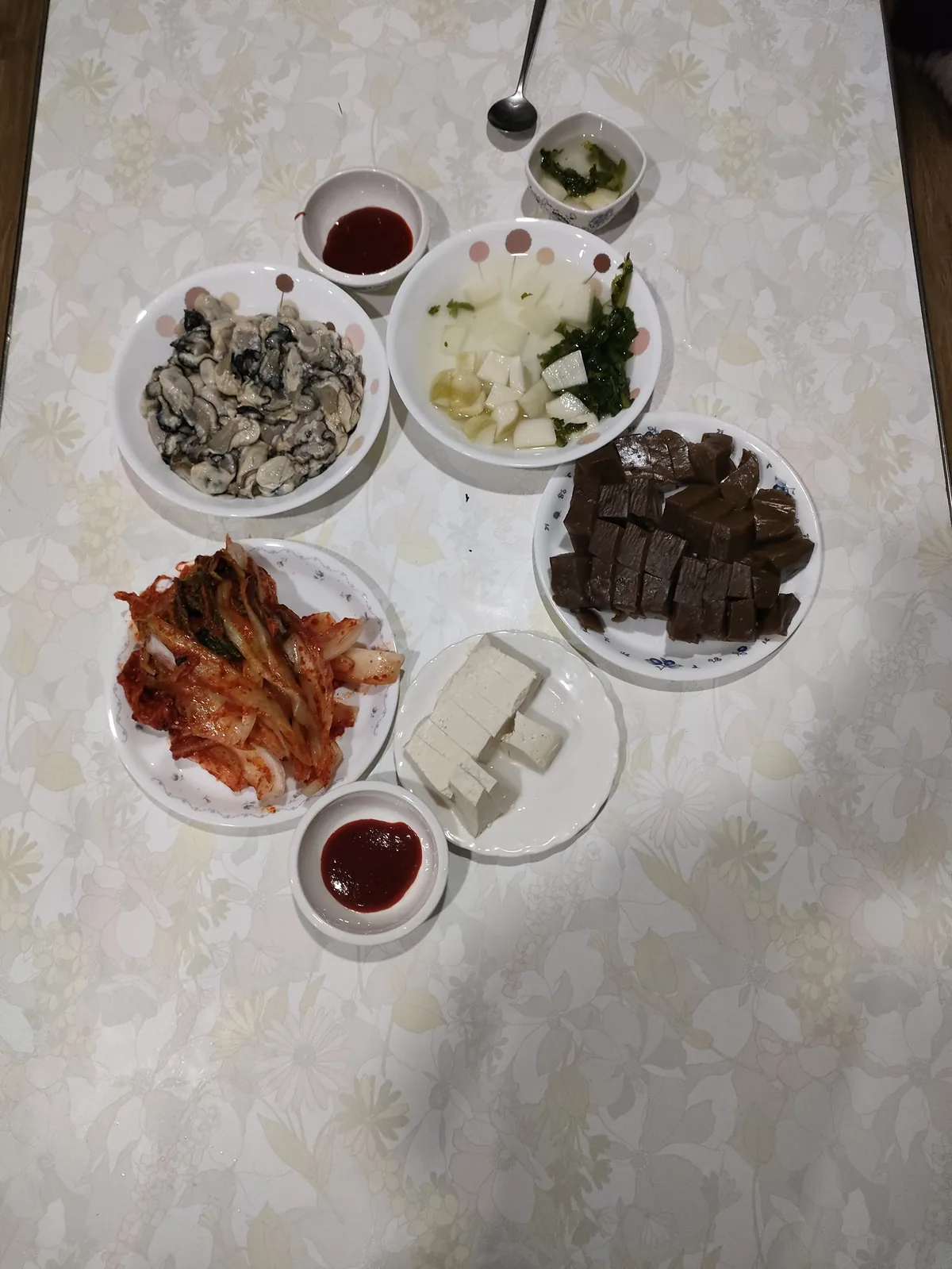
The table also had homemade tofu, fresh oysters, and dotorimuk (도토리묵 — acorn jelly). Soju and makgeolli were present, as they should be. The freshly made kimchi — still raw, bright, and intensely flavored — was the best side dish on the table by a significant margin. This is the version of kimchi that supermarket packaging cannot replicate. Not because the ingredients are different, but because of everything that happened before it ended up on the plate.
💡 Pro Tip:
Freshly made kimjang kimchi eaten on the same day is a completely different experience from aged kimchi. It is bright, crunchy, intensely seasoned, and has none of the sourness that develops during fermentation. If you ever get an invitation to a kimjang day, do not skip the meal. That moment at the table is the whole point.
Kimjang as a Multicultural Family Tradition in Korea
My wife was not at this kimjang. Our daughter was born in July 2025 — too small to travel to the countryside in early December. So my wife stayed home with the baby, and I worked for three people: my share, my wife’s share, and whatever our daughter will eat in future years when she is old enough.
There is something clarifying about that. You carry the containers home and put them in the fridge and think: this is ours. My wife loves kimchi — especially knowing it came from her in-laws’ farm, made with ingredients they grew themselves. Our daughter cannot eat it yet. But I have no doubt she will love it. Just as families across Korea gather for Seollal and other deep-rooted communal traditions, kimjang is one of those events that quietly holds a family together across distance and generations.
When I was a child, this was ordinary. We lived together, ate together, made kimchi together every year without thinking much about it. Now I live in an apartment in Hwaseong, far from my parents’ farm. The distance makes kimjang feel less like an obligation and more like something rare. In a modern life where even close families struggle to find reasons to spend a full day together, kimjang provides one.
Can Foreigners Participate in Kimjang?
Realistically, there are two paths.
The first is structured kimchi-making events — short workshops run by community centers, cultural organizations, or tourism programs around November and December. These are accessible, beginner-friendly, and a perfectly good introduction to the process. They are not a real kimjang. You will make a small batch, learn the basics, and go home with a jar. That is still valuable.
The second path — a genuine, full-scale family kimjang — requires an invitation. There is no ticket to buy. You need a Korean friend or family member who is doing their own kimjang and willing to bring you in. If you have that connection, ask. Most Korean families would be genuinely pleased to have an interested foreigner join. Show up on time, wear clothes you do not mind ruining, bring extra rubber gloves, and be prepared to work a full day. The meal at the end is worth every hour of it.
The Korea Tourism Organization lists seasonal cultural events including kimjang festivals in regions like Pyeongtaek and Jeonju — these are a reasonable starting point if you do not yet have a local connection.
❓ Frequently Asked Questions
What is kimjang and why is it important in Korean culture?
Kimjang (김장) is the Korean tradition of making large quantities of kimchi before winter to last a household through the cold months. It is a communal, multi-generational event — not just cooking. UNESCO recognized kimjang as Intangible Cultural Heritage in 2013 because of its role in strengthening community bonds, sharing food across social classes, and preserving cultural identity. For many Korean families, it is one of the few occasions in modern life that reliably brings everyone together for a full day.
How does a multicultural family do kimjang in Korea?
In our case, the Korean side of the family leads the process — the recipe, the timing, the technique — while the non-Korean family members participate in the physical work. Our kimjang kimchi family tradition as an expat family in Korea is not a modified or simplified version. It is the full process, at a Korean farming family’s home, using self-grown ingredients. The multicultural element is not about adapting the tradition — it is about passing it on intact to the next generation.
How much kimchi does a Korean family make for winter?
It depends on household size and whether they are making for multiple families, but a typical kimjang produces enough to fill one or more large kimchi-fridge containers — enough for a year’s supply. Our kimjang covers three households. As a rough commercial benchmark, a 10.5kg pre-packaged kimjang kit cost around 75,000 KRW in November 2025 — but a real family kimjang runs significantly larger than that in both volume and effort.
What ingredients do you need for kimjang kimchi?
The core ingredients are napa cabbage (baechu), Korean radish, spring onion, garlic, ginger, gochugaru (red pepper flakes), jeotgal (salted fermented seafood), and fish sauce. Salt is used heavily in the overnight cabbage-salting phase. Families who grow their own produce often add carrots and other seasonal vegetables. The exact ratios vary by family — there is no single correct recipe, and most experienced kimjang makers adjust by taste on the day.
Can foreigners participate in kimjang in Korea?
Yes — but the realistic paths are different. Short kimchi-making workshops run by cultural centers are accessible year-round and a good introduction. A real family kimjang requires a personal invitation from a Korean family or friend. If you have that connection, ask directly — most families will welcome a willing participant. Come ready to work a full day, dress for mess, and bring your own rubber gloves.
For those interested in expanding their Korean cooking repertoire beyond kimchi, there is also a related guide on preparing fresh abalone for homemade miyeokguk that offers insight into another traditional Korean dish often prepared alongside seasonal family cooking traditions.
Navigating Korean Life Without a Family Farm to Fall Back On?
If everyday life in Korea — from bureaucratic paperwork to hospital visits to just figuring out where to buy what — feels like a maze, JustAskJin is here to help. Our concierge service exists specifically for foreigners who need practical, boots-on-the-ground support in Korea.
Get Help from JustAskJin