📌 Quick Summary:
Quitting a job in Korea sets off a chain of administrative deadlines most expats never see coming. You have two months to lock in your health insurance rate, a window to pause your pension payments, a May tax filing you must do yourself, and — depending on your visa — unemployment benefits that may not exist at all. Start by securing your documents from your company before you do anything else.
- → Step 0: Get Your Documents From Your Company First
- → Health Insurance After Resignation: Your Three Options
- → National Pension Payment Exemption Korea: How to Pause the 9%
- → Unemployment Benefits: What Your Visa Actually Allows
- → Comprehensive Income Tax Return Korea Foreigner: The May Filing
- → Frequently Asked Questions
The first thing most people think about when quitting a job in Korea is the resignation letter. The paperwork that follows — the health insurance deadline, the pension decision, the tax filing you have to do yourself — that part catches almost everyone off guard. If you also have family members covered under your employee insurance, like a spouse or a child, the urgency doubles immediately. Before you touch any government office or online portal, there is one thing you need to sort out first. You’ll also want to check your health insurance payment history in Korea so you have a clean record before your status changes.
Step 0: Get Your Documents From Your Company First
Before any government office, before any online form — secure your paperwork from your employer. This is the step nobody writes about, and it is the one that matters most.
You will need your employment certificate (재직증명서), your salary statements, and your resignation acceptance confirmation. Without these, you cannot apply for unemployment benefits, you cannot accurately calculate your pension exemption, and you may hit delays at every counter you visit.
If your company takes extra days to issue these after your last day, get a written promise with a date. Do not leave without that commitment. Everything else in this guide depends on having clean documentation in your hands.

Health Insurance After Resignation: Your Three Options
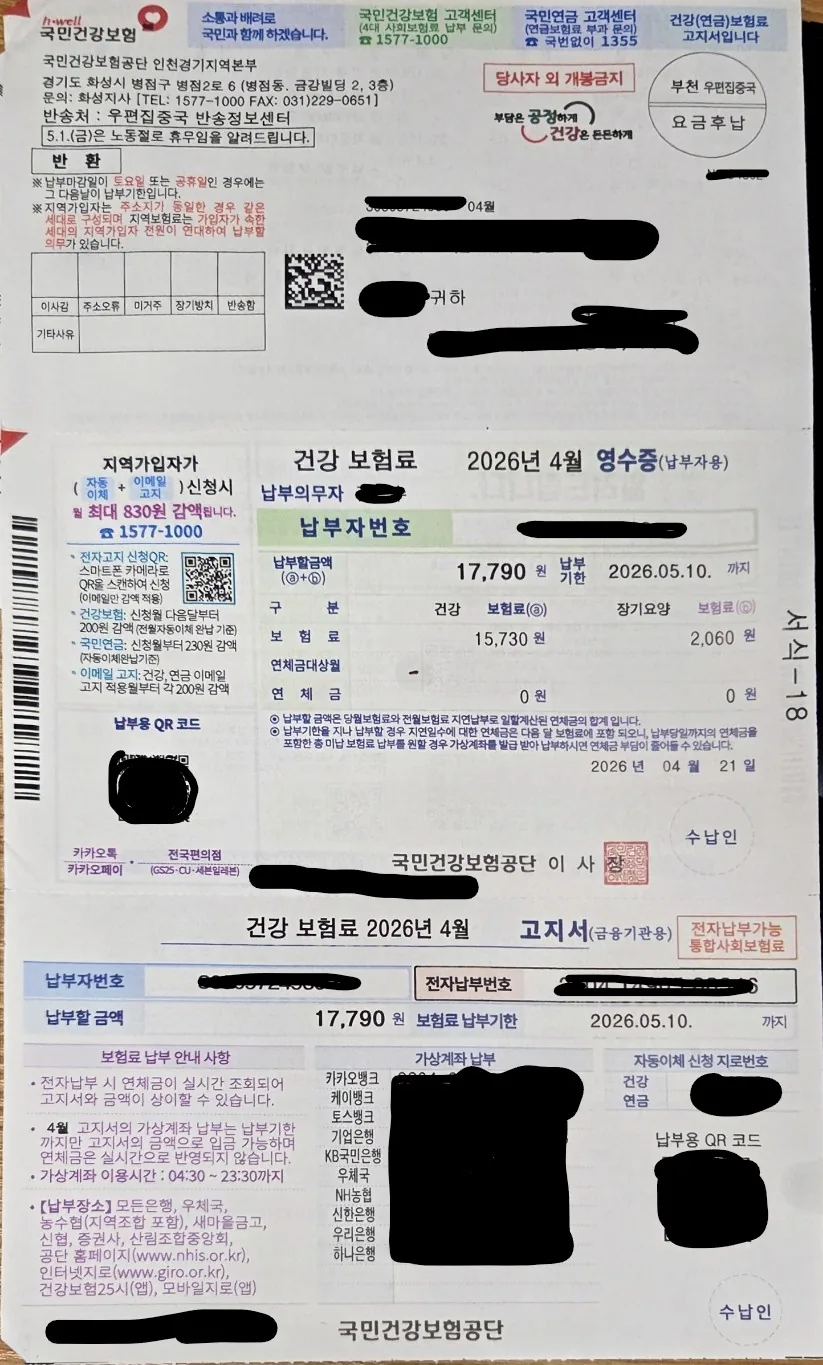
This is where most expats get an unpleasant surprise. The moment you leave your company, you become a 지역가입자 (jiyeok-gaipja) — Regional Subscriber. And regional subscriber rates are not calculated on your income alone.
The Korean government looks at your total assets: your apartment’s jeonse deposit, your car, your financial holdings. For many expats, that first bill arriving in the mail is significantly higher than anything they paid while employed. The National Health Insurance Service (NHIS) has adjusted the average regional subscriber flat rate upward for the 2024/2025 fiscal period, making this more urgent than ever.
💡 Pro Tip:
Do not ignore your first post-resignation health insurance bill. The two-month clock to lock in your previous rate starts from the payment deadline printed on that bill — not from your last day at work.
You have three realistic paths:
- Option 1 — Dependent Registration: If your spouse is employed in Korea, the cleanest solution is registering under their company’s national insurance. No separate premium for you. If you have children covered under your previous policy, they move with you under the employed spouse’s plan. For our family, this was the answer — my daughter’s regular hospital visits continue without interruption under her mother’s coverage.
- Option 2 — 임의계속가입 (imui-gyesok-gaip), the Voluntary Continuous Subscription System Korea: You apply to keep your previous employee insurance rate for up to three years. You must have maintained employee subscriber status for at least one cumulative year in the 18 months before resignation. You must apply within exactly two months of receiving your first regional insurance bill. Miss this window and it is permanently closed — no appeals, no exceptions.
- Option 3 — Pay the Regional Rate: The default if you do nothing. Compare the numbers before accepting this. For long-term foreign residents on E-1 through E-7, F-2, and F-4 visas, the government charges a flat rate based on the average Korean regional subscriber amount rather than assessing your individual assets.

To apply for the voluntary continuous subscription, visit your nearest National Health Insurance Corporation branch office or apply by phone, mail, or fax. Bring your resignation document and your first regional premium bill.
📍 National Health Insurance Corporation (국민건강보험공단)
Address: Find your nearest branch at the NHIS branch locator online — branches are in most major districts across Korea.
National Pension Payment Exemption Korea: How to Pause the 9%
While employed, you and your employer each paid 4.5% of your pre-tax salary into the National Pension. Once you resign, the National Pension Service (NPS) expects you to cover the full 9% yourself as a regional contributor. On a modest salary, that is a significant monthly drain with zero income coming in.
** Before you resign, understanding your rights as a foreign worker under Korean labor law will help you navigate post-employment obligations like health insurance transitions and pension claims.
Once you’ve submitted your resignation letter, one of the five most critical administrative steps after resigning is securing continuous health coverage—and registering as a dependent under a family member’s plan is often the fastest way to avoid a coverage gap.
If paying is genuinely difficult without income, you can apply for 납부예외 (napbu-yewae) — Payment Exemption. This pauses your contributions for up to three years. The catch: the exemption period does not count toward your total pension subscription years, which can reduce your eventual payout.
There is also the option to pay back the missed contributions later — either in a lump sum or installments — once income resumes. This is called 추후 납부 (subsequent payment), and it allows you to recover the lost contribution period if your financial situation improves.
💡 Pro Tip:
Do not apply for payment exemption automatically. If you are receiving unemployment benefits, check the 실업크레딧 (Unemployment Credit System) first — it may cover part of your pension contributions during unemployment at a much lower personal cost.
To apply for the exemption, visit your local National Pension Service branch, send an application by mail or fax, or use the National Pension app to fax the form. You need documentation confirming you have no current income.

Need help translating these pension application forms or figuring out which option fits your specific visa and income situation? JustAskJin can walk you through the paperwork step by step — get in touch here.
Unemployment Benefits: What Your Visa Actually Allows
Here is the misconception that costs expats the most: not all foreign workers in Korea are entitled to 실업급여 (sileop-geupyeo) — Unemployment Benefits — even if they paid taxes and were dismissed unfairly.
F-5, F-2, and F-6 visa holders are enrolled in Employment Insurance automatically, the same as Korean citizens. If you hold one of these visas and were paying in, you can claim benefits.
E-7 and F-4 visa holders are different. Enrollment in Employment Insurance is opt-in. If you did not explicitly choose to pay the premium during your employment, you are not covered — and you will receive nothing when you resign or are let go. Check your pay stubs now, before you leave, to confirm whether you were enrolled.
If you are eligible, the Worknet Employment Insurance portal sets a hard 12-month deadline from your resignation date to claim any benefits. After that, unpaid benefits expire permanently. The application process requires registering as a job seeker on Worknet, completing mandatory online training, and submitting in person at an Employment Welfare Plus Center within 14 days of finishing the training.

Comprehensive Income Tax Return Korea Foreigner: The May Filing
When you resign mid-year, your company’s HR processes a final tax settlement — but it is a stripped-down version. They use only the most basic legally required deductions. Your credit card spending history, medical bills, and education costs are not included. That means you almost certainly overpaid on your way out.
To claim that money back, you must file a 종합소득세 (jonghap-sodeukse) — Comprehensive Income Tax Return yourself. The window is May 1st to May 31st of the year following your resignation. If you do not file in that month, you lose those deductions permanently.
This applies if you were not re-employed by the end of the calendar year. If you started a new job and your new employer ran a year-end tax settlement, you may already be covered — but verify that the previous employer’s income was included in the calculation.
💡 Pro Tip:
Time any large credit card purchases or significant medical expenses before your official resignation date. The Korean tax system only allows deductions during the period you were actively employed and earning a salary. Spending after resignation does not qualify.
Foreign workers also have a unique option: apply a flat 19% tax rate to gross income for up to 20 years instead of using progressive Korean tax brackets. The trade-off is that you cannot claim any additional deductions under this flat rate. Check with the National Tax Service (NTS) English portal to determine which method works in your favour before filing.
If you have children and want to understand how dependent registration affects both your insurance and your tax situation, see our guide on pregnancy and family benefits available in Korea.
❓ Frequently Asked Questions
What happens to my National Health Insurance when I become a regional subscriber after quitting a job in Korea?
Your premium is recalculated based on your total assets — including your housing deposit and any vehicles you own — rather than just your income. For many expats, this means the regional health insurance premium in Korea is significantly higher than what they paid as an employee. Long-term foreign residents on most work visas are charged a flat rate based on the national average rather than individual asset assessment, but that flat rate was increased for the 2024/2025 period.
How do I apply for the Voluntary Continuous Subscription System Korea within the two-month deadline?
You must apply within exactly two months of the payment deadline printed on your first regional health insurance bill — not from your last day at work. Visit a National Health Insurance Corporation branch, or apply by phone, mail, or fax. You need to have been an employee subscriber for at least one cumulative year in the 18 months before resignation. Missing this deadline is final with no appeal process.
Are E-7 and F-4 visa holders eligible for unemployment benefits in Korea?
Only if they opted in to Employment Insurance while employed. Unlike F-5, F-2, and F-6 holders who are enrolled automatically, E-7 and F-4 holders must have explicitly chosen to pay the premium. If you never opted in, you receive no benefits regardless of how you left the company. Check your pay stubs before your last day to confirm your enrollment status.
How do I get a National Pension payment exemption Korea while unemployed?
Apply for 납부예외 (Payment Exemption) at any National Pension Service branch, by mail, or via fax through the NPS app. The exemption pauses your 9% monthly obligation for up to three years, but the paused period does not count toward your total subscription years. You can pay back missed contributions later in a lump sum or installments to recover the lost period.
Why do I have to file a Comprehensive Income Tax Return in Korea myself after resigning?
When you resign mid-year, your company processes only a basic tax settlement that excludes your credit card spending, medical expenses, and education costs. Filing your own 종합소득세 return between May 1st and May 31st the following year is the only way to claim those missed deductions and recover overpaid tax. If you were unemployed at year-end, this manual filing is mandatory.
Drowning in Korean admin paperwork after your resignation?
Pension forms, health insurance applications, tax filings — the paperwork doesn’t stop after you leave your company. JustAskJin can help you navigate the right documents for your specific visa and family situation, in English.
Get Help With Your Paperwork