- → Step 1: Get the Official Pregnancy Confirmation
- → Step 2: Register with National Health Insurance
- → Step 3: Book the Postpartum Care Center — Now
- → Step 4: Apply for the National Happiness Card
- → Step 5: Visit Your Local Public Health Center
- → Step 6: Fetal Insurance & Free Post Office Insurance
- → Step 7: Car Insurance Discount
- → Step 8: Ongoing Support After Birth
- → Prenatal Vitamins: What to Take and When
She held the tester out to me and I looked at it — two lines. We bought a second one. Two lines again. Neither of us said much. We were in our late thirties, we had prepared carefully, moved from a small officetel into a proper apartment, done the fertility health checks. We knew the statistics. So when the gynaecologist confirmed it, I felt joy and something quieter underneath it at the same time. I kept my face calm. What came next — the paperwork, the phone calls, the government websites — was going to fall almost entirely on me. If you are navigating pregnancy benefits in Korea for foreigners, this is what that preparation actually looks like from the inside.
📌 Quick Summary:
Korea’s pregnancy support system is extensive — and it applies fully to multicultural families. From the moment of confirmation you can access free supplements, medical subsidies, insurance discounts, and monthly cash benefits that continue for years after birth. The system rewards those who move fast. Several steps have tight time windows, and at least one popular booking fills up months in advance.

Step 1 — Get the Official Pregnancy Confirmation (4–7 Weeks)
The first document you need is the 임신확인서 (pregnancy confirmation letter) from your OB-GYN. Without it, nothing else on this list moves. Get it as early as weeks four to seven, photograph it immediately, and store it somewhere accessible — you will be showing it at almost every subsequent step. This single sheet of paper is the key that unlocks the entire system.
Step 2 — Register Your Pregnancy with National Health Insurance
With your confirmation letter in hand, register as a pregnant person through the National Health Insurance Service (국민건강보험). This step quietly activates several downstream benefits, including the reduced co-payment code F015 that your hospital enters whenever you have an outpatient visit. That code alone cuts your out-of-pocket costs by 20 percent for the duration of your pregnancy. If your hospital misses it, remind them. And if you are paying with a voucher card, tell the desk staff before they run the payment — not after.
Step 3 — Book the Postpartum Care Center — Now
I mean now. I confirmed the pregnancy and thought I had time. Three months later I called around and found myself on a waiting list. We ultimately decided not to go — both of us took parental leave, and my wife’s mother flew in from abroad to help — but that decision was ours to make freely. Plenty of couples don’t have that luxury.
The 산후조리원 (postpartum care center, or joriwon) is a Korean institution that has no real equivalent anywhere else: a residential facility where mother and newborn spend one to two weeks recovering, with nurses on call around the clock. Popular centers fill up months in advance. Book first. Decide later.

Step 4 — Apply for the National Happiness Card (국민행복카드)
This was the step that gave us the most friction — and the one I most want to flag for multicultural couples specifically.
The National Happiness Card is issued through commercial banks and card companies and carries the government vouchers that cover pregnancy and birth expenses. The first-birth medical voucher alone is 1,000,000 won, plus a further 2,000,000 won 첫만남이용권 (First Meeting Benefit) once the baby arrives. For a second child, the First Meeting Benefit rises to 3,000,000 won.
Here is the problem for foreign spouses: applying for any credit card in Korea requires a credit history. My wife, as a foreigner, did not have one strong enough to apply independently. So we did it in two steps — I applied for my own National Happiness Card first, then added her as a supplementary family cardholder. We ended up with two physical cards. Hers is the one she uses at clinics. Mine mostly sits in a drawer.
💡 Pro Tip:
When paying at any medical facility using the voucher, declare it before the transaction is processed — not after. The desk staff need to switch the payment type first. Once a standard payment goes through, reversing it is a headache for everyone. Also: applying through parenting platforms like 베베폼 or 미즈톡톡 often comes with sign-up gifts. Hospital card booths are convenient but usually gift-free.

Step 5 — Visit Your Local Public Health Center (보건소)
Of every step on this list, this is the one I would most encourage you not to skip. The health center near your registered address (주민등록소재지) is quieter than a hospital, genuinely friendly, and staffed by nurses who will proactively hand you information you didn’t know to ask for. When we visited, staff treated us exactly as they would any Korean couple — no friction, no awkwardness. They simply helped.
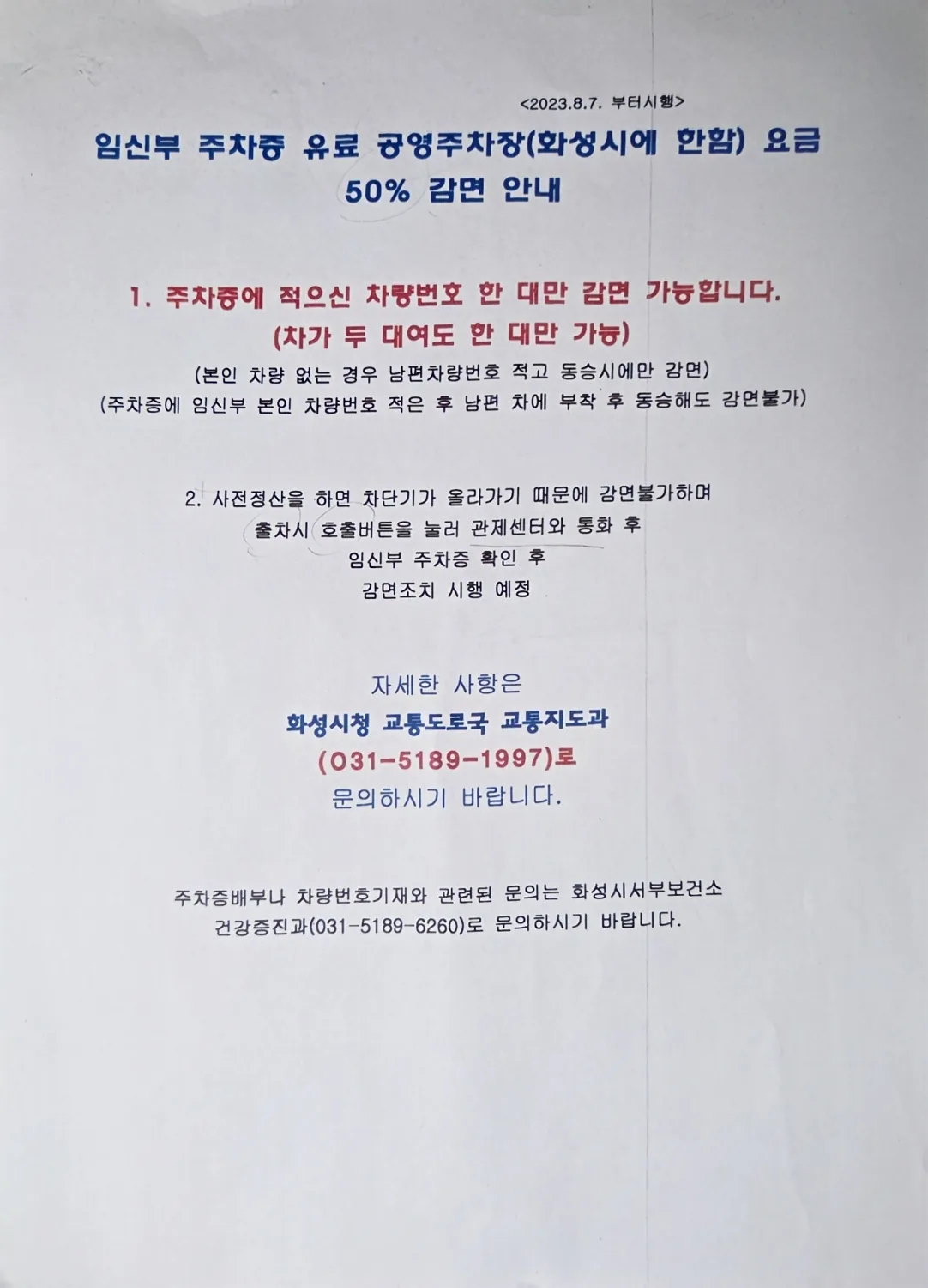
At minimum, expect: folic acid supplements through week eleven, iron tablets from week sixteen onward, a maternal health booklet (산모수첩), and the pink pregnancy badge that clips to your bag on public transport. You may also receive a car windshield sticker — in Hwaseong City, that means 50 percent off public parking lots.
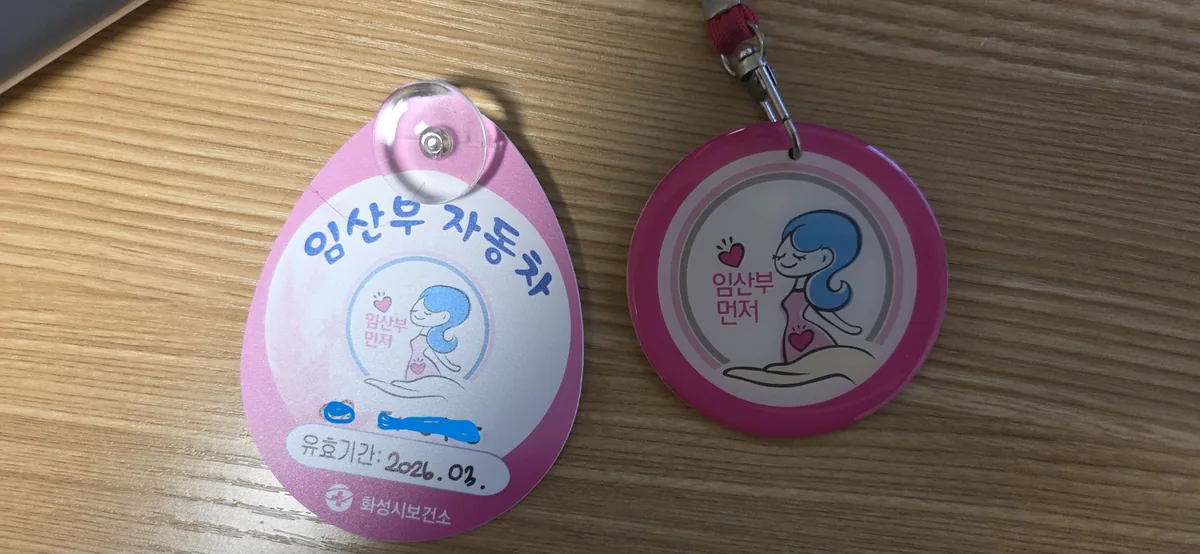
My wife carries the badge every day. On the subway, she has watched people in the priority seats look away rather than move. She doesn’t make a fuss. I notice it.
The health center also offers free blood work at two points: a basic panel between weeks six and eleven (covering anaemia, rubella, liver function, syphilis, HIV, hepatitis B and C, thyroid, and urinalysis), and a late-pregnancy panel from week thirty-four onward. Bring your ID and maternal health booklet each time. Results are available in person one week later, or through the e-보건소 portal at www.g-health.kr.
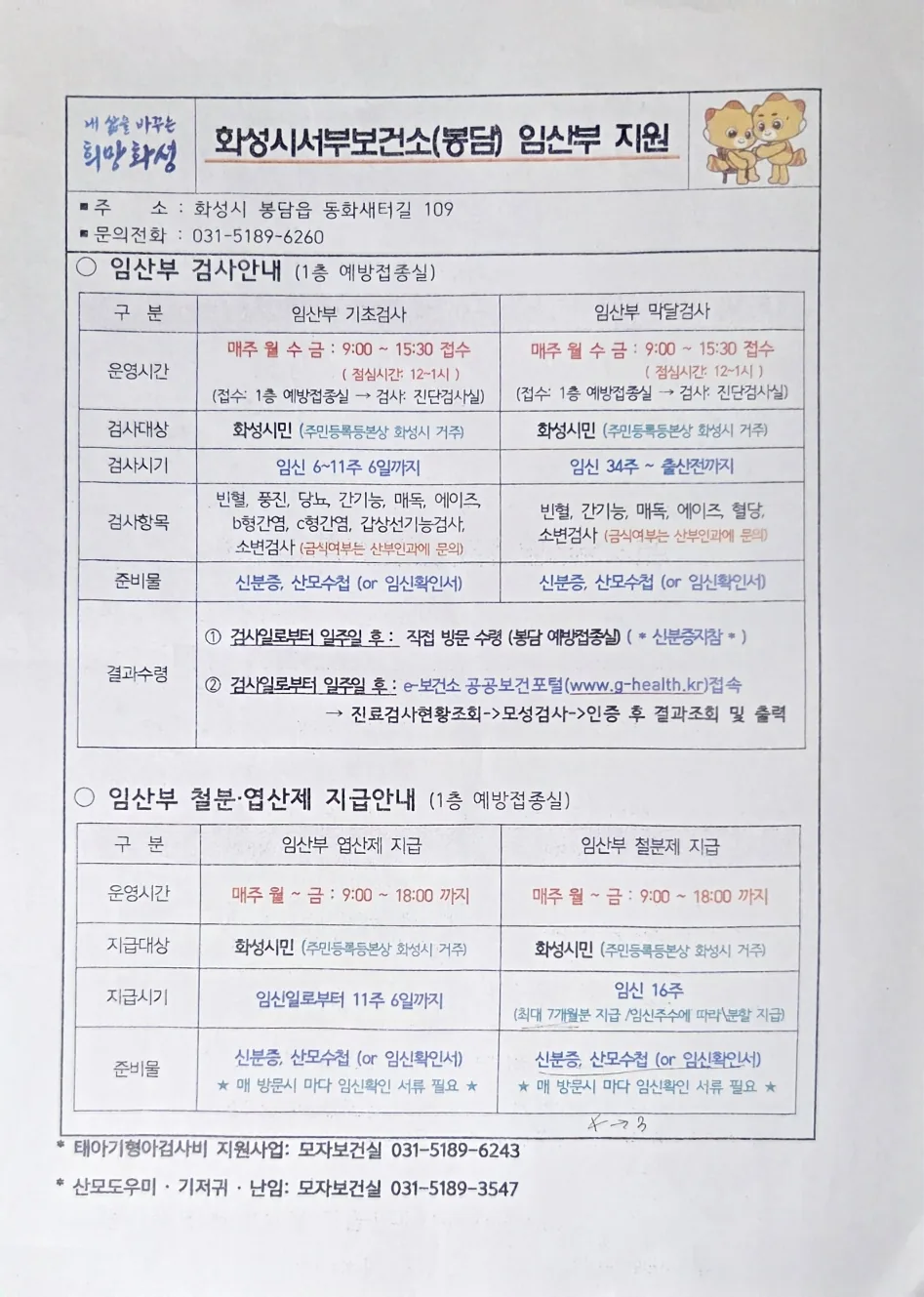
📍 Hwaseong City Western Health Center (Bongdam)
Address: 109 Donghwasaeteo-gil, Bongdam-eup, Hwaseong-si, Gyeonggi-do
If visiting in person is difficult, many services can be initiated through the Government24 website under the 맘편한 임신 (Comfortable Pregnancy) menu.
Step 6 — Fetal Insurance & the Free Post Office Insurance
Get fetal insurance in place before any genetic screening or abnormality tests are done. Some policies will not cover conditions identified prior to enrollment.
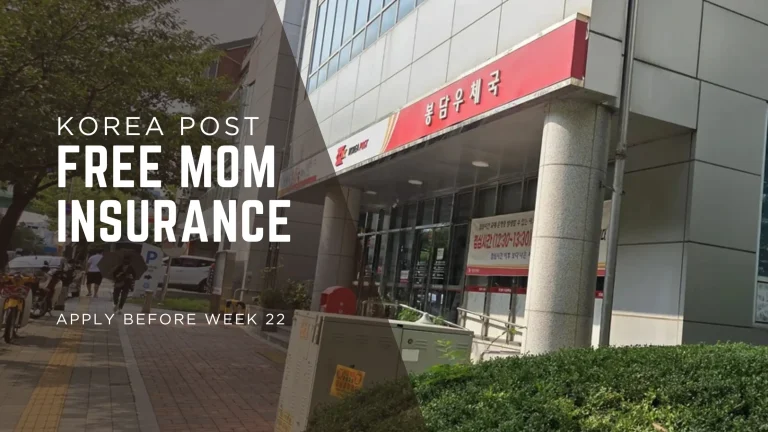
Alongside a standard fetal policy, there is one free option almost nobody outside Korea knows about: 우체국대한민국 엄마보험, the Korea Post Mother’s Insurance. Available to pregnant women aged seventeen to forty-five, up to twenty-two weeks, at zero cost. Coverage runs for ten years and includes rare disease protection for the child (up to 1,000,000 won), pregnancy toxemia (100,000 won), gestational hypertension (50,000 won), and gestational diabetes (30,000 won). Apply through the Korea Post Insurance app — it is faster than the website.
Step 7 — Car Insurance Discount
Call your car insurance provider and ask about the 임산부 할인 (pregnant woman discount). Most major insurers offer between 15 and 24 percent off premiums from confirmation of pregnancy through to when the child turns five to seven years old. One phone call. That is genuinely all it takes.
Step 8 — Ongoing Government Support After Birth
The system does not stop when the baby arrives. Once your child is born, the following benefits activate automatically or with minimal paperwork:
- 첫만남이용권 (First Meeting Voucher): 2,000,000 won for a first child, 3,000,000 won for a second.
- 부모급여 (Parental Benefit): 1,000,000 won per month through eleven months, then 500,000 won monthly through twenty-three months.
- 아동수당 (Child Allowance): 100,000 won monthly until the child turns eight.
- 출산축하금 (Birth Congratulation Payment): Varies by district — from nothing to several hundred thousand won or gift vouchers.
- Electricity discount: Korea Post reduces your bill for thirty-six months after birth.
- Water bill discount: Available for families with two or more children.
What This System Means for a Multicultural Family
Korea’s birth rate is among the lowest in the world, and the government knows it. The support programs reflect that urgency — and they apply fully to multicultural families. I think about it this way: when a Korean man and a foreign woman have a child here, it is not one new person entering the system. It is two. A child, yes — and also a foreign-born working adult who has made this country home. That is not nothing. The benefits are there for you. Use them.
When my wife asked me once how I managed to keep track of all of it, I told her the truth: I didn’t do it alone. Every form, every phone call, every document — we worked through it together. She provided the information; I navigated the language and the system. If you are reading this as a foreign partner feeling overwhelmed, registering an international marriage in Korea already taught us that this country’s paperwork rewards patience and teamwork. And once the baby is here, we have written separately about sorting out your baby’s dual citizenship and passport.
Pregnancy benefits like the National Happiness Card cover prenatal care, but maternity and paternity leave benefits require separate applications to your Employment Center and have distinct eligibility windows and payment structures.
** Beyond the National Happiness Card, expats should understand the full landscape of childbirth support policies now available in South Korea, including parental leave increases and housing eligibility changes for 2026.
In addition to pregnancy benefits, be aware that Korea offers a separate outpatient medical expense reduction for premature and low-birth-weight babies—one expat parent’s mistake and the document submission workaround that saved them a trip to city hall.
Beyond the National Happiness Card and health center support, expat parents should also explore Hwaseong’s Book Start program, which complements early childhood development initiatives by offering free picture books and parenting guides to registered babies.
If you or your partner is also navigating a job change, make sure you understand how resigning affects your family’s health insurance coverage in Korea — especially if your child is currently listed under your employee plan.
Once your pregnancy benefits are registered, make sure your household insurance payments are also in order — here is how to check your health insurance payment history in Korea and print the official certificate you may need for government subsidy applications.
If your baby is born early and needs NICU care, the financial picture changes significantly — read our full breakdown of what a premature NICU stay actually costs as a foreigner in Korea, including the specific government subsidies that apply.
This is just the beginning of a very long journey of doing things together. Don’t try to manage it by yourself. You and your partner are the same team.
Prenatal Vitamins: What to Take and When

First Trimester (Weeks 0–12)
Folic acid (400mcg pre-pregnancy, 800mcg during — go higher if you eat few leafy greens) and Vitamin D (2,000 IU). We take Nutri More, for reference.
Second Trimester (Weeks 12–24)
Add iron (around 30mg), calcium, and omega-3 with high DHA content. Start omega-3 from around weeks twelve to sixteen.
Third Trimester (Weeks 25–40)
Continue calcium. Stop omega-3 approximately one month before your due date — it can affect clotting during delivery.
Vitamin B6 helps with morning sickness. Probiotics counteract the constipation that iron supplements reliably cause. Avoid tuna and salmon throughout — heavy metal content is the concern, not the taste.
In addition to pregnancy benefits and the National Happiness Card, parents should know that the government’s hourly childcare subsidy can be paid directly through the same card, making it easy to access affordable, flexible childcare once baby arrives
Need Help Navigating Life in Korea?
From hospital appointments to government paperwork, JustAskJin offers a personal concierge service for expats in Korea — so you never have to figure it out alone.
Get in Touch